News
Nigeria Moves to Build Thousands of Tractors Locally

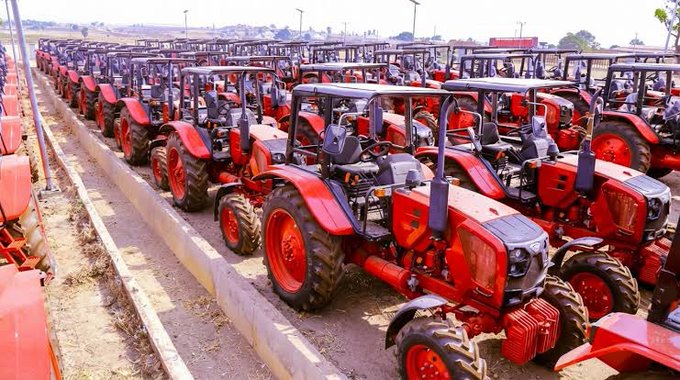
(Tractors. Photo by Nigeria Stories)
The Federal Government unveiled a national policy and investment strategy for agricultural mechanisation, alongside plans for a tractor assembly plant capable of producing between 2,000 and 4,000 units annually.
Agriculture and Food Security Minister Abubakar Kyari announced the initiatives at a High-Level National Policy Dialogue on Agricultural Mechanisation in Abuja, describing mechanisation as central to Nigeria’s effort to strengthen food security, productivity and economic resilience.
The new framework comprises the National Agricultural Mechanisation Policy and the National Agricultural Mechanisation Investment Strategy, intended to shift Nigeria from fragmented government interventions towards a commercially sustainable mechanisation ecosystem where farmers can access equipment and services when needed.
Under the Renewed Hope National Agricultural Mechanisation Programme launched in February, the government commenced procurement and deployment of 2,000 tractors alongside more than 9,000 assorted implements and spare parts.
The tractors are deployed through mechanisation service providers rather than handed directly to individual farmers, widening access particularly for smallholder farmers unable to afford equipment outright.
Government projections indicate the programme could support approximately 1.2 million farmers and cover more than 1.5 million hectares annually.
The proposed assembly plant would reduce Nigeria’s dependence on imported agricultural machinery whilst creating domestic industrial capacity and employment.
The investment strategy aims to attract private-sector participation and capital into mechanisation.
The programme includes seven planned mega mechanisation service centres and 36 mobile service trucks for technical support, with tractors receiving two years of service support.
Ensuring machinery remains productive after deployment presents a significant challenge, dependent on access to affordable financing, spare parts, trained operators, maintenance infrastructure and suitable rural roads.
The proposed assembly plant marks a potential shift from reliance on imported equipment towards local manufacturing, though economic impact will depend on execution, private investment and ability to build a sustainable market around mechanisation services rather than equipment procurement alone.
Kyari urged young Nigerians and women to participate in the emerging mechanisation economy, arguing they should not only operate machinery but also own businesses, develop technical skills and create new services around agricultural technology.






Tinubu orders sweeping football reforms after int’l setbacks

Cleric shot d3ad as bandits abduct villagers in Sokoto

Police rescue abducted Kwara monarch and two other victims, k!ll kidnapper

Kano water rehabilitation projects to be completed by December — Commissioner

Ex-Bosnian Serb warlord, Ratko Mladic d!es in prison at 84

UEFA threaten legal action against FIFA president Gianni Infantino over World Cup sell-off plan

Gov. Sani approves N810m startup grants for 4,050 Kaduna skills graduates

 Investigation3 days ago
Former BBNaija star Ike Onyema issues warning amid photographer David Martins and wife Alicia Daniellaâs drama; claims that gospel singer Neon Adejo flirted with Alicia
- Investigation2 days ago
K!ller Robots could target humans â UN and Red Cross warn
- Investigation2 days ago
Kano man opens fire at neighbourâs wedding ceremony over loud music, k!lls one guest and injures four others
- Society2 days ago
Government Of Ghana Declines MTN’s GH¢20 Million Donation For Victims Of South African Xenophobic Attacks
- National3 days ago
Osun: Oyetola condemns post-election violence, calls for justice
- Investigation2 days ago
Judge rejects Ghislaine Maxwellâs bid to throw out conviction for aiding Jeffrey Epstein s3xually abuse teenage girls
- National3 days ago
Nigeria’s envoy to India presents letters of credence
- National3 days ago
Lagos gives ultimatum to occupants of public setbacks