Breaking
‘Nigeria’s Democracy Is Nosediving’ — Reps’ group accuses Tinubu Govt of constitutional violations, fiscal opacity

Advertisement
Advertisement
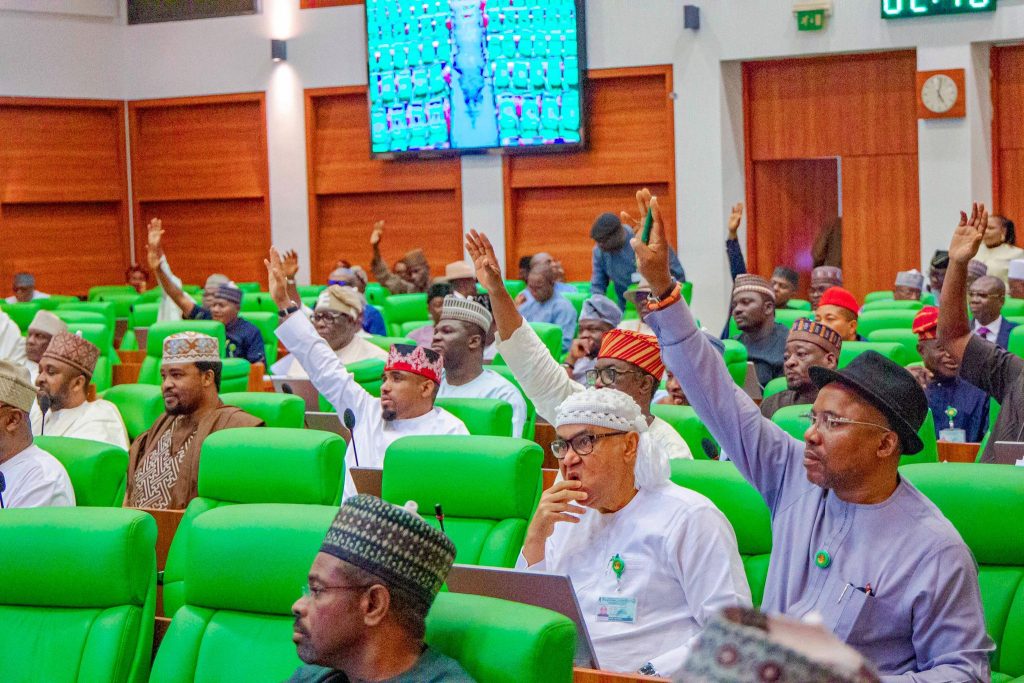
Members of the House of Representatives under the aegis of the Save Democracy Group have raised the alarm over what they described as a dangerous decline in Nigeria’s democratic governance, citing alleged constitutional violations, chronic budget under-implementation, opaque public expenditure, worsening insecurity and economic hardship.
The group, a bipartisan platform comprising members of the 10th National Assembly, made the allegations in a statement issued on Aug. 5, 2026, warning that continued silence in the face of what it described as repeated constitutional violations and institutional failures could further undermine democratic governance in the country.
The statement was signed by Rep. Awaji-Inombek Dagomie Abiante, leader of the group and member representing Andoni-Opobo/Nkoro Federal Constituency of Rivers State; Rt. Hon. Abubakar Yahaya Kusada, member representing Kankia/Ingawa/Kusada Federal Constituency of Katsina State; and Hon. Mansur Musa Jega, member representing Gwandu/Aleiro/Jega Federal Constituency of Kebbi State.
The lawmakers said their membership cuts across political parties, regions and ideological interests, stressing that the group was neither an opposition platform nor an instrument of any political interest.
According to them, their intervention was motivated by growing concern over what they called the increasing tendency of public institutions to subordinate the Constitution, due process and citizens’ welfare to political convenience.
“Nigeria’s democracy is nosediving, and silence in the face of repeated constitutional violations and institutional failures can no longer be justified,” the group said.
The lawmakers identified disregard for the rule of law as one of the major threats to democratic governance, arguing that constitutional procedures must not be treated as optional whenever they become inconvenient.
They specifically raised concerns over the National Assembly’s approval of the declaration of a state of emergency in Rivers State in March 2025, alleging that the approval was conducted through voice votes despite the constitutional requirement under Section 305(6) that such a proclamation must be supported by a two-thirds majority of all members of each chamber.
The group also questioned the validity of the purported passage of the Executive State Police Constitutional Alteration Bill by the House of Representatives on July 23, 2026.
It said the Speaker announced that 311 lawmakers had voted in support of the bill, exceeding the constitutional threshold of 240 affirmative votes required for the alteration of the Constitution.
However, the group claimed that some of its members were physically present throughout the proceedings and that “at no time that day were as many as 240 members in the Chamber, particularly when the Bill was considered.”
According to the lawmakers, the figure announced by the Speaker could only have been reached through the inclusion of votes allegedly transmitted via WhatsApp by lawmakers who were absent from the chamber at the time.
They argued that Section 9(2) of the Constitution requires affirmative votes from not less than two-thirds of all members of each chamber before the Constitution can be altered.
“The Constitution cannot be altered by presumption, improvisation or undisclosed voting arrangements,” the group said.
While acknowledging that State Police might be desirable, the lawmakers maintained that any such reform must be established through a lawful constitutional process.
Budget implementation under scrutiny
The Save Democracy Group also accused the Federal Government of chronic under-implementation of appropriated budgets, describing the situation as a potentially impeachable breach of constitutional responsibility.
It argued that Appropriation Acts were laws passed by the National Assembly and assented to by the President, rather than campaign promises or policy suggestions.
The group said Nigeria had experienced repeated budget extensions, rollovers and delays in capital implementation during the 2024, 2025 and 2026 fiscal cycles.
It cited a 2025 indication by the Federal Government that only about 30 per cent of the 2025 capital budget would be funded, with approximately 70 per cent carried forward into 2026.
The lawmakers described the development as a recurring breakdown of fiscal governance rather than an occasional administrative delay.
They also referred to comments attributed to the Senate Chief Whip, Sen. Mohammed Tahir Monguno, who reportedly described failure to implement an Appropriation Act as a breach of the law capable of amounting to an “impeachable offence.”
The group said it agreed with Monguno that deliberate or persistent refusal to implement duly enacted Appropriation Acts raised serious constitutional questions.
It further argued that repeated budget rollovers weakened parliamentary oversight, complicated fiscal accountability and made it difficult for citizens to determine the financial year to which particular projects belonged.
The lawmakers consequently demanded comprehensive budget implementation reports for the 2024, 2025 and 2026 fiscal years, as well as full disclosure of capital releases to ministries, departments and agencies.
They also called for reconciliation of revenues collected against expenditures authorised by the National Assembly and an explanation for the failure to release duly appropriated capital funds.
The group further demanded a joint parliamentary investigation into chronic budget under-implementation and appropriate constitutional action where deliberate or unjustifiable non-implementation was established.
“An Appropriation Act is law, and the Government cannot choose which laws to obey,” it said.
Group demands probe into alleged off-budget expenditure
The lawmakers also expressed concern over reports of allegedly unrecorded public expenditure, calling for immediate legislative scrutiny and forensic auditing.
They stressed, however, that allegations of misappropriation must be established through competent investigation and due process.
The group cited what it described as a July 2026 report by the International Monetary Fund that approximately two per cent of Nigeria’s Gross Domestic Product, estimated at about N8.83 trillion, had not been recorded in recent official budgets.
According to the lawmakers, the reported unrecorded expenditure allegedly contributed to a discrepancy between Nigeria’s declared fiscal deficit and its actual financing requirements.
They said the matter could not be dismissed through public relations or general denials by the Federal Ministry of Finance.
“Public funds cannot lawfully be spent outside duly enacted Appropriation Acts, concealed under opaque accounting classifications or omitted from fiscal information presented to the National Assembly and the Nigerian people,” the group said.
It called for an independent forensic audit of all reported off-budget expenditure, stressing that public officials entrusted with public resources must account for how the funds were appropriated, released, spent and utilised.
Insecurity: lawmakers question funding priorities
The lawmakers also raised concerns over the worsening security situation across the country, noting that Nigerians continued to be killed, kidnapped and displaced by terrorists, bandits, criminal gangs and other violent groups.
They cited further comments attributed to Monguno that some security agencies had received no capital releases despite the deteriorating security situation.
The group also referred to budget-performance reports which, according to it, raised questions about government spending priorities.
It claimed that approximately N20.27 billion, representing nearly the entire budgetary provision for the Presidential Air Fleet, had been released, while only a small fraction of the Nigerian Army’s allocation for security equipment was made available during the period under review.
The lawmakers stressed that their concern was not necessarily about maintaining the Presidential Air Fleet but about what they described as the disparity between funding for the mobility of public officials and resources available to security personnel confronting terrorists and bandits.
“The question is why the comfort and mobility of public officials should receive more predictable funding than the equipment, logistics, operational vehicles, aircraft maintenance and protective resources required by personnel confronting terrorists and bandits,” they said.
The group consequently called for the immediate release of duly appropriated capital funds to the Armed Forces, the Nigeria Police Force, intelligence institutions and other security agencies.
Commendation for religious bodies
The Save Democracy Group also commended the Catholic Bishops’ Conference of Nigeria for speaking openly about insecurity, economic hardship, democratic decline and concerns over emerging one-party dominance.
It equally commended the Supreme Council for Shari’ah in Nigeria for calling for caution, broader consultation and national consensus before the establishment of State Police.
The lawmakers said the position demonstrated that concerns about due process, accountability and constitutional safeguards transcended religious and regional differences.
According to them, constructive criticism should not be interpreted as hostility to government but as part of the responsibilities of citizens and institutions in a democracy.
Reps demand immediate reconvening of National Assembly
The group called on the President of the Senate and the Speaker of the House of Representatives to immediately reconvene both chambers for an emergency session.
It said the prevailing circumstances in the country did not permit the legislature to remain away from plenary while critical constitutional, fiscal, economic and security issues remained unresolved.
Among the issues it wants addressed are the under-implementation of the 2024, 2025 and 2026 budgets; the constitutional controversy surrounding the State Police Constitutional Alteration Bill; allegations of off-budget expenditure; non-release of capital funds to security agencies; the deteriorating security situation; and measures required to restore public confidence in the rule of law and democratic governance.
The lawmakers maintained that the National Assembly was not merely an institution for passing executive bills and approving requests from the Presidency.
They said Parliament was constitutionally empowered to represent the people, defend the Constitution, appropriate public funds, conduct oversight and hold the Executive accountable.
“At moments of national difficulty, Parliament must be present. At moments of constitutional uncertainty, Parliament must defend the Constitution. At moments of economic hardship, Parliament must speak for the people,” the group said.
The lawmakers stressed that their position should not be interpreted as opposition to State Police, economic reforms or necessary public expenditure.
Rather, they said they were opposed to what they described as unconstitutional procedures, legislative shortcuts, unimplemented budgets, opaque expenditure and the failure to adequately protect Nigerians.
They urged the National Assembly to rise above partisan interests and reclaim what they described as its constitutional responsibility.
“History will judge every member of the 10th National Assembly by whether we defended the Constitution and the Nigerian people at this defining moment,” the group said.
“Nigeria’s democracy must be protected before it is too late.”


AbdulRazaq receives 163 rescued Kwara kidnap victims in Ilorin

Man City reject Barcelonaâs £38.5m bid for Rodri

RFK Jr. to decertify organ harvesting organization for operating on patients who still showed ‘active signs of life’

Customs intercepts 140 Rifles, Cannabis-infused snacks worth N373.8m at TinCan Port

‘Nigeria’s Democracy Is Nosediving’ — Reps’ group accuses Tinubu Govt of constitutional violations, fiscal opacity

Chelsea to offload 16 Players as FIFA bans bomb squads

30-year-old man arrested for allegedly k!lling his biological father and dumping the corpse in a well

 Society9 hours ago
Two Ladies Subjected To Public Humiliation, Forced To Remove Their Drɔss, Clothes And Dance After Being Caught Stealing Bone-Straight Wig
- Investigation2 days ago
Japa: Canadaâs Ontario opens new permanent residence programme for foreign workers
- Investigation3 days ago
US firm initiates moves to stop Tinubuâs meeting with Trump at UN General Assembly
- Breaking3 days ago
"Iâm the mother of a one-year-old, I’m flying her to London for her birthday partyâ â Toke Makinwa says in video
- Society3 days ago
Man Claims He Lost ₦1 Million After Using Roadside POS
- Investigation3 days ago
2027: Weâll do whatever Tinubu wants us to do at the field â Rotimi Amaechi
- Investigation3 days ago
Rivers: I wanted Fubara to run for second term, we love him â Wike
- World3 days ago
Can Trump Wriggle Out One Last Time?