Breaking
Tinubu’s time is up, Nigerians need cheaper fuel, not transport promises — Atiku

Advertisement
Advertisement
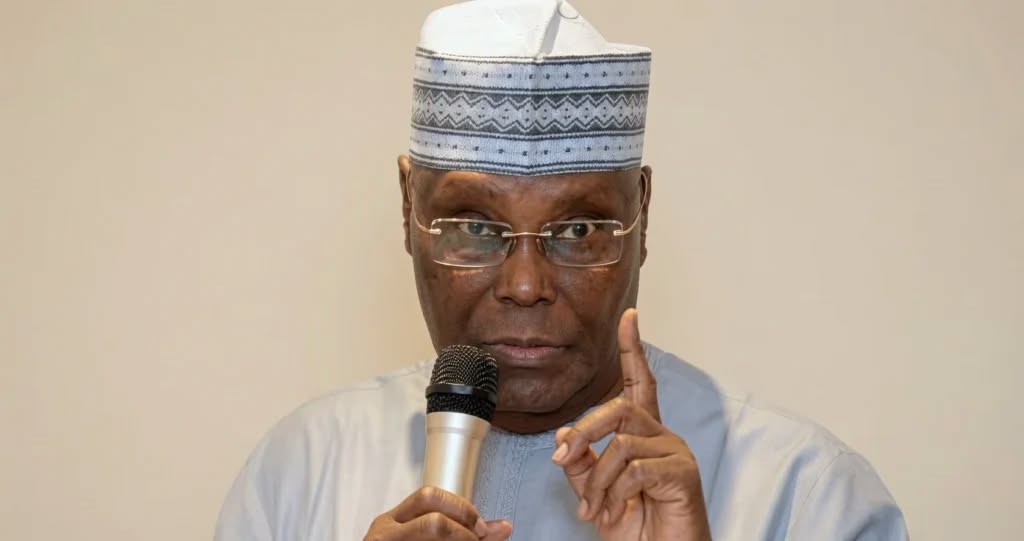
Former Vice President and presidential candidate of the African Democratic Congress, ADC, Atiku Abubakar, has criticised President Bola Tinubu’s latest promise to work with state governors to reduce public transport fares, describing it as a belated attempt to address the cost-of-living crisis.
Mr Atiku said the administration’s plan was coming after more than three years of economic hardship triggered by the removal of fuel subsidy, arguing that Nigerians needed cheaper fuel and lower living costs rather than what he described as last-minute transport promises.
The former vice president’s position was contained in a statement issued by his Senior Special Assistant on Public Communication, Phrank Shaibu.
He also faulted the Federal Government’s CNG conversion programme, saying the conversion of about 120,000 vehicles represented less than one per cent of the estimated 14 million vehicles on Nigerian roads.
According to him, the figure being celebrated by the government was evidence of what he described as the failure of the Tinubu administration’s economic policies.
“If Tinubu’s grand strategy for cushioning the consequences of his reckless and poorly thought-out subsidy removal is CNG conversion, then the admission that only about 120,000 vehicles have been converted in more than three years is not an achievement.
“It is an advertisement of policy failure,” Atiku said.
He added that against widely cited estimates of about 14 million vehicles in Nigeria, the 120,000 conversions represented less than one per cent.
“That is the government’s own number. That is Tinubu marking his own examination script,” he said.
Atiku compared the figure with an examination result, saying no examination body or university would consider a score of less than one per cent in a core subject as evidence of progress.
“Yet Tinubu wants Nigerians to reward the political equivalent of that catastrophic score with another four years.
“The truth is simple: Nigeria cannot afford another four years of monumental failure,” he said.
The former vice president also took exception to President Tinubu’s argument that cheaper fuel should translate into cheaper transport fares.
According to Atiku, the statement amounted to an admission that the administration’s energy policies had failed to address the realities confronting Nigerians.
“For more than three years, Nigerians begged this government for relief. Tinubu removed subsidy without a credible cushioning framework, watched transport costs explode, watched food prices follow, watched businesses suffocate under crushing energy costs, and repeatedly told Nigerians that their suffering was the unavoidable price of reform,” he said.
Atiku further alleged that the government had only begun to focus on transport affordability because of the approaching 2027 elections and what he described as growing support for his proposal for a production-based subsidy.
He said the administration had previously criticised his proposal but was now adopting some of its underlying principles.
“Now that elections are approaching, and Nigerians are rallying behind Vice President Atiku Abubakar’s proposal for a production-based subsidy to immediately tackle the cost-of-living crisis created by Tinubu, the same government that ridiculed and criticised Atiku’s plan has suddenly discovered that Nigerians need cheaper transportation,” he said.
“This is medicine after death.
“You cannot break a man’s leg, abandon him in pain for three and a half years, then return with crutches and demand applause for compassion.
“Tinubu created the transport crisis; CNG cannot now be packaged as heroism.”
Atiku, however, acknowledged that expanding the use of compressed natural gas could help reduce the operating costs of converted vehicles.
He argued, however, that CNG alone could not address the broader purchasing-power crisis facing Nigerian households.
“CNG can make a converted bus cheaper to operate. It cannot make a poor Nigerian richer.
“That distinction demolishes the propaganda,” he said.
According to him, the impact of the economic crisis was evident across the country, as Nigerians were travelling less because of high transport costs, while workers were increasingly forced to calculate whether their wages could cover transportation to work.
He said traders were also buying less because transportation costs were consuming their capital, while students, farmers and other vulnerable groups were struggling with higher transportation expenses.
“So what exactly has Tinubu solved if the bus becomes cheaper to operate but the passenger has become too poor to enter it?
“A cheaper bus without an affordable passenger is not economic recovery,” he said.
The ADC presidential candidate also criticised the government’s celebration of the 120,000 CNG conversions, arguing that the figure was insignificant compared with the estimated number of vehicles in the country.
He likened the situation to celebrating a bucket of water while a house was still on fire.
Atiku said transportation operators continued to contend with higher costs of tyres, spare parts, maintenance and other operating expenses, while households were simultaneously facing increased expenditure on food, rent, education and other basic needs.
“A bus driver does not buy tyres with a presidential statement. A market woman does not transport tomatoes with a government committee. A farmer does not move yam, rice and maize with promises,” he said.
The former vice president also questioned the decision to set October 1 as the possible commencement of relief measures, arguing that Nigerians were already struggling with the effects of high transportation and food costs.
“And now Nigerians are being told to wait until October 1 before they may begin to feel relief from a crisis they are suffering today.
“Nigerians are hungry today. Transport is expensive today. Food is expensive today. Businesses are dying today.
“Why must relief arrive by appointment?” he asked.
Atiku said the country’s transportation crisis could not be separated from the wider cost-of-living and purchasing-power crisis.
He argued that lowering the cost of operating vehicles would have limited impact if workers’ incomes remained insufficient to cover transportation, food, rent, healthcare and education.
“You cannot solve a purchasing-power crisis simply by changing the fuel inside a bus.
“What matters to the Nigerian worker is not merely whether the bus runs cheaply, but whether his salary can still afford the fare, food, rent, medicine, school fees and the basic dignity of life,” he said.
“When fuel rises, transport rises. When transport rises, food rises. When food rises, the household shrinks.
“That is the economic chain Tinubu broke, and that is the chain Atiku intends to repair.”
Atiku reiterated his call for a targeted and transparent fuel subsidy intervention linked to domestic production, saying such a policy should be fiscally capped and independently audited.
He said the proposed intervention would be designed to ensure that the benefits of lower energy costs reached commuters, farmers, workers, traders and small businesses rather than politically connected individuals.
“Fuel subsidy must return for struggling Nigerians, not the rich friends of the President and multinational companies but a targeted production intervention that is transparently budgeted, independently audited and guarantees that the benefit reaches consumers,” he said.
“We will support domestic refining. We will track every barrel. We will cap the cost. We will reduce energy costs.
“And we will ensure that money and relief reaches the commuter, farmer, worker, trader and small business owner — not politically connected middlemen.”
Atiku described the difference between his proposed approach and that of the Tinubu administration as one between addressing the root cause of hardship and providing temporary relief.
“That is the difference between Tinubu and Atiku: Tinubu manufactures hardship and distributes palliatives. Atiku will attack hardship at its source,” he said.
He further accused the administration of prioritising increased government revenues over the economic welfare of citizens since the removal of fuel subsidy.
“For more than three years, Tinubu told Nigerians to endure pain while government celebrated bigger revenues. Families became poorer, businesses collapsed, transport fares multiplied and workers watched the value of their wages disappear,” he said.
According to him, the current emphasis on cheaper transportation had vindicated his argument that energy costs have a direct impact on transportation, food prices and production.
“Now, with Nigerians responding positively to Atiku’s alternative, the same government that attacked subsidy as economic heresy has suddenly discovered Atiku’s central argument: when energy becomes cheaper, transportation becomes cheaper; when transportation becomes cheaper, food and production costs begin to fall,” he said.
Atiku said the central issue before Nigerians was not simply how cheaply vehicles could operate but how affordable life could become for ordinary citizens.
“The question before Nigeria is therefore bigger than, ‘How cheaply can a bus run?’
“The real question is: How cheaply can a Nigerian live?
“Tinubu has failed that examination. His own CNG numbers have supplied the score sheet.”
He ended the statement with a direct political message to President Tinubu, saying Nigerians had endured enough hardship under his administration.
“President Tinubu, Nigerians have paid enough for your economic experiment. Too little. Too inadequate. Too late. Your time is up. Prepare your handover.
“We are coming to make life affordable again,” Atiku said.


Just in: World’s youngest reigning monarch King Oyo is dead

Niger abduction: Terrorists yet to make contact six days after attack – Commissioner

Breaking: NPFL action resumes today as 3SC host Inter Lagos in Ibadan

NFF Crisis: Tinubu orders Comprehensive reform of Nigerian Football

Man with no trousers on ‘shoved carrot up his b^m’ and walked around with it in full view of public

Ayra Starr to headline halftime show at NFL London game
Actress Funke Akindele replies to netizen questioning why she hides her children’s faces

 Investigation3 days ago
K!ller Robots could target humans â UN and Red Cross warn
- Investigation3 days ago
Kano man opens fire at neighbourâs wedding ceremony over loud music, k!lls one guest and injures four others
- Society2 days ago
Government Of Ghana Declines MTN’s GH¢20 Million Donation For Victims Of South African Xenophobic Attacks
- National3 days ago
Osun: Oyetola condemns post-election violence, calls for justice
- Investigation3 days ago
Judge rejects Ghislaine Maxwellâs bid to throw out conviction for aiding Jeffrey Epstein s3xually abuse teenage girls
- Investigation3 days ago
No African university in worldâs top 100 – Good luck Jonathan laments
- News2 days ago
Naira Holds Firm as Dollar Stays Near ₦1,347
- Investigation2 days ago
Gospel singer, Neon Adejoâs wife defends him, asks photographer David Martins to address abuse allegations