National
Yilwatda, Sultan lead call for religious tolerance

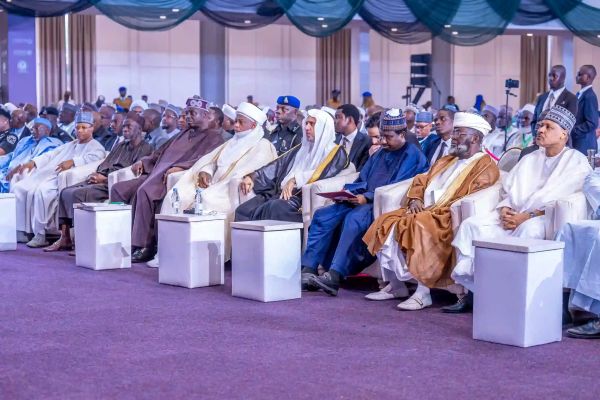
The National Chairman of the All Progressives Congress (APC), Professor Nentawe Yilwatda, and Sultan of Sokoto, Muhammad Sa’ad Abubakar, have called on all religious faithful in Nigeria, irrespective of their beliefs, to come together in unity and promote inter-religious harmony and peaceful coexistence to achieve a greater Nigeria.
The two eminent leaders made the call in their speeches at the opening ceremony of an international conference in Abuja on Tuesday.
The conference, themed: “Diversity and Social Peace: A Partnership for a Promising Future,” was organised by the Muslim World League.
Yilwatda, who described diversity as a defining reality of Nigeria’s national existence, said the country’s different faiths, ethnicities, languages, cultures, and traditions should be transformed from potential sources of division into instruments of national strength and development.
He challenged Nigerians to look beyond religious and ethnic identities and recognise their shared humanity and common destiny.
He stressed that the fundamental question confronting the country was not whether Christians and Muslims could live together, but “what kind of nation are we building by the way we live together?”
In a statement by his Special Adviser on Media and Information Strategy, Abimbola Tooki, the APC National Chairman, who spoke from his personal experiences growing up in Yobe State and later witnessing communal conflicts in Plateau State, recalled the close friendship between his late father, a pastor, and the Chief Imam of Nguru.
According to him, the relationship between the two religious leaders demonstrated that religious differences should never become barriers to friendship, mutual respect, and peaceful coexistence.
Yilwatda said: “Religious difference does not have to produce human distance.
“Indeed, our differences should not prevent us from recognising what we share.
“We may worship differently, but we share the same humanity.
“We may speak different languages, but we share the same hopes for our children.
“We may come from different communities, but we share one country and one future.”
Professor Yilwatda, however, warned that Nigeria’s diversity could become dangerous when citizens were encouraged to dehumanise people of other faiths or ethnic backgrounds.
He identified terrorism, banditry, farmer-herder conflicts, communal violence, ethnic suspicion, religious intolerance, hate speech, and political manipulation of identity as major threats to national cohesion.
He noted that while terrorism could attempt to wear a religious identity, banditry could exploit ethnic narratives and political actors could seek to weaponise identity for electoral advantage, none of these should be allowed to define Nigeria or its people.
He said: “The real battle is for the soul of our nation.
“And that battle cannot be won by security measures alone.”
Yilwatda added that lasting peace required justice, education, responsible leadership, economic opportunity, dialogue, and moral courage.
The APC National Chairman further called on religious leaders to deploy their enormous moral influence to promote tolerance and reconciliation.
He urged churches and mosques to become centres of peace and platforms for teaching citizens how to live together despite their differences.
He equally urged political leaders to resist the temptation to exploit religious and ethnic sentiments for political gain, while calling on traditional rulers to use their influence to make reconciliation stronger than retaliation, dialogue stronger than suspicion, and justice stronger than vengeance.
Yilwatda also challenged academics and civil society organisations to educate a new generation to see Nigeria’s diversity not as a threat, but as an asset capable of strengthening the country.
He proposed what he described as a “Nigerian Covenant for Coexistence”, a shared moral commitment by religious leaders, political leaders, traditional institutions, civil society, and citizens to reject violence, hate speech, religious intolerance, and politicisation of identity.
Under such a covenant, he said Nigerians must commit to protecting places of worship, defending vulnerable communities, and teaching children that those who worship differently are not their enemies.


Angry Mob Nabs Suspected ATM Fraudster With Over 30 Cards At A Bank Trying To Withdraw Money, Lands Multiple Slaps On His Face

Cristiano Ronaldo marries longtime partner Georgina RodrÃguez in âintimateâ wedding in Portugal (Photo)

Farmer arrested for k!lling Fulani herder during altercation in Kaduna

NFF Issues Official Apology To President Tinubu After Super Falcons Flop

APP senatorial candidate advocates end to cycle of poverty in Imo

‘Live Within Your Means’ – Man Faces Eviction After Struggling to Renew Rent

Yilwatda, Sultan lead call for religious tolerance
- Investigation2 days ago
âTribalism is one of Nigeriaâs problems. Voting for someone solely because of their tribe doesnât exempt you from the consequences of that b@d choiceâ â Solomon Buchi
- Society3 days ago
Thief Tears Through Ceiling Of A Young In Lapaz, Makes Off With ¢50,000 And Belongings
- Investigation2 days ago
Kano court remands woman accused of cutting off boyfriendâs genital
- Investigation2 days ago
AFC, UEFA, CONCACAF demand review of Infantinoâs failed FIFA deal
- Investigation2 days ago
âPeople who arenât financially stable should legally not be allowed to have childrenâ â TikToker Shirin doubles down amid backlash
- Investigation3 days ago
âTemitope Osoba died at a police stationâ â Late actressâ fiancé claims, dismisses cancer, poisoning rumours
- Investigation2 days ago
Police arrest alleged fake âpastorâ over Jerusalem pilgrimage scam
- Investigation2 days ago
Lagos government warns celebrities against patronising âagberosâ

