World
Mystery cave collapse uncovers 'advanced human time capsule' from 300,000 years ago

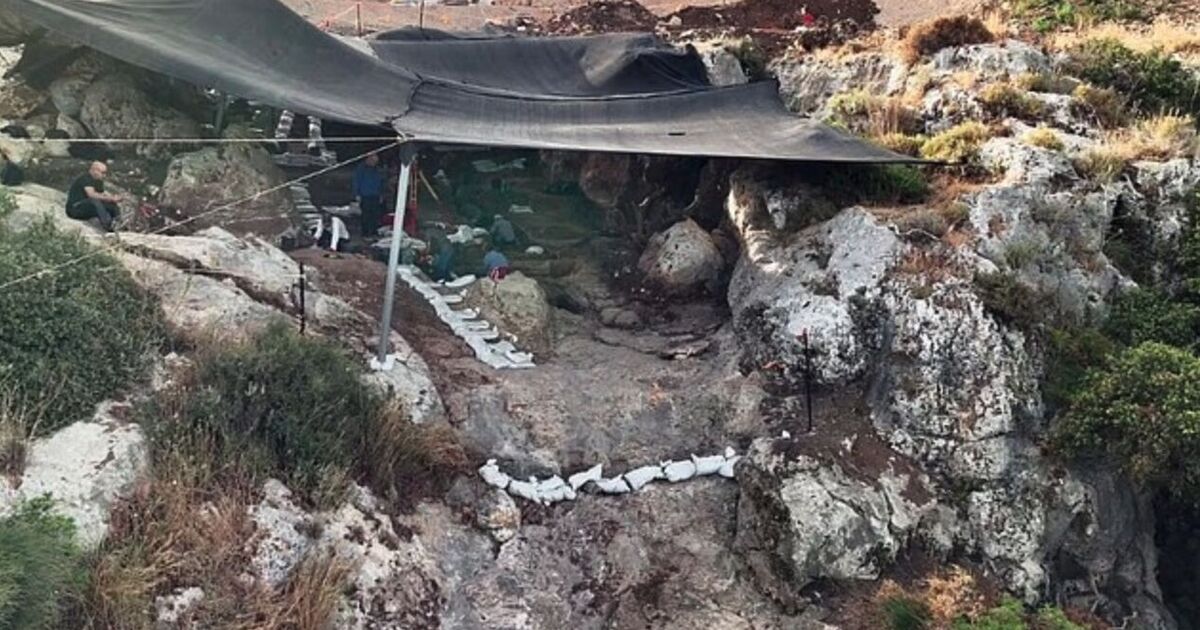
Archaeologists have uncovered a remarkably preserved prehistoric cave that is helping researchers piece together a crucial chapter in human evolution.
The site, near the town of Fureidis south of Haifa, contains stone tools, animal remains and evidence of controlled fire dating to a period between 400,000 and 250,000 years ago.
Researchers said the cave’s inhabitants appeared to possess surprisingly advanced skills for the period, with evidence they controlled fire, hunted a range of animals, quarried flint from nearby rock outcrops and produced sophisticated stone tools.
The team said the sophisticated tools, evidence of hunting and signs of controlled fire suggest these people were already displaying behaviours that would later become hallmarks of Neanderthal and modern human societies.
Experts believe the cave was occupied during the Acheulo-Yabrudian period, a little-understood era that came before the emergence of classic Neanderthals and modern humans.
The cave remained largely untouched after its roof collapsed, sealing its contents for hundreds of thousands of years and preserving what researchers have described as a prehistoric “time capsule”.
Why are researchers excited by the discovery?
The excavation is providing a rare look at a period when older human traditions appear to have been fading while behaviours associated with later human populations were beginning to emerge.
Researchers believe the cave captures a pivotal stage in prehistory, offering clues about how ancient humans hunted, used fire, made tools and organised themselves socially.
Dr Kobi Vardi, head of the Israel Antiquities Authority’s Prehistory Branch and co-director of the excavation, told The Times of Israel: “This is probably the last culture of a very long continuum [of cultures].
“Between 250,000 years and 50,000 years ago, Homo sapiens and Neanderthals created a totally different culture, so we are right in the moment of transition.”
Although no human remains have been found at the site, archaeologists believe the people who lived there may have belonged to an archaic population that occupied the Levant before the appearance of classic Neanderthals and Homo sapiens.
Who were the cave’s inhabitants?
Without human bones, researchers cannot say with certainty who occupied the cave, reports the Daily Mail.
However, some scientists believe the population may have been descended from groups often classified as Homo heidelbergensis, or closely related humans.
Homo heidelbergensis is widely regarded as the last common ancestor that directly gave rise to both Neanderthals and modern humans.
Researchers believe the cave’s occupants may represent a transitional population occupying a key position in the human family tree, sharing characteristics with both later groups.
What was discovered inside the cave?
The team dated the site by analysing the stone tools recovered during the excavation.
Among the most significant finds were around 100 side scrapers, considered one of the defining features of the Acheulo-Yabrudian culture.
Researchers believe the tools were used for tasks including butchering animals and processing hides.
Several finely crafted handaxes were also uncovered.
While handaxes remained a staple of human technology for roughly one million years during the Palaeolithic period, Vardi said the examples found at Fureidis stood out because of their advanced design.
The combination of side scrapers and handaxes allowed researchers to identify the cave’s occupants as members of the Acheulo-Yabrudian culture.
Vardi said: “This is very important because sites from this phase are extremely rare; there are about ten sites in the Near East, two in Syria, one in Lebanon and six in Israel.
“However, this is the only site in the Carmel Ridge where this phase was discovered, where we have this culture in pristine condition, meaning not covered by later layers, except for a small part of the cave.”
What does the evidence reveal about daily life?
The findings suggest the cave’s inhabitants possessed sophisticated survival skills.
Researchers found evidence that they quarried flint from nearby rock outcrops and hunted a wide range of animals.
Among the remains uncovered were fallow deer, gazelles, ancient horses and wild cattle, many bearing signs of human butchery.
Scientists noted that animal bones of this age are rarely found in such good condition.
Evidence from the site suggests the community lived in relatively large and socially connected groups compared with earlier populations.
Researchers also believe the cave may have been located beside a spring, providing a dependable source of water for those living there.
Taken together, the discoveries are helping scientists fill significant gaps in understanding how ancient humans lived and adapted during a poorly documented stage of prehistory.


"Please. It will look as if it’s my fault. His family doesnât like me" Young wife, 18, assaulted by husband begs for him not to be arrested and reveals she regrets marriage (videos)

Aradel Holdings posts N728bn Q1 revenue

Yahaya presents APC Gombe governorship candidate to Tinubu

PenCom gives MDAs deadline to submit retirees’ details

Did Iran agree to IAEA inspections for 'nuclear honesty'? Trump, Vance say so

Lionel Messi breaks record for most career World Cup goals

Beyond primary: How ADC is positioning for Kwara’s 2027 gov battle

 Investigation2 days ago
Update: Abia police arrest man caught on camera ass@ulting woman
- World2 days ago
Russia burning as Ukraine launches massive attack on key waterway 160 miles from frontline
- Investigation9 hours ago
He said he wanted to sleep with me, but I told him I am a married woman – Lady in viral video being ass@ulted by a man in Abia speaks
- News3 days ago
My Tasty Naija Food Festival returns
- Investigation2 days ago
Police detain TikToker following boyfriendâs death in Kano

 World3 days ago
'Be quiet now': Israeli envoy shouts at UN official at hearing on children in conflict; watch
- Breaking3 days ago
Paraguayâs Almiron becomes first player to be sent off under new FIFA âmouth-coveringâ rule
- News3 days ago
FUOYE suspends two students over leaked video of ex-SUG president