Business
NIMASA strengthens maritime security amid regional hub push

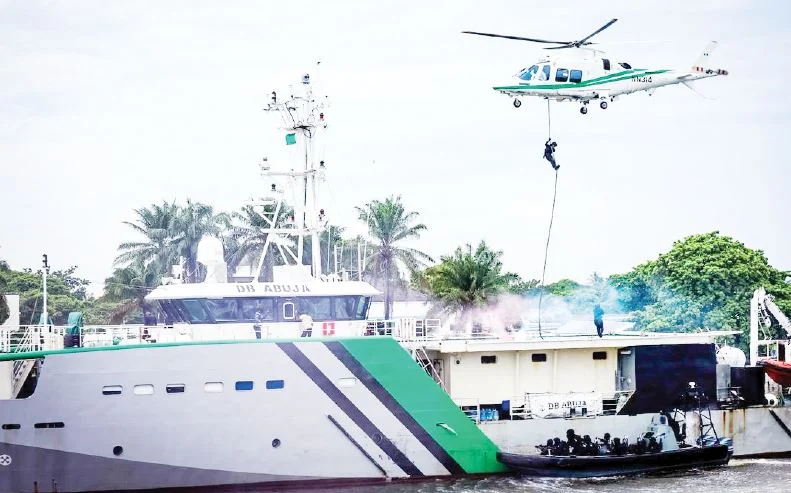
The Nigerian Maritime Administration and Safety Agency has added 177 new members to the Deep Blue Maritime Security Unit as the country intensifies efforts to dominate West African shipping, writes FELIX OLOYEDE
It felt like a scene from an American movie when fresh graduates of the Deep Blue Maritime Security Unit demonstrated a rescue mission involving a pirate attack vessel at Navy Town, Ojo, Lagos, on Tuesday, May 19, 2026. Visitors at the ceremony were in awe as three boats from the Deep Blue Maritime Security Unit surrounded the attacked ship. A helicopter even dropped special squad members onto the ship mid-air in a commando-style operation.
After the team secured the vessel, another helicopter arrived to airlift an injured member of the squad who had been hurt during the crossfire with the pirates. Meanwhile, a plane was hovering above the scene at 1,000 kilometres above sea level, providing surveillance for the rescue team. In less than 10 minutes, the special squad completed the mission and apprehended the pirates.
During the programme, certificates and awards were presented to 177 members of the Maritime Security Unit.
“The 177 graduates before us today comprise 33 special mission vessel officers, 14 special mission vessel engineers, 107 first intervention boat drivers, technicians, and boarding team, and of course, 23 helicopter team members, who are members of the Armed Forces, the police, and the Department of State Security.
“These graduates have undergone rigorous training aimed at improving operational efficiency, intelligence coordination, and rapid response capabilities within the Nigerian maritime domain.
“These trainings include helicopter operations, medical evacuation, vessel landing and clearing, interceptor boats, tactical operations and manoeuvres, communications training, unmanned aerial system capability, and first aid and combat medic skills,” the Director-General of NIMASA, Dr Dayo Mobereola, stated.
Losses to piracy
Today, Nigeria proudly celebrates three consecutive years without any incidents of piracy, as it strengthens its efforts to become a maritime hub in the West African subregion. This achievement marks a significant shift from the situation before the Deep Blue Project was launched on June 10, 2021. Formally known as the Integrated National Security and Waterways Protection Infrastructure, the Deep Blue Project was developed in response to the Gulf of Guinea’s reputation for piracy. It was once one of the most dreadful routes for sailors due to frequent pirate attacks. Around 2020, over 100 pirate attacks were reported in the Gulf of Guinea around the year 2000, which cost the region US$2bn annually in diverted trade, lost goods, insurance, and heightened security costs, according to the European Union Institute for Security Studies.
Nigeria, which has sovereign control over approximately 315,240 km² of the Gulf of Guinea’s total area of 2.35 million km², lost around US$783m due to sea piracy and related maritime crimes in 2021, as reported by the Nigerian Maritime Administration and Safety Agency. This situation led importers in the country to pay a war risk premium, which subsequently raised the costs of imports.
Though the country has the largest economy in the West African subregion, and it is the most populous country on the African continent, it is not the largest leader in West Africa by overall cargo tonnage. It is second to the Port of Abidjan in Côte d’Ivoire, which handles more than 46 million metric tons annually. The Port of Lagos ─ Apapa Port, Tin Can Island Port, and the Lekki Deep Seaport in the Lekki area ─ handles over 1.5 million TEUs of containerised cargo annually.
Meanwhile, the government has been making concerted efforts to make the country dominate the maritime industry in the subregion.
The government recently signed a US$1bn contract for the modernisation and digitisation of the Apapa and Tin Can Island seaports. The project, according to the management of the Nigerian Ports Authority, will be funded by the UK Export Finance and was awarded to Hitech Construction and ITB Nigeria.
The government has also approved the construction of five new deep seaports across the country. They are the Badagry Deep Sea Port, Lagos State; Olokola Deep Sea Port, Ondo State; Ibom Deep Sea Port, Akwa Ibom State; Bakassi Deep Sea Port, Cross River State and Bonny Deep Sea Port, Rivers State. Once these deep seaports become operational, Nigeria will surpass Côte d’Ivoire in the number of TEUs handled annually.
Rescue mission
However, the tide has turned against in the Gulf of Guinea with the launch of the Deep Blue Project in 2021, which is spearheaded by NIMASA and comprises men from the Armed Forces, police and Department of State Security. According to the European Union Institute for Security Studies, piracy has reduced by over 90 per cent since the Deep Blue Project. Nigeria is now counting its gains from the about US$195m investment in the project.
The project is made up of the Command, Control, Communication, Computer, and Intelligence, usually referred to as the C4i project and the Maritime Security Unit. The C4i Centre, often called the brain of the Deep Blue Project, coordinates the initiative from the Kirikiri office of NISAMA. The Maritime Security Unit utilises radar technology, maritime VHF radios, and artificial intelligence to monitor shipping data, combat piracy, and safeguard the nation’s maritime domain. This unit plays a crucial role in addressing maritime crimes, enforcing regulations, and protecting lives within Nigerian territorial waters and the broader Gulf of Guinea. It is equipped with two specialised mission aircraft, 6 unmanned aerial vehicles (drones), two special mission vessels, 17 fast interceptor boats, and 16 armoured coastal patrol vehicles. The Maritime Security Unit has 600 personnel trained in handle-ups, vessel landing and clearing, command and integration, air, maritime and landing operations and communication capabilities.
Just a year after the Deep Blue Project launch, the country was removed from the International Maritime Bureau’s global list of piracy-prone countries for the first time in three decades. The Gulf of Guinea, previously ranked the most dangerous waters globally, has experienced one of the sharpest declines in maritime kidnappings.
Deep Blue gains
According to NIMASA, in 2025, Nigeria accounted for over 46 per cent of the port calls (the complete operational event of a vessel arriving, anchoring, staying at, and departing from a maritime port) in the Gulf of Guinea, with the help of the Deep Blue Project.
The agency also revealed that in 2022, there was a 52.9 per cent increase in port calls in the Nigerian Exclusive Economic Zone between Q1 and Q2. The country’s port calls rose from 1,400 in Q2 2021 to almost 1,900 in the corresponding period of 2022. It has, however, dropped to below 1,500 in Q1 2026.
Giving a timeline of the successes report through the Deep Blue Project, NIMASA disclosed that from being a dent for pirates between 2017 and 2021, which made the US Maritime Administration issue a warning about Nigerian waters, and the country consequently lost the Category C election of the International Maritime Organisation, Nigeria has recorded three consecutive zero piracy cases between 2022 and 2025. Thanks to the launch of the Deep Blue Project.
The country was also taken off the International Bargaining Forum unsafe waters list in 2023 and re-elected into IMO Category C.
Reactions
The NIMASA boss, while speaking on the gains recorded with the Deep Blue Project, noted, “It is important to state that for the last four years, Nigeria has maintained an impressive record of zero incidents of piracy attacks, leading to reduced war risk insurance premiums and restoring Nigeria’s global maritime confidence all through the instrumentality of the Deep Blue project.
“Suffice it to state that the successes recorded contributed immensely to Nigeria’s election into Category C of the International Maritime Organisation”
He emphasised the agency’s commitment to enhancing its collaboration with other security agencies in Nigeria to address the insecurity in its territorial waters.
“I wish to reiterate the shared vision to ensure the sustainability of the Deep Blue project. It is our commitment to strengthen these partnerships for the overall progress of the Nigerian maritime industry.
“Together, we shall continue to build a maritime sector that is safe, secure, resilient, and capable of driving sustainable economic growth for Nigeria and the entire world,” he noted.
Also, the Flag Officer Commanding the Western Naval Command of the Nigerian Navy, Rear Admiral Abubakar Mustapha, who represented the Chief of Naval Staff, Vice Admiral Idi Abbas, said the ceremony marked not only the completion of a course but also the strengthening of the country’s collective resolve to ensure the safety, security, and prosperity of the Nigerian maritime domain.
“It reflects the strong partnership and shared commitment between the Nigerian Navy and other sister services and NIMASA towards enhancing maritime safety and security within the Nigerian maritime domain and the Gulf of Guinea,” he said.
He added that the Deep Blue project was a classic example of inter-agency collaboration, noting that national security is fundamentally built on such cooperation.
He further stated that the maritime environment continues to face evolving threats that demand professionalism, cooperation, vigilance, and continuous capacity development among maritime security personnel.
“The agency has continued to play a strategic role in supporting initiatives aimed at strengthening maritime governance and operational effectiveness in the Nigerian maritime space,” he said, while commending NIMASA for spearheading the collaboration.
“The Nigerian Navy, in collaboration with NIMASA and other stakeholders, will continue to strengthen synergy in order to deny criminal elements freedom of action within our maritime space,” Mustapha asserted.
According to the Head of Deep Blue Project, Mrs Gladys Owolabi, the country’s waters are significantly safer and more secure against piracy, robbery, and other maritime crimes, “so that business can thrive and positively impact the Nigerian economy and the Gulf of Guinea by extension.
“More so, the sustainability agenda is the hallmark of the project’s consistency, progress, and continual existence. It includes extensive training, maintenance, and effective coordination of various assets and platforms of the Deep Blue Project,” she maintained.
The Deep Blue Project’s latest graduation is more than a parade of skill and hardware; it’s a further step towards weaning the country from its overdependence on crude oil as the mainstay of the economy. What began as an urgent response to a region battered by piracy has matured into a coordinated, technology-driven force that is reshaping Nigeria’s maritime fortunes. The 177 new specialists are not just recruits — they are proof that investment, interagency cooperation and sustained training can convert costly vulnerability into strategic advantage.
If Nigeria sustains this momentum — by nurturing technical capacity, maintaining the C4i backbone, deepening partnerships with the navy, police and international stakeholders and providing appropriate funding for the project — the country can translate improved security into lasting commercial gains: lower insurance premiums, higher port traffic, and stronger investor confidence. That, in turn, will accelerate the government’s push to become West Africa’s maritime hub and deliver tangible benefits to coastal communities and the national economy.
For now, Nigeria has flipped the script in the Gulf of Guinea: from a piracy problem to a model of regional maritime resurgence. The next task is to keep it that way.


MTN targets Nigeria’s lending market as it seeks fintech licences

Iran: We will negotiate with bombs if need be – US

Inside China's '8D Magic City': People think they're on the ground floor until they discover they're 20 storeys up

FG unveils digital platform to boost tax compliance

No child’s future should be defined by poverty – Emir Sanusi

Horror as 1,317 migrants die on world's 'deadliest' small boat route in 2026

African Development Bank approves USD 125 million investment to expand risk insurance capacity

 National3 days ago
Exclusive: Inside Union Bank’s Boardroom Storm And Crumbling Bank, MD Yetunde Oni Acquires N1.9 Billion US Home Barely One year in Office
- World3 days ago
Russia burning as Ukraine launches massive attack with 'more than 50 explosions'
- World2 days ago
Horror as woman gang raped in field after being knocked unconscious
- World2 days ago
Pope Leo denounces what he calls "scourge" of sexual abuse by Catholic clergy
- Breaking2 days ago
"Before HIV vs living with HIV" – Man writes as he shares his photos before and after HIV diagnosis
- Breaking3 days ago
35-year-old woman who has been divorced twice responds to those telling her not to remarry
- National3 days ago
Wikki Tourists declare six players AWOL, notify NFF
- Breaking19 hours ago
UNIJOS emerges top winner at JAMB Admissions Awards, receives ₦500m grant