Breaking
Nwelue’s meteoric rise with “The Tokyo Spies”

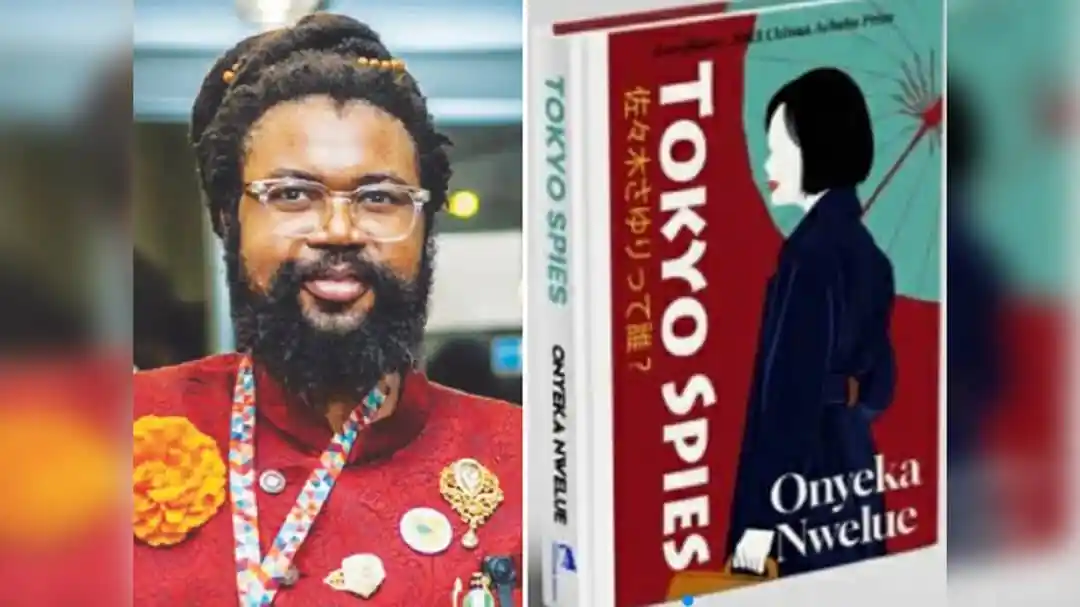
Not many writers get the kind of attention Onyeka Nwelue gets. Or even the characters in his books.
In the tradition of the Bildungsroman, the protagonist must fail before he can grow.
Onyeka Nwelue is unusually honest about the nature of Zenjiro’s failure: it is not dramatic or violent. It is relentless small avoidance – of his sick family, of a choice between two women, of his own mediocrity.
Nwelue names the flaw explicitly, which is a risk. ‘The flaw in his character, avoidance, was growing, spreading like a stain,’ he writes midway through the novel. Naming a character’s flaw outright can deflate the mystery, but here it works because Nwelue has already shown us so many instances of it: the escape to China, the double-dealing with Lin Ruo and Mei, the lies by omission in letters to Taro, the refusal to go home even as his father declines.
Onyeka Nwelue is a Nigerian writer, filmmaker, jazz musician, a trained anthropologist and a Žižekian disciple, a Soyinkaphile, who has published over 40 books, including the Crime Awards and ANA prize-winning The Strangers of Braamfontein, hailed by Nobel Laureate, Wole Soyinka as ‘raunchy.’
He is the founding director of the James Currey Society in Oxford, was an Academic Visitor at the University of Oxford and a Visiting Scholar in the University of Cambridge simultaneously.
He was a Visiting Research Fellow at Ohio University and a Research Associate at the University of Johannesburg and a Visiting Assistant Professor of African Literature to the University of Manipur, Imphal in India.
His documentary The House of Nwapa was nominated in the Best Documentary category at the 2017 Africa Movie Academy Awards. The next year, he adapted my novella Island of Happiness into an Igbo film, Agwaetiti Obiụtọ, which was nominated in the Best First Feature Film and Best Film in an African Language categories at the 2018 Africa Movie Academy Awards and won the Best Film by a Director at the Newark International Film Festival.
In 2024, his biopic of Emeka Ojukwu, Other Side of History, was screened at the Toronto International Film Festival and premiered at Lincoln College, University of Oxford.
He is the director of Africa Center Mexico and Associate Director of African Centre of India.
What the novel does brilliantly is map avoidance onto artistic failure. Zenjiro’s brushwork collapses precisely at the moments he is most dishonest. When he tries to impress rather than express, the strokes break down. This is a quietly radical idea – that art made for approval is structurally dishonest – and it may explain why Japanese publishers, a market not known for paying extravagantly for foreign literary fiction, committed 85 million yen ($600,000) to bring it to their readers first. They recognised something true in it.
The novel raises a question it does not fully answer – whether self-knowledge is enough, or whether the people we have wronged must also be restored. What Nwelue seems to suggest is that redemption is first personal, and then, if we are lucky, communal. It is a sober conclusion, and the right one.


Electricity: Challenge of Nigeria’s power sector not technical but governance – Minister, Tegbe

Barcelona reject Rashford buy option, eye fresh talks

Maine Democrats pick Platner; Trump back to winning ways: Tuesday's US primaries
Maine Democrats pick Platner; Trump back to winning ways: Tuesday's US primaries

Skilled Worker Visa: UK may consider easing immigration rules for Nigerians, others

Inflation, insecurity still major challenges despite reforms – FG

Blessing CEO Faces Fresh EFCC Charges Over Alleged N13 Million Donation Scam

 National2 days ago
Exclusive: Inside Union Bank’s Boardroom Storm And Crumbling Bank, MD Yetunde Oni Acquires N1.9 Billion US Home Barely One year in Office
- World2 days ago
Russia burning as Ukraine launches massive attack with 'more than 50 explosions'
- Breaking3 days ago
I was forced to sleep with 20 men daily – 18-year-old Benue girl recounts escape from s3x traffickers in Mali
- Breaking2 days ago
"Before HIV vs living with HIV" – Man writes as he shares his photos before and after HIV diagnosis
- World2 days ago
Horror as woman gang raped in field after being knocked unconscious
- World1 day ago
Pope Leo denounces what he calls "scourge" of sexual abuse by Catholic clergy
- Breaking3 days ago
Netizen claims newly wedded woman declared missing in Abuja left her matrimonial home after discovering her husband has two children with different women
 National3 days ago
SCOAN Marks TB Joshua’s 5th Anniversary, Says “He’s With The Saints”