Breaking
Poverty hit 63% under Tinubu, 27Million Nigerians faced food insecurity in 2025 — IMF

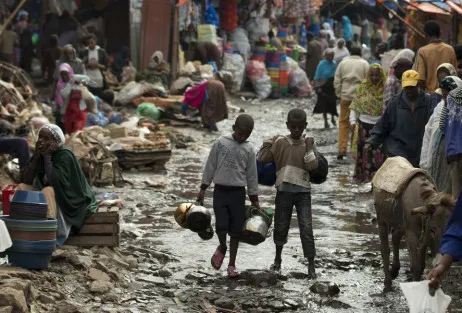
The International Monetary Fund, IMF, has revealed that poverty in Nigeria rose to 63 per cent under the administration of President Bola Tinubu, while an estimated 27 million Nigerians experienced food insecurity during the latter part of 2025 despite improvements in key macroeconomic indicators.
The Fund disclosed this in a statement issued on Tuesday in Washington, DC, where it assessed Nigeria’s economic performance and reform efforts over the past three years.
According to the IMF, although recent economic reforms have strengthened macroeconomic stability and improved the country’s resilience, the benefits have yet to translate into better living conditions for millions of Nigerians.
The institution noted that poverty reached 63 per cent under the national poverty line, while food insecurity remained widespread among vulnerable households.
The IMF warned that rising global fuel, food and fertiliser prices could further worsen inflationary pressures, deepen poverty and increase food insecurity across the country.
“Strong reforms over the past three years have yielded improved macroeconomic outcomes and built resilience,” the Fund stated.
The IMF reported that Nigeria’s gross international reserves rose to $46 billion in 2025 from $40 billion at the end of 2024, driven by a current account surplus, non-resident investments in Central Bank open market instruments and a successful Eurobond issuance.
It also disclosed that net international reserves increased significantly from $23 billion in 2024 to $35 billion at the end of 2025.
Despite these gains, the Fund said economic conditions remained difficult for many Nigerians, particularly low-income households grappling with high food and transportation costs.
The IMF estimated Nigeria’s economic growth at four per cent in 2025 and projected a modest increase to 4.1 per cent in 2026. However, it noted that rising living costs continued to place pressure on households and businesses.
According to the report, inflation rose to 15.4 per cent year-on-year in March 2026 after declining steadily for more than a year.
The increase was attributed largely to rising international fuel and food prices, which have begun to impact domestic markets.
“After being on a declining trend for over a year, inflation nudged up to 15.4 per cent year-on-year in March 2026 as the jump in international fuel and food prices started hitting Nigeria,” the Fund stated.
Nevertheless, the IMF expressed optimism that inflation would resume its downward trend during the second half of 2026 as macroeconomic reforms continue to take effect.
On fiscal performance, the Fund estimated that Nigeria’s consolidated government deficit widened to 4.4 per cent of Gross Domestic Product (GDP) in 2025.
While non-oil revenues met projections, oil revenues fell short of expectations, according to the report.
The IMF said the revenue gap was partly offset by lower-than-planned capital expenditure implementation and welcomed efforts by the government to improve transparency in public spending through recent legislative reforms.
The Fund identified uncertainty in global fuel and food prices as a major risk to Nigeria’s economic outlook and warned that persistent inflation could further erode household incomes.
It also highlighted insecurity as a significant threat to economic activity and citizens’ welfare.
“Risks to the outlook come from the uncertain global environment, in particular the outlook for fuel and food prices. The domestic security situation is another risk to people and economic activity,” the IMF stated.
The institution stressed the need for stronger revenue mobilisation to create fiscal space for critical investments and social protection programmes.
It recommended maintaining a neutral fiscal stance in 2026 while protecting priority spending and expanding support for vulnerable households through targeted cash transfer programmes.
The IMF also called for improved budgeting processes, stronger fiscal reporting systems and enhanced transparency in public financial management.
On monetary policy, the Fund commended Nigerian authorities for efforts to curb inflation and advised the Central Bank of Nigeria to maintain a tight monetary policy stance until inflationary pressures are firmly contained.
The IMF further praised Nigeria’s commitment to exchange rate reforms and noted that the country’s financial system remains resilient, supported by the ongoing recapitalisation of banks.
However, it urged regulators to remain vigilant against emerging financial risks and accelerate the implementation of global banking standards.
The Fund reiterated that structural reforms in governance, security, electricity, agriculture, infrastructure and human capital development remain critical to achieving inclusive growth and reducing poverty across the country.


Wrong to hand over churches to your son – Pastor Kumuyi on hereditary succession [VIDEO]

Alaska’s rivers are turning rust-orange and scientists say the cause has been frozen for thousands of years

JUST IN: PDP House of Reps Member Dumps Party for APM in Bauchi

US air force plane declares mid-flight emergency after taking off from UK airport

Flash flooding and destructive storms slam Midwest like a "horror movie"

Police arrest four robbers, recover stolen motorcycle in Kwara

How an Iowa woman became a key witness in her own murder

 National2 days ago
Exclusive: Inside Union Bank’s Boardroom Storm And Crumbling Bank, MD Yetunde Oni Acquires N1.9 Billion US Home Barely One year in Office
- World2 days ago
Russia burning as Ukraine launches massive attack with 'more than 50 explosions'
- Breaking3 days ago
I was forced to sleep with 20 men daily – 18-year-old Benue girl recounts escape from s3x traffickers in Mali
- Breaking2 days ago
"Before HIV vs living with HIV" – Man writes as he shares his photos before and after HIV diagnosis
- World2 days ago
Horror as woman gang raped in field after being knocked unconscious
- World2 days ago
Pope Leo denounces what he calls "scourge" of sexual abuse by Catholic clergy
- Breaking3 days ago
Netizen claims newly wedded woman declared missing in Abuja left her matrimonial home after discovering her husband has two children with different women
 National3 days ago
SCOAN Marks TB Joshua’s 5th Anniversary, Says “He’s With The Saints”