News
Pregnant women stranded as collapsed bridge cuts off Gombe community from healthcare

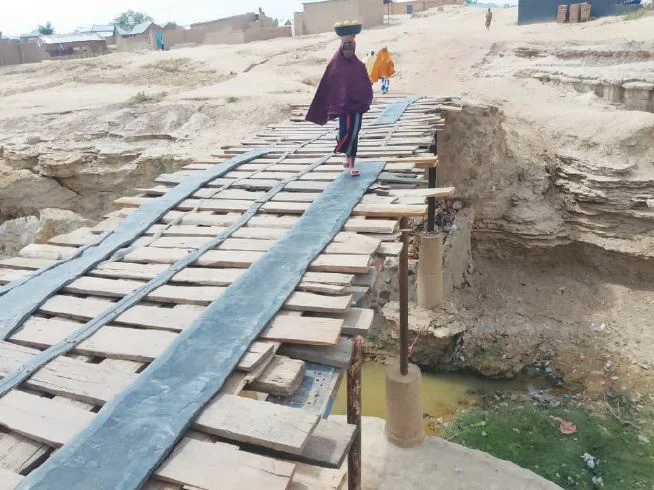
In Afghanistan Community in Garko Ward of Akko Local Government Area of Gombe State, more than 4,000 residents are cut off from healthcare, schools and markets during the rainy season whenever floodwaters submerge the community’s only wooden bridge linking them to neighbouring towns and a healthcare centre. With pregnant women dying from labour complications, missing antenatal care, sick children denied treatment, poor infrastructure continues to endanger lives and livelihoods. CHIMA AZUBUIKE reports
The pain came once, then again. At 40 weeks pregnant, Hajiya Fatima, as she was fondly called, knew her baby’s arrival was near.
Being a mother of two, the 25-year-old knew the signs of labour and began mentally checking the things she had already prepared for her newborn.
As another contraction tightened across her abdomen, she gently rubbed her belly and whispered reassuring words to the child she was about to meet.
In response, the pain coursed through her, and she hastened to where her maternity bag was already packed.
As the expectant mother reached for the bed, the cool evening breeze reminded her that it had rained heavily throughout the day.
A few minutes later, the rain returned, as it usually does in July, the peak of the rainy season in Gombe State.
As the skies opened, Fatima’s contractions became stronger and more frequent.
Still, Fatima was determined to go in the rain to the health centre where she had registered and attended antenatal, but quickly remembered that the wooden bridge linking her Afghanistan Community in Garko Ward of Akko Local Government Area of Gombe State, to the neighbouring town where the only health centre was located would have been submerged in the floodwaters.
As labour intensified, Fatima sent her older children into the rain to seek help from neighbours and hours later, she delivered her baby at home after a prolonged labour. But the bleeding would not stop.
By the time the floodwaters receded enough for movement, it was too late.
A community leader who narrated the story to PidomNigeria Healthwise, Ishaq Afghanistan, stated that Fatima who died in 2024 continued bleeding and because of the overflow of water on the wooden bridge, she could not be taken to the hospital.
“Her labour started as it was raining. The wooden bridge was flooded, and nobody could pass due to the current. Before it could drain off, Hajiya passed because she could not access the health facility on time. The baby, too, didn’t make it because she was in labour for a long time,” he said.
Afghanistan told our correspondent that Fatima’s husband moved on shortly after she passed, “the husband is now married to ensure the children are properly taken care of, but as a community, we can’t forget her.”
Delay, maternal health experts have said, is a contributing factor to Nigeria’s already high maternal mortality ratio.
Nigeria accounts for about 34 per cent of the global burden of maternal mortality, with postpartum bleeding, hypertensive disorders during pregnancy, sepsis, and unsafe procedures being major reasons for the deaths.
A Professor of Obstetrics and Gynaecology at the Obafemi Awolowo University, Ile-Ife, Osun State, Ernest Orji, said delays in accessing and receiving maternal healthcare remain major contributors to maternal deaths in Nigeria.
He explained that maternal mortality is often driven by the “three delays” model, stating that the first delay occurs when a pregnant woman fails to recognise the seriousness of her condition or the need to seek medical care promptly.
The professor noted that the second delay arises when a patient decides to seek care but is unable to access a health facility because of barriers such as poor road networks, lack of transportation and poverty.
“Then phase two delay is when a patient knows they need to go to the hospital but cannot get access to the hospital, due maybe to bad roads, lack of a transportation system, among other things,” he stated.
He further explained that the third delay occurs after a patient reaches a health facility but is unable to receive timely and appropriate care due to inadequate equipment, supplies or personnel.
“The phase three delay is that the patient cannot reach health facilities, and there is no adequate supply of materials needed, or not available at all. So, these are three phases of delay that lead to maternal death,” Orji said.
Struggle to reach treatment centres
Fatima’s story weighs heavily on the minds of the residents, but the situation, PidomNigeria Healthwise gathered, remained unchanged.
A village head, Muhammad Banbulasta, said the incident remains painful years later.
“We still remember it because it showed how dangerous this situation is. When roads are good, people focus on treatment. Here, people first struggle to reach treatment,” he said.
He noted that while the need for a standard bridge is always on the lips of the residents, no concrete action has been taken.
Banbulasta said women in the community bore the heaviest burdens created by the community’s isolation, stating that many of them walk long distances daily searching for water.
For other pregnant women in the community, the fear of a repeat of Fatima’s situation, the village head said, forces them to stay with relatives in the nearby town that has a healthcare centre.
Despite that, Banbulasta said they face difficult journeys whenever they go for antenatal care, making many of them miss their appointments.
The village head further noted that taking children for routine immunisation and for medical attention was a tough task, especially during the rainy season.
A mother of five, Hauwa Musa, said she spends hours looking for motorcycle riders who would agree to cross the bridge to the other community whenever she is to take her children to the clinic.
“When my youngest child became sick during the rainy season last year, we spent hours looking for transport. The motorcycle rider was afraid of crossing because the bridge was slippery,” she said.
When she found a willing rider, the ride was accompanied by intense prayer sessions for safe passage through the rickety bridge.
“I was holding my child tightly while praying throughout the journey,” she recalled.
Cut off from family
As dawn broke after a night of relentless rainfall, 38-year-old farmer Ibrahim Adamu stood at the edge of a swollen stream, staring helplessly at what remained of the road leading to Afghanistan Community.
On the opposite side of the floodwater lay his home, his wife and four children. He had spent the previous evening at a nearby market where he sold maize and groundnuts. Normally, the journey home would take less than thirty minutes.
But this was not a normal day. The rains had arrived.
The narrow access road had disappeared beneath muddy floodwater, while the ageing wooden bridge connecting the community to the outside world shook under the pressure of the current.
Unable to cross safely, Ibrahim spent the night on a wooden bench outside a shop in a neighbouring village.
“I could see my community from a distance, but I could not reach it.
“My children kept calling me. My wife was worried. There was nothing I could do except wait for the water level to reduce,” he recalled.
For residents of the Afghanistan Community, stories like Ibrahim’s are not unusual. They have become part of life.
Every rainy season, thousands of people in the settlement face a recurring reality that many describe as abandonment by successive governments.
The community, home to more than 4,000 residents, remains accessible only through a deteriorating road and a fragile wooden bridge built almost entirely through communal efforts.
When heavy rains arrive, both become dangerous and sometimes unusable.
The consequences stretch beyond transportation.
They affect healthcare, education, farming, business, family life and even burial rites.
For years, residents have appealed to the state government for intervention, yet the bridge remains wooden, the road damaged and the community vulnerable.
Elsewhere, rain is often associated with prosperity; farmers celebrate improved soil moisture, children play in puddles, and families welcome cooler weather.
But in the Afghanistan Community, the sound of heavy rainfall triggers anxiety.
Residents say every downpour raises the same questions.
Will the bridge survive? Will the road remain passable? Will sick people be able to reach the hospital? Will schoolchildren be able to attend classes? Will traders reach the market? Will families remain connected?
These concerns dominate conversations throughout the rainy season.
Village elders say the situation has persisted for nearly a decade.
Each year, floodwaters carve deeper channels into the road, residents organise repairs, and hope authorities will finally intervene. Yet, each year, the problems return.
“We’ve learnt to live with fear”
For many residents, the bridge represents both hope and danger. Hope, because it provides the only connection to the surrounding communities. Danger because crossing it can feel like gambling with one’s life.
Saleh Maina remembers several occasions when he hesitated before stepping onto the wooden planks.
“There are times you hear the wood creaking beneath your feet.
“You look down and see the water rushing beneath. You simply pray and continue walking,” he said.
According to him, children and elderly residents face the greatest risks.
“Parents escort their children across because they are afraid something might happen. Elderly people move very slowly. Everyone knows the bridge is weak.
“We have learnt to live with fear because we have no alternative,” Maina said.
Education suffers
School-age children frequently encounter difficulties travelling during periods of heavy rainfall.
Teachers sometimes struggle to reach schools.
Examinations can become stressful because students worry about transportation.
Residents say some parents keep younger children at home whenever conditions become too dangerous.
A secondary school student, Abubakar Ismail, recalled missing classes after flooding cut off the road.
“Sometimes you wake up ready for school and discover there is no way to leave the community. You watch other students continue learning while you remain at home,” he said.
Education experts often describe infrastructure as a foundation for development.
In the Afghanistan Community, residents say poor infrastructure has become a barrier to educational progress.
Agriculture remains the primary source of livelihood for many families.
Yet farmers say poor roads significantly reduce their profits.
Transporting produce to markets is often expensive and unpredictable.
During peak rainfall periods, some products spoil before reaching buyers.
Farmer Musa Adamu said, “We work hard throughout the farming season, but transporting our harvest becomes another struggle.”
According to him, buyers sometimes exploit the situation by offering lower prices.
“They know we have limited options.”
The result is reduced income for farming households already facing economic pressures.
Perhaps no aspect of the community’s experience illustrates the severity of isolation more than what happens when someone dies.
Residents describe moments of grief becoming even more painful because of transportation challenges.
Funeral arrangements that should focus on mourning often become logistical exercises.
There have been occasions, residents say, when vehicles could not reach the community.
As a result, corpses had to be carried on foot. The image remains difficult for many residents to discuss. Yet they insist it reflects reality.
“Nobody should have to carry a corpse because there is no road,” one resident said quietly. “It is painful.”
The issue touches deeply on dignity and culture.
In many Nigerian communities, funerals are collective events bringing together relatives from near and far, but poor infrastructure disrupts those traditions.
For years, residents have relied on self-help initiatives.
Whenever the bridge deteriorates, contributions are collected, carpenters are hired, wood is purchased, and repairs are undertaken. The process repeats almost every year.
Community leaders estimate that millions of naira have been spent over time maintaining a structure the government was expected to provide.
Despite these efforts, residents acknowledge that community repairs can’t achieve so much.
The bridge requires complete reconstruction; anything less merely postpones the inevitable.
Ironically, the Afghanistan Community is expanding.
Population growth continues, new homes appear, young families settle, economic activity increases, yet infrastructure has remained largely unchanged.
Residents say development has not kept pace with population growth.
The gap between community needs and available services continues to widen.
This mismatch fuels frustration.
People see growth around them, but little improvement in public amenities.
One issue repeatedly raised during interviews was political representation.
Residents argue that communities often attract development when they command political attention.
The Afghanistan Community, they say, has struggled to achieve that visibility.
As another rainy season gathers momentum, the Afghanistan Community once again finds itself waiting.
Waiting for repairs, recognition, for promises to become projects and for authorities to remember that more than 4,000 citizens depend on a bridge they built themselves.
For now, the wooden structure still stands, residents continue crossing it, farmers continue using it, schoolchildren continue walking over it, and mothers continue praying on it.
But every rainfall serves as a reminder that hope alone cannot replace infrastructure.
And until meaningful intervention arrives, Afghanistan Community will remain a place where resilience bridges the gap left by neglect, a community connected to the outside world not by modern infrastructure, but by determination, endurance and an unwavering belief that one day, somebody in authority will listen.
Dilapidated wooden bridge, death trap – Official
When contacted, the Information Officer for Water, Environment and Forest Resources, Amos Fabulous, described the community’s plight as a death trap, urging the community to write formally to the ministry.
“The community should make a written request to the ministry and also to move the Ministry of Works,” he said.
However, calls and text messages to the Information Officer for the Ministry of Health, Hauwa Ibrahim, on efforts being made to bring healthcare closer to the Afghanistan community to mitigate maternal mortality due to lack of passage to access care has yet to receive a response as of press time.







NPFL: Ranchers Bees appoint Bodunde new secretary

Reps order NPF, NAHCON to reinstate disengaged personnel

NATO realizes Russia can’t be defeated through Ukraine – Putin

Kebbi: Police dismiss rumours of school closure over insecurity

Stupid public policy reason Nigeria without electricity – Kemi Badenoch

Abia links reform drive to investor confidence

Pregnant women stranded as collapsed bridge cuts off Gombe community from healthcare

 World1 day ago
Horror as girl, 12, 'gang raped by 5 classmates' at birthday party
- Politics3 days ago
Environmental Protection: Edo, FG to strengthen collaboration as Okpebholo pledges partnership to protect Edo environment
- World1 day ago
Horror as bodies of 29 unborn babies discovered buried at a family home
- Breaking2 days ago
Two brothers beat each other to de@th after satanism accusation sparks de@dly fight
 News3 days ago
Benue Youths Rescue Kidnapped Victims, Detain Suspects in Community Operation
- World2 days ago
Escalation in attacks between U.S. and Iran
- Breaking24 hours ago
Fight breaks out between student, hostel staff and Rev. Sister at Coal City University
- Business12 hours ago
Wema Bank’s 5 for 5 Rewards Delivers ₦17.96 Million to 273 Customers in One Month