Politics
Russia Defends Ukraine Operation, Deepens Strategic Partnership With Nigeria and Africa

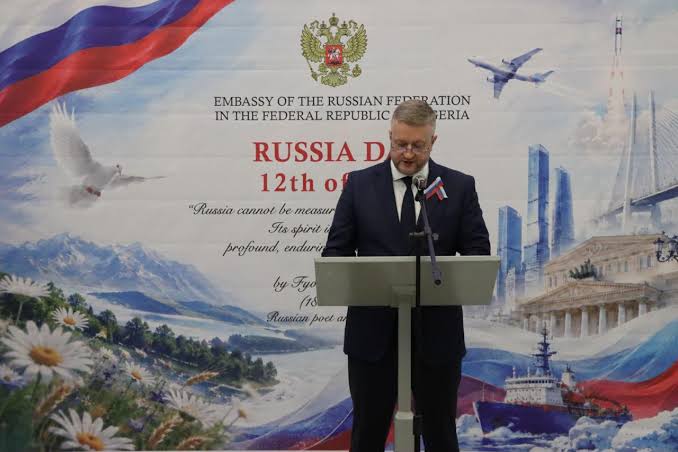
Russia has defended its ongoing military operation in Ukraine, rejected Western efforts to isolate it internationally, and reaffirmed its commitment to expanding strategic cooperation with Nigeria and Africa.
Speaking at a reception in Abuja to commemorate Russia Day, Russia’s Chargé d’Affaires ad interim in Nigeria, Vladimir Nestoyanov, said Moscow remained resolute in pursuing its national interests despite sanctions, political pressure and international criticism over the conflict in Ukraine.
Addressing diplomats, government officials, business leaders and members of the diplomatic community, Nestoyanov described Russia as a resilient global power whose influence could not be diminished by external attempts at isolation.
“This year’s celebration takes place against the backdrop of the Special Military Operation in Ukraine,” he said, reiterating Russia’s position that the operation was launched to protect Russian-speaking populations and secure the country’s strategic interests.
The envoy maintained that Russia had consistently sought a diplomatic resolution to the crisis and accused Western nations of escalating tensions by supporting Ukraine and disregarding Moscow’s security concerns.
According to him, Russia was compelled to act after years of failed diplomatic efforts and what he described as the militarization of Ukraine against Russian interests.
He insisted that sanctions and international pressure would not alter Russia’s independent course, stressing that the country possessed vast human, scientific, technological and natural resources that would continue to sustain its global relevance.
“No amount of unlawful sanctions, political pressure, or attempts at isolation will force Russia to abandon its national interests or alter its independent course,” he stated.
Nestoyanov also argued that the international system was undergoing a historic transformation towards a multipolar world order, which he described as more equitable and reflective of the interests of developing nations.
He said Russia was committed to building international partnerships based on sovereign equality, mutual respect, non-interference in internal affairs and adherence to the principles of the United Nations Charter.
Highlighting Africa’s growing influence in global affairs, the Russian diplomat said the continent occupies a central place in Moscow’s foreign policy strategy.
He noted that Russia was committed to implementing agreements reached at Russia-Africa summits and expanding cooperation with African nations in key sectors, including energy, agriculture, education, healthcare, security, science and trade.
Nestoyanov singled out Nigeria as one of Russia’s most significant partners on the continent, describing the country as a major force in Africa’s political and economic development.
“As Africa’s most populous nation and one of its leading economies, Nigeria plays a vital role in promoting peace, stability and development across the continent,” he said.
He praised the longstanding relationship between both countries, noting that cooperation continues to deepen across multiple sectors.
The envoy particularly acknowledged the contributions of thousands of Nigerians educated in Soviet and Russian universities, describing them as enduring links that have strengthened people-to-people relations between the two nations.
He further commended Nigeria’s role in addressing regional challenges, strengthening African institutions and advancing the continent’s interests on the global stage.
Nestoyanov expressed appreciation to the Nigerian government, members of the diplomatic corps, business leaders, academics and media professionals for supporting Russia-Nigeria relations.
He reaffirmed Moscow’s commitment to dialogue and partnership, expressing optimism about the future of bilateral relations.
Russia Day, celebrated annually on June 12, marks the adoption of the Declaration of State Sovereignty of the Russian Federation in 1990 and serves as a symbol of the country’s modern statehood and national identity.


NUJ raises alarm over criminals masquerading as Keke, Okada riders in Abia

Quote of the day by Jeff Bezos' ex-wife MacKenzie Scott: "There are lots of resources each of us can pull from our safes to share with…”

Haywood Mall shooting: Horror as police storm shopping mall where 'several people shot'

Nigerian inmates in Ethiopia celebrate prisoner transfer deal, thank Tinubu

Horror as woman 'taken from her home, tied up and gang raped'

Trump says Iran deal will be signed tomorrow – 'Strait open to all'

Nigerian Army arrests 10 terrorists’ informants in Niger

 World1 day ago
Horror as girl, 12, 'gang raped by 5 classmates' at birthday party
- Politics2 days ago
Environmental Protection: Edo, FG to strengthen collaboration as Okpebholo pledges partnership to protect Edo environment
- Breaking3 days ago
Nobody can stop me from visiting any part of Nigeria â Sheikh Gumi
- World1 day ago
Horror as bodies of 29 unborn babies discovered buried at a family home
- World2 days ago
Escalation in attacks between U.S. and Iran
- Breaking2 days ago
Two brothers beat each other to de@th after satanism accusation sparks de@dly fight
 News2 days ago
Benue Youths Rescue Kidnapped Victims, Detain Suspects in Community Operation
- Breaking3 days ago
Ebola: Tinubu approves â¦10bn for emergency