News
Shettima, Oyedele defend reforms, say economy now on stronger footing

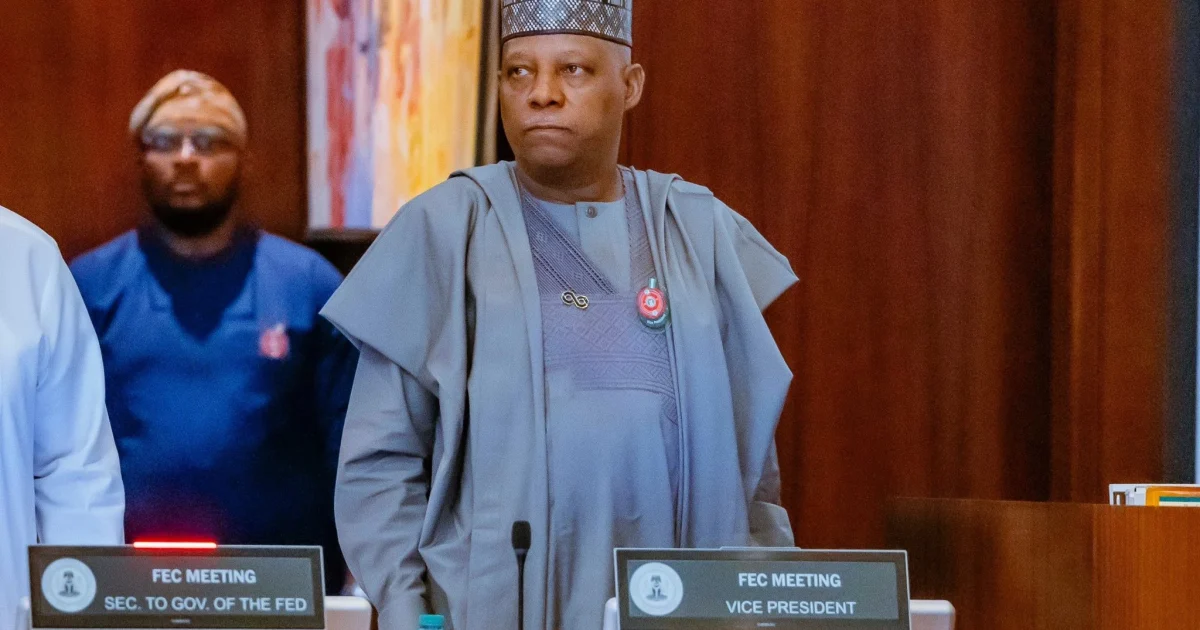
The Federal Government on Monday defended its sweeping economic reforms, insisting that although the measures have been painful for businesses and households, they have helped pull Nigeria away from fiscal distress and laid the foundation for long-term growth.
Vice President Kashim Shettima and the Minister of Finance and Coordinating Minister of the Economy, Taiwo Oyedele, said the removal of fuel subsidy, foreign exchange reforms and tax changes were necessary to rescue the economy from years of structural distortions.
The government, however, acknowledged that businesses and ordinary Nigerians were still bearing the burden of high inflation, elevated interest rates and rising operating costs.
Speaking at the fifth Nigeria Employers’ Summit in Abuja, themed “Leveraging Reforms and ESG for Enterprise Competitiveness and Inclusive National Growth, Shettima, represented by his Special Adviser on General Duties, Aliyu Modibbo Umar, said the current administration inherited an economy burdened by unsustainable subsidies, weak government revenues and declining investor confidence.
He said the easy option would have been to postpone difficult decisions but that leadership required taking hard choices.
“The economies that flourish today did not stumble into prosperity. They summoned the foresight to imagine a different future and the courage to implement the reforms that brought that future within reach. Foresight without courage produces fine speeches and empty outcomes. Courage without foresight produces motion without progress. What a nation requires is the marriage of both: the vision to see what must change and the resolve to change it, even when the path is steep.”
According to the Vice President, the Renewed Hope Agenda was designed to confront longstanding distortions that had weakened the economy.
“When President Bola Tinubu assumed office, the economy carried deep structural burdens. Fuel subsidy had become fiscally unsustainable, the foreign exchange market was fragmented, government revenue was weak and investor confidence required rebuilding. The easy option at that time was to postpone difficult decisions. But leadership is tested when the right decision is also the difficult one.”
He said the administration could not continue to build prosperity on distortions or create jobs in an economy burdened by multiple taxation, poor logistics and insecurity.
“The reforms have been difficult, but their purpose is to correct the foundations so that growth becomes real, durable and inclusive. There is no doubt that restoring macroeconomic stability was our first task because a stable economy is the first infrastructure of business. Before roads, railways and ports, businesses need confidence to plan and invest.”
The Vice President also defended the removal of fuel subsidy and the liberalisation of the foreign exchange market, describing both policies as central to economic recovery.
“The subsidy crowded out investment while encouraging inefficiency and rent-seeking. The foreign exchange reforms are delivering a more transparent and market-reflective system. Businesses do not reject taxation. They reject multiple taxation, harassment and systems that punish compliance while rewarding informality.”
He said the government’s tax reforms were designed to reduce the number of taxes, harmonise administration and support small businesses. “Our agenda reduces the number of taxes, harmonises administration, protects the vulnerable, supports small businesses and encourages compliance by lowering rates while widening the tax base needed to fund infrastructure.”
The VP added that the administration’s interventions in the power sector, gas development and the Presidential Compressed Natural Gas Initiative were all targeted at reducing the energy burden on businesses. “Our work in the power sector, gas development, debt management, the Presidential CNG Initiative and the broader energy transition serves one purpose: to reduce the energy burden on businesses and households.”
He urged the private sector to take advantage of the reforms and become a key driver of national development. “Government designs policy, but businesses build the factories, farms, services and innovations that create jobs and prosperity. We must keep engagement open because any government that ignores employers cannot fully understand the economy.”
On his part, the finance minister acknowledged that the reforms had come with painful consequences but insisted that the economy was in a far better position than it was three years ago.
Speaking during a panel session titled, “Reforms in Focus: The Milestones, the Challenges, the Prospects,” at the fifth Nigeria Employers’ Summit in Abuja, Oyedele said the biggest obstacle facing the government’s reform agenda was widespread misunderstanding of policy measures and a growing trust deficit between citizens and government.
According to him, although Nigerians have endured significant pain from the reforms, the country is already beginning to witness some positive outcomes, including improved external reserves, increased investor confidence and the expansion of social intervention programmes such as the Nigerian Education Loan Fund.
The tax reform chairman maintained that the administration inherited an economy on the brink, with dwindling foreign exchange liquidity, mounting debt obligations and limited fiscal space, stressing that the reforms were designed to prevent a total economic collapse and place the country on a path of sustainable growth.
“When you say the economy has stabilised, we are operating where we are now because that is where we must be. Three years ago, you couldn’t even pay for a $20 application with your ATM card, and some people needed to make a living because dollars were drying up. Three years ago, many states could not pay salaries. Our revenues were being used to service debt and there was hardly any money left for infrastructure.”
He said the government had made measurable progress in stabilising the economy and expanding social interventions.
“We didn’t even have the Nigerian Education Loan Fund. Today, more than one million households have benefited. It is not just about tuition and monthly stipends. The money that families would have spent on school fees is now being used to support small businesses and meet other household needs.”
Oyedele admitted that one of the biggest challenges confronting the reform programme was widespread misunderstanding of government policies and declining trust in public institutions. “The biggest issue I am dealing with in my portfolio is policy misunderstanding and the low level of trust. It just makes everything harder. Every single thing we put out, just wait for 30 minutes and it will be turned upside down. You’re spending your whole day trying to explain.
“We are not saying we have arrived and we are not saying we have solved all our problems. But if we don’t work with data, acknowledge the sacrifices and the pain, while also recognising the little progress that we have made, then it becomes difficult to move forward,” he said.
He lamented the spread of misinformation about government policies, saying false narratives often undermined genuine reform efforts. “We are not saying we have arrived and we are not saying we have solved all our problems. But if we don’t work with data, acknowledge the sacrifices and the pain, while also recognising the little progress that we have made, then it becomes difficult to move forward.”
On foreign exchange reforms, Oyedele said Nigeria had moved away from a period when investors were unwilling to bring capital into the country.
“You remember when airlines such as Emirates stopped operations because they could not repatriate their funds. Nigeria became the number one country in the world for funds owed to international airlines. We were at a point when nobody wanted to bring money into Nigeria. Today, we have over $50bn in external reserves. Many investors are coming because they appreciate the reforms, even though some are initially attracted by the interest rate environment.”
He added that large-scale foreign direct investments, particularly in the oil and non-oil sectors, would take time to materialise.
“The foreign direct investment that we desperately need does not happen overnight. Investors take time to study reforms and build confidence. But let us accept that where we are today is better than where we used to be, and where we hope to be very soon will be better than where we are today.”
The fifth Nigeria Employers’ Summit, organised by the Nigeria Employers’ Consultative Association, brought together policymakers, business leaders and development partners to discuss the impact of ongoing reforms and strategies for improving enterprise competitiveness and inclusive economic growth.
The Tinubu administration’s reforms, including the removal of petrol subsidy, exchange rate unification and ongoing tax changes, have drawn praise from international financial institutions and investors but have also triggered inflationary pressures and increased the cost of living and doing business across the country.






Saudi Arabia football chief Yasser Al-Misehal resigns after World Cup group-stage exit

BREAKING: FG, SSANU, NASU, NAAT conclude renegotiation of 2009 agreement

NDC deregistration: ‘Relax, wait for our next line of action’ – Kwankwaso to Obidients, Kwankwasiyya

Subsidy Removal and FX Reform: Pillars of Nigeria’s Economic Revival Strategy

US troops killed 199 jihadists in single operation in Nigeria – Trump’s aide

Indian-origin techie says he has 'made peace' after failing to land job in US despite 15+ years of experience

NDPC Pivots to Accountability: Mandating Robust Data Governance for Digital Economy Trust

 Breaking1 day ago
UNBELIEVEABLE: Video of A Fat Wife Beating And Flogging Her Slim Husband Sparks Debate Online Among Couples and Youths
- Investigation1 day ago
âThe Islamic Republic of Iran will no longer exist!â Trump threatens amid fragile ceasefire
- Investigation22 hours ago
Emerging facts points to his innocence – Harrison Gwamnishu shares update on man brutally beaten after being accused of N2m theft in Enugu
 Breaking6 hours ago
Forget about body count. Sometimes itâs better to marry a lady who has gone into the world and experienced life than to marry one who hasnât- Nigerian doctor’s advice to men sparks debate online
- Breaking3 days ago
Stop insulting the intelligence of Nigerian women – Arise TV anchor, Ayo Mario-Ese knocks First lady, Remi Tinubu, over âAkara, Kuli-Kuliâ business advice
- Investigation2 days ago
"The moment I started posting my fiancé online, women flooded his DMs" â Married woman shares screenshots, calls out women who messaged her husband while they were engaged
- Investigation1 day ago
ISWAP fighterâs wife surrenders to troops with her two-month-old baby in Borno
- Investigation1 day ago
Iran vows to unleash âhellâ on US bases after fresh attacks as Trump warns regime will âno longer existâ if war restarts