News
Andy Burnham Cuts UK Power Tax in First Move as Prime Minister

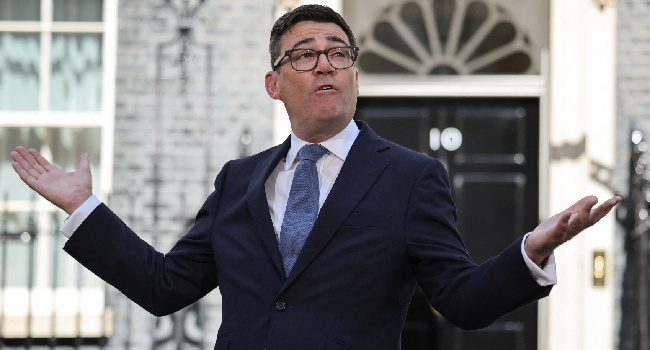
(Andy Burnham. Photo Credit: Channels Tv)
As his first significant policy move, Britain’s new prime minister, Andy Burnham, has announced a reduction in the value-added tax (VAT) on home power bills, offering those who are having trouble keeping up with the rising cost of living immediate assistance.
Burnham, who took over for Keir Starmer on Monday, stated that the move will provide households “some breathing space” and indicate the course of his new government.
Before his first cabinet meeting on Tuesday, Burnham declared, “Give people some breathing space now, some help with the cost of living.”
The tax reduction will remove the five per cent VAT on domestic electricity bills from October, saving the average household about £45 annually.
The government said the policy would initially be funded by cancelling plans to introduce digital identity cards.
Business Secretary Jonathan Reynolds described the move as a tremendous announcement for the first day of the new cabinet, saying it demonstrated the government’s commitment to easing financial pressure on households.
Burnham formally became Britain’s prime minister after meeting King Charles III at Buckingham Palace, becoming the monarch’s fourth prime minister since his accession in 2022.
In his first address outside 10 Downing Street, Burnham pledged to restore confidence in government through economic reforms and greater regional empowerment, stressing the need to regain stability while promising to build a new political model and a new economy.
The new prime minister also promised to re-industrialise Britain, decentralise power away from Westminster, and strengthen public services, disclosing that his administration would soon present a long-term roadmap for national development, describing it as a 10-year plan for the country.
Addressing social welfare, Burnham vowed to tackle homelessness as one of his government’s first priorities, stating that his first instruction would be to end rough sleeping, reviving a policy he had championed during his time as Mayor of Greater Manchester.
Burnham also moved swiftly to reshape his government by dismissing several ministers who served under Starmer and appointing key allies into strategic positions.
Former Defence Secretary John Healey was named Chancellor, Ed Miliband became Foreign Secretary, while Angela Rayner returned to cabinet.
Wes Streeting was appointed Defence Secretary, and Shabana Mahmood retained her role as Home Secretary.
On the international front, Burnham held his first telephone conversation with United States President Donald Trump, reaffirming Britain’s commitment to defence cooperation and bilateral relations.
Reacting after the call, Trump described the discussion as productive, saying they had a very good conversation and expressing confidence that Burnham would be able to handle the demands of the role, with US support behind him.
According to Downing Street, Burnham also assured Ukrainian President Volodymyr Zelensky of Britain’s continued support for Ukraine, while French President Emmanuel Macron congratulated the new prime minister and called for renewed cooperation between the United Kingdom and the European Union.
Burnham inherits an administration facing significant economic and political challenges, including sluggish economic growth, rising public debt, persistent inflationary pressures, high welfare spending, irregular migration and volatile global energy markets.
Opposition parties have questioned his mandate and called for a fresh general election, but the new prime minister has insisted his government remains focused on delivering economic stability and long-term reforms.







Why some Dems are standing by Israel

Deputy Speaker Denies N1bn Church Instrument Budget Claim, Explains Youth Programme Plan

Apapa Gridlock: MEMAN reacts to alleged involvement of members

Police nab suspected robbers with toy guns in Niger
Police nab suspected robbers with toy guns in Niger

Zendaya Bashfully Confirms Marriage To Tom Holland While Turning Down Fan’s Proposal: ‘You’re Too Late!’

JUST IN: Prof Olapegba emerges as new UI VC

 Society2 days ago
Pepper Seller Caught On Camera Applying Pepper On Newborn Baby As Rituals To Usher Her Into The Business
- Society2 days ago
2026 Ballon d’Or: Top 4 players to win award after World Cup final revealed
- Investigation1 day ago
65-year-old married female teacher blindfolded and tied 10-year-old schoolboy to bed before having s3x with him
- World3 days ago
Spain earns $51 million for World Cup win and runner-up Argentina gets $34 million as total payout for all 48 teams hits record-high $871 million
- Investigation23 hours ago
âBusinesses are dy!ng in South Africa. Nobody is making money – South African man decries low patronage days after anti-immigrant protest
- Investigation1 day ago
"I ‘m fine and healthy" – Video of late Mary Habila debunking her d3ath rumours 3 days before she d!ed at Umahi’s residence
- Investigation2 days ago
âResurrection of the Christâ writer reveals actor Mel Gibsonâs dark spiritual warning about âPassionâ sequel
- Investigation3 days ago
Choirmaster sentenced to 25 years imprisonment for r@ping 16-year-old girl during âdeliveranceâ in Anambra