World
Jordan Stands by U.S. Troop Presence Though They Make the Kingdom an Iranian Target

This Video Is Trending Right Now
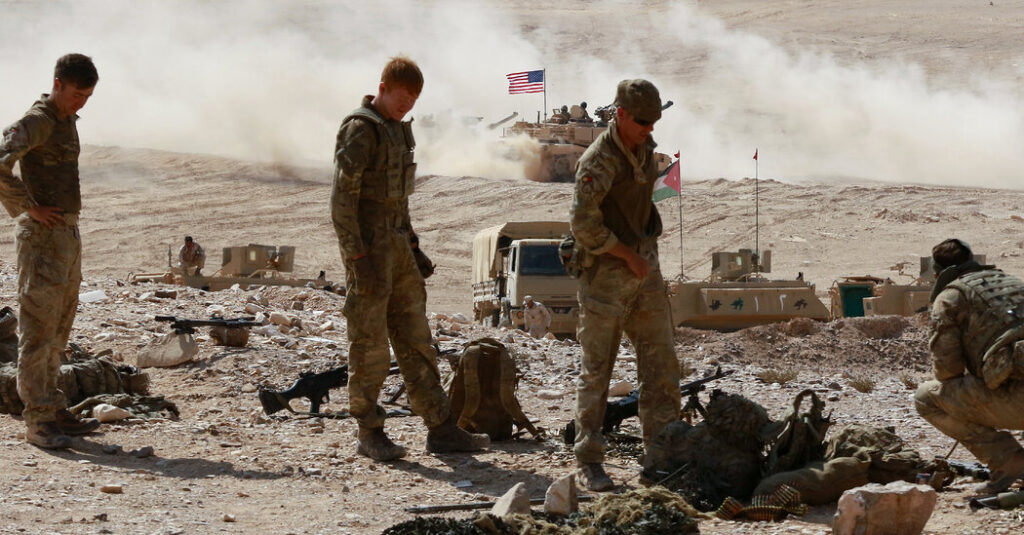
For some three decades, Jordan has been an important base for American military operations around the Middle East.
Now, Jordan is paying a price. Over recent days, Iran has stepped up its airstrikes against the kingdom, targeting U.S. military forces there.
But even as sirens are sounding over Jordan, it has refrained from limiting the American presence. The country’s exceptional dependence on the United States has kept Jordan from curtailing those military activities, analysts say.
Jordan has come to rely on the United States for billions of dollars in economic and military aid, provided over their decades-old relationship, as well as for protection in a dangerous region.
Unlike some of its Gulf Arab neighbors with abundant oil and other natural resources, Jordan is a resource-poor country heavily reliant on foreign aid. Last year, the United States gave the kingdom $1.65 billion in economic and military assistance, according to Jordanian officials.
And while some other American allies in the region have restricted Washington’s ability to base troops on their territory and fly aircraft over it during the war with Iran, U.S. officials say, Jordan is not in a position to place such limits.
“Jordan is a weak state in the Middle East,” said Sean Yom, a professor of political science at Temple University and author of the book “Jordan: Politics in an Accidental Crucible.” “It’s fairly small and it’s surrounded by regional threats. And it does need some sort of great power patron or outside protector, and the U.S. has played that role for several generations now.”
The assistance Jordan gets from the United States, which dates back to the 1950s, is far too large for anyone else to provide, Mr. Yom said.
Since the United States and Israel launched the war against Iran in late February, it has retaliated in part by carrying out strikes on American allies in the Middle East. During the first months of the war, Iran primarily targeted Israel and U.S. allies in the Gulf, but it also directed hundreds of drones and missiles at Jordan.
The conflict quickly hurt Jordan’s tourism industry, which provides up to 18 percent of the country’s revenue, just as the high season was getting underway. Although most of the missiles and drones were intercepted, airlines canceled flights, and would-be visitors canceled hotel reservations.
Now, with the U.S.-Iran cease-fire unraveling, both sides have ramped up attacks, and Iran has widened its targeting in recent weeks. On Sunday, Jordan’s air defenses shot down three Iranian missiles, the Jordanian military said, while a fourth landed in an unpopulated area.
“This Iranian strategy of vertical escalation hitting its neighbors aims at creating pressure on those neighbors, aims at creating pressure on the United States,” said Hassan Almomani, director of the Center for Strategic Studies, a think tank that advises the Jordanian government on national security.
Iran said recently that some of its strikes on Jordan had targeted fuel tanks at the Muwaffaq Salti Air Base in Azraq, a hub for the U.S. Air Force, and aircraft shelters at other bases, according to the Fars News Agency, a semiofficial Iranian news outlet. Previously, Iran said it had targeted radar and communications systems used by U.S. forces.
Two U.S. soldiers were killed and a third was missing on Friday in an Iranian attack on the Muwaffaq Salti base. Three other attacks on U.S. forces in Jordan earlier in the week wounded dozens of American soldiers and damaged a number of Blackhawk helicopters.
American forces have long operated out of Jordanian air bases, and the kingdom has been a base for such American military activities as the fight against the Islamic State, the training of rebel fighters during Syria’s civil war and the invasion of Iraq. There are now nearly 4,000 American service members in the country, according to a congressional report.
Muwaffaq Salti and other bases have been adapted to accommodate a permanent U.S. presence.
“The infrastructure in Jordan has been pretty robust from a U.S. standpoint for a while,” said Grant Rumley, a former Middle East adviser at the Pentagon and now a senior fellow at the Washington Institute for Near East Policy. He likened it to a “land-based aircraft carrier.”
Muwaffaq Salti is also relatively remote, allowing U.S. forces to operate without attracting unwanted attention, Mr. Rumley said. And since Jordan is farther from Iran than Gulf countries, U.S. forces in Jordan have more time to respond to missile and drone attacks, he said.
In the run-up to the war with Iran and in its early days, the U.S. military moved some of its troops from several Gulf Arab nations to relatively more secure locations in Jordan and neighboring Israel, U.S. officials said.
“War in Iran has revealed how important Jordan is to the United States,” said Mr. Almomani. This year, he said, Washington has increased military aid to Jordan by half a billion dollars.
Jordanian officials often emphasize the strategic importance of their relationship with the United States. In a call with President Trump in April, King Abdullah II stressed Washington’s pivotal role in the Middle East, specifically in prospects for de-escalating the conflict with Iran.
Earlier this month, Jordan’s army chief, Maj. Gen. Yousef Hunaiti, and the U.S. assistant secretary of defense for international security affairs, Daniel Zimmerman, discussed expanding military cooperation further, according to the Petra state news agency in Jordan.
The Jordanian government rarely discusses the extensive U.S. military presence publicly. Nor has Jordan openly criticized the U.S. for its airstrikes on Iran or for launching the war alongside Israel, though analysts say that the government was strongly opposed to the conflict from the beginning.
Jordanian officials have repeatedly condemned Iran’s attacks on its soil, and last week Foreign Minister Ayman Safadi said the Iranian justification for its strikes — that there are U.S. bases — is false.
“There are no American bases in Jordan,” he said, speaking at a panel discussion at the Aspen Security Forum. “We have American troops that are in Jordan as part of our longstanding military cooperation. Their presence is governed by a defense agreement that fully respects our sovereignty.”
Despite the attacks, Jordan would not consider re-evaluating its alliance with the U.S., Mr. Almomani said. “Under no circumstances can Jordan change its strategic partnership,” he said.
There is no meaningful demand in Jordan for giving up its dependency on the United States, Mr. Yom said.
“No serious political stakeholder is suggesting that Jordan replace over $1.5 billion in economic and military assistance it receives from the United States every year with, say, European Union money or Chinese support,” he said.
Aaron Boxerman contributed reporting from Jerusalem.


Trump’s battering left me with ‘post traumatic stress disorder’: Rosie O’Donnell

Fresh Details on PFIPC Probe Emerge as ICPC Grills Adeyemi Adeniyi In Detention

English pubs, clubs and music venues to get 20% cut to business rates from April

Late Night Rags on Trump and His Cabinet Joining TikTok

Micheál Martin to meet Ukraine’s Volodymyr Zelenskiy in Kyiv

Trump ordered by judge to reveal financial records in BBC defamation case

Elliot Page Explains Why He Was ‘Terrified’ to Take on the Role of Sinon in ‘The Odyssey’

 Society3 days ago
Pepper Seller Caught On Camera Applying Pepper On Newborn Baby As Rituals To Usher Her Into The Business
- Investigation2 days ago
65-year-old married female teacher blindfolded and tied 10-year-old schoolboy to bed before having s3x with him
- Investigation2 days ago
âBusinesses are dy!ng in South Africa. Nobody is making money – South African man decries low patronage days after anti-immigrant protest
- Society3 days ago
“My ₦5 Million Is Gone!” — Destiny Etiko Vows Never to Bet Again After First Football Wager
- Investigation3 days ago
âResurrection of the Christâ writer reveals actor Mel Gibsonâs dark spiritual warning about âPassionâ sequel
- Investigation2 days ago
"I ‘m fine and healthy" – Video of late Mary Habila debunking her d3ath rumours 3 days before she d!ed at Umahi’s residence
- World2 days ago
Trump Is Caught in the Trap He Set
- Investigation3 days ago
Army, hunters rescue kidnapped victim along BenueâNasarawa border