Society
The electoral act 2026 and the prospect for political stability (1)

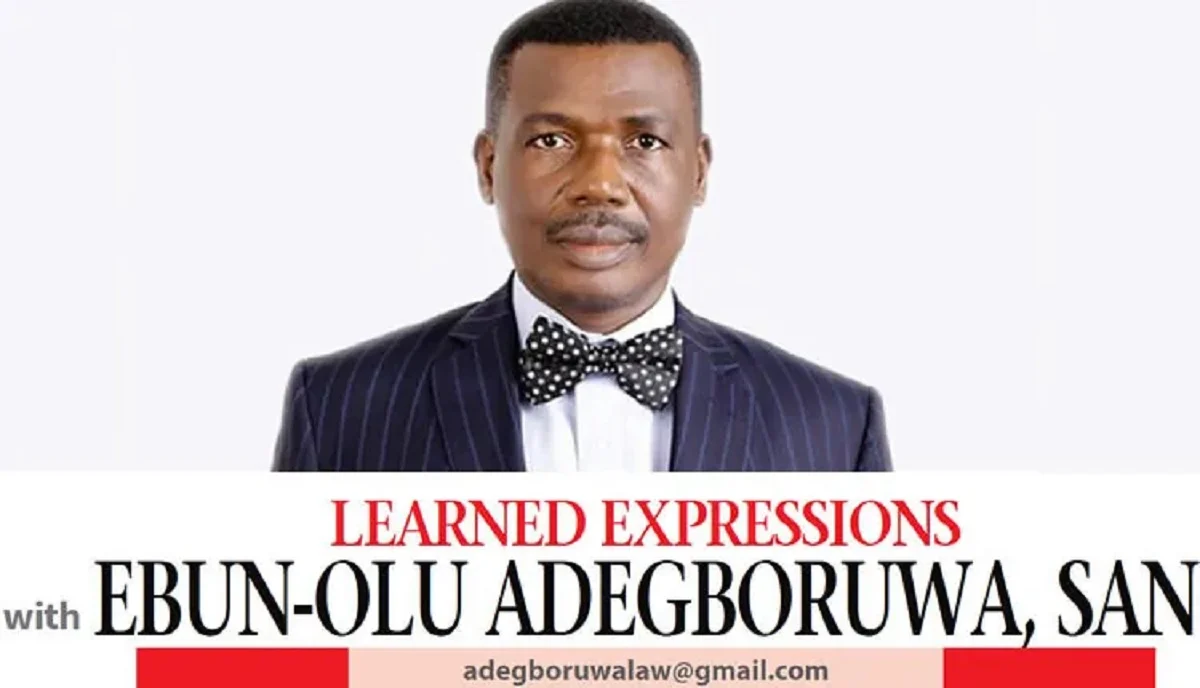
THE Egbe Amofin Oodua, a collective of lawyers from the SouthWest extraction of Nigeria, organized a robust conference at the Ojaja Conference Centre in Ile-Ife, to which I was invited as a guest speaker/panelist. The keynote address was delivered by the inimitable Professor Ademola Popoola of the Faculty of Law of Obafemi Awolowo University, Ile-Ife. Other panelists were Dr. Wahab Shittu, SAN, an astute legal practitioner and a cerebral academician, and Prince Adewole Adebayo, a brilliant lawyer, politician and the presidential candidate of the Social Democratic Party. The theme of the conference dwelt on the role of law in advancing constitutional democracy, accountability and responsible governance.
The gathering was very timely, considering the state of the nation and the issues surrounding the upcoming 2027 general elections. The discussions were very frank, incisive and illuminating, in dissecting the topic for the day. I did not have the opportunity of participating in the other sessions but I later learnt that they were equally thought-provoking and explosive. As stated at the conference, the major challenge of these landmark gatherings is always the absence of documentation and implementation of key points identified by speakers and participants, thus leading to a recycling of conferences and topics year in year out. Permit me to share with you the contents of my brief presentation at the event.
Protocols
I crave your kind indulgence to stand on the protocols already established for this event whilst not forgetting to acknowledge my teacher and law giver, Professor Ademola Popoola, at whose feet we learned law and jurisprudence at the Faculty of Law of Obafemi Awolowo University. Thus, this is a form of home coming for me, having served as the President of the Students’ Union of Great Ife and also worked with the Ooni of Ife who was the predecessor of the present Ooni, on behalf of students and stakeholders of Great Ife. However, the best way to welcome you all to the source (as we call Ife-Ile) is to humbly ask you to rise up for us to take the Great Ife anthem. As Professor Popoola has dealt wonderfully with the main issues in his keynote address, I will limit myself to other areas of the Electoral Act which deserve greater attention.
What is political stability?
According to a widely cited definition of Professor Claude Ake, political stability refers to the regularity and predictability of distribution of power, a system where the rules governing political behaviour are consistently observed. For Leon Hurwitz (“Contemporary Approaches to Political Stability”), the concept has been perceived as a multidimensional mix of related ideals such as absence of violence, governmental longevity, the existence of a legitimate constitutional order, the absence of structural change, and societal attributes. It represents the enduring state of a government that is free from turmoil, conflict, or abrupt changes, which fosters a predictable environment for citizens and investors. The main issue however is to situate these definitions within the context of our national experience in order to determine if indeed the Electoral Act alone, as a legal instrument, can birth political stability.
Political stability in Nigeria
In the present dispensation, can it be boldly asserted that Nigeria is in observance of the rules governing the distribution of power in order to avert chaos in the political circle? The starting point in answering the question is to turn to the organic law of the land, being the Constitution. Section 14(2)(b) & (c) of the Constitution of the Federal Republic of Nigeria, 1999 (as altered) (“the Constitution”) is pivotal in this regard. It provides that “the security and welfare of the people shall be the primary purpose of government; the participation by the people in their government shall be ensured in accordance with the provisions of this Constitution.” Simply put, government must first create the enabling environment for political stability through adequate security and enduring welfare of the people.
When people are not safe or they are hungry, electoral issues become not only secondary but also relegated to the background. The politicization of security and weaponization of poverty are two cardinal factors hindering political stability in our nation. The alarming incidences of terrorism come just a little short of overwhelming and disarming of the security apparatus of the government. It is so bad nowadays that critical agencies and schemes of national integration have grown wary and developed jumpy nerves and cold feet. For instance, the National Youth Service Corps (NYSC) has indicated that it would stop posting its youth corps members to troubled zones. It is noteworthy that INEC deploys youth corps members as ad hoc staff for major elections. If insecurity goes unchecked, such electoral manpower would be a thing of the past. With the rising spate of kidnapping and violence across the land, participation at elections and other electoral activities will become largely unpredictable, leading to voter apathy and loss of confidence in the electoral process such that even if you have the best law to regulate politics and political behaviour, the underlying factors, insecurity and endemic poverty, will ultimately hinder political stability. It is against this background that we must situate our focus on the role of the Electoral Act as an instrument of securing stable governance.
In a constitutional democracy such as Nigeria, societal and institutional code of conduct is not arbitrary. Behaviour is defined and regulated by law. As such, any enduring reform in the electoral system must be fixed through legislation following honest and robust review of the electoral issues that have continued to trouble the waters in our political/electoral landscape.
The critical question remains this. Is the 2026 Electoral Act fashioned for domestic democracy? Is there such a possibility that democracy can be tailored to suit particular expectations and experiences given its universal concepts? Has the 2026 Electoral Act addressed the nagging electoral issues or are there still surviving issues which it failed to fix hence the need for another piece of legislation?
Surely, since the signing into law of the Electoral Act, 2026, much internet ink and opinion voices have flowed ceaselessly critically appraising the improvements or shortcomings of the Act. A host of voices think it was hastily designed and foisted on the polity to overreach the opposition. Yet, many believe certain laudable advances have been made through some of the key innovations introduced by the new Act. We shall further examine some outstanding electoral issues which appear to have eluded the newborn Act.
Key innovations in the electoral act, 2026: problems and prospects
In order to robustly explore the substance of the topic, it would be necessary to x-ray some of the key innovations in the Electoral Act, 2026 (“the Act”) in the light of problems or matters arising and the prospects attending.
a. Mandatory digital membership register under section 77 (2) – (7) of the act:
The Problems:
Systematic Disenfranchisement:
The stringent sanction imposed by the section to the effect that failure to submit the digital register to INEC not later than 21 days before the date fixed for party primaries, convention or congress, can have the effect of systematically disenfranchising millions of voters, thereby hampering democratic participation. A careful examination of the register of members of many political parties will show inflated and non-existent members whose identities and locations cannot be verified. It is even doubtful if INEC itself has the capacity to undertake any verification, thus leaving the foundation of electoral contests and leadership recruitment vacuous. Pray, what can you build on a faulty foundation? According to Lord Denning, you cannot put something on nothing and expect it to stand.
Constitutionality Issues:
To my mind, this provision also conflicts with Section 40 of the Constitution which guarantees the right of every citizen to “assemble freely and associate with other persons, and in particular he may form or belong to any political party.” Thus, for political parties that are recognized by INEC, what chances has a citizen who desires to join a political party after the submission of the digital membership register under pressure to beat the 21 days threshold? Citizens in rural areas are automatically ostracized and marginalized in such a process, rendering political engagement elitist and at best, at large.
Cyber Insecurity of Digital Membership Data:
We must be conscious of the worrisome reality of criminal access into INEC’S database by compromised INEC elements in cahoots with political parties to overreach the opposition. The alleged unlawful sharing of voters or candidates’ membership information in INEC database allegedly by any INEC insider from INEC’s backend, exposes the credibility of the electoral umpire, especially where such is alleged to have been executed in agreement with close associates of politically exposed persons.
Prospects:
Designed to Curb Membership Data Manipulation:
The bright side of this however is that this reform is designed to curb manipulation of party membership lists, a longstanding source of intra-party dispute. By prohibiting the use of alternative registers and imposing the severe sanction of disqualification from fielding candidates, the Act seeks to enforce discipline and transparency. The question then is compliance by all stakeholders, both the actors, players and the regulator.


Women 'kidnapped and gang-raped' after travelling to Pakistan to meet investors

Woman Tries to Get Even After Husband Glances at Another Woman, His Reaction Wins Praise

First Lady, Remi Tinubu, showcases vegetables she harvested from Aso Villa Garden

Ajayi eyes more feats after Prefontaine Classic win

NIPSS DG tenders apologies to Berom Nation over militia remarks

Tony Elumelu to Retire as UBA Chairman After 12 Years

Man Says Men Become More Emotionally Attached the More They Spend on Women

 National3 days ago
Against Nigerian Law, CBN Deputy Governor Emem Usoro Allows Her Eleven Years Old Twin Daughters To Be Company Boss
 Society24 hours ago
H0rny Old Man Caught On Camera In Broad Daylight Trying To Chop Mad Woman At Roadside
 Society2 days ago
Sad Video emerges showing Kenyan Lady working in the Middle East crying in distress
- World3 days ago
Girl, 16, repeatedly raped by her older brother who 'saw his late wife in her'
- Investigation3 days ago
âWhatâs my sin?â â TV host Morayo Afolabi-Brown reacts after caller cÂ¥rses her over questions asked during interview
- Society3 days ago
61-Year-Old Woman Gives Birth To Healthy Baby In Greater Accra After Decades Of Childlessness
- Politics3 days ago
BudgIT demands probe into ₦1.3bn allocation to ‘fake’ presidential agency
- News3 days ago
UNIOSUN rejects Army position on assault claims, seeks legal action