National
Democracy: Hamzat, Oshiomhole, Shekarau, others urge Nigerians to avoid ethnic, religious discrimination

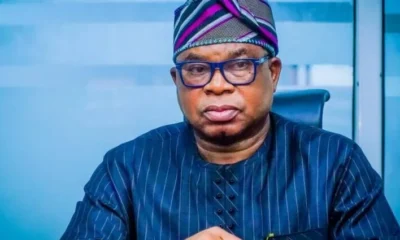
Lagos State Deputy Governor, Dr Kadir Obafemi Hamzat has called on Nigerians to shun religious discrimination and entrench love in their respective communities, irrespective of ethnic group or religious faith.
Hamzat made the call, while speaking at the 7th National Discourse of The Companion, an association of Muslim men in business and the professions, in Lagos.
The Deputy Governor who was the Special Guest of Honour at the event, noted that if for instance, Islam and Christianity preach tolerance and love to neighbours, religion should not be used as a tool to discriminate among people.
Against this background, Hamzat emphasized the need for Nigerians to make deliberate efforts to build a stronger national identity that transcends ethnic, religious and cultural differences.
Speaking directly on the theme of the Discourse: “Nigeria’s Political Landscape and The Ethno-Religious Divides” the DG again stressed that the country’s political system should find effective ways to accommodate its diverse identities without allowing them to undermine national unity.
In his words, ethnic and religious identities remain deeply rooted in the country’s social and political space, noting that the challenge was not to eliminate those identities, but to prevent them from becoming instruments of division.
He said: “The question that sociologists have not told us is how we marry our culture and democracy, without losing our identity and putting it into our democratic setting.
“And I think that will be the issue for us. As Nigerians, we must learn to accommodate our differences while we are also promoting a common national identity. The experience of other multi-ethnic societies showed the dangers of allowing identity and class differences to fuel conflict among us”.
Hamzat advocated greater religious tolerance and adherence to the core teachings of Islam and Christianity, urging citizens to respect the faith of others, rather than use religion as a basis for discrimination.
He emphasised the importance of culture in strengthening national unity and enjoined Nigerians to preserve their cultural heritage while building a common identity.
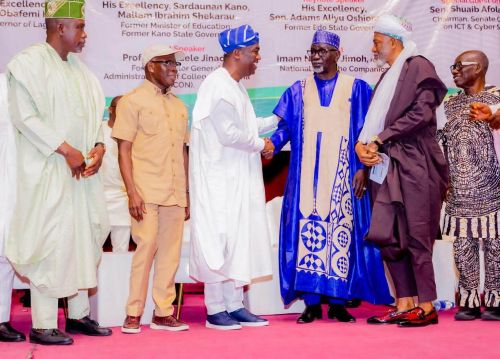
Also speaking at the exercise, which was held at the University of Lagos main auditorium, former Edo State Governor, Senator Adams Oshiomhole stressed that if Nigeria should move forward, the citizens, especially, the youth must de-emphasise religious and ethnic differences.
The Senator who is representing Edo North Senatorial District also called on Nigerians to discard ethnic and religious divisions and build a nation, where leadership is determined by competence, ideas and values, rather than place of birth or religious affiliation.
Oshiomhole added that ethnicity and religion should not be used as tools for political mobilisation or to shield leaders from accountability.
The Senator reasoned that Nigeria’s diversity should be regarded as an asset capable of driving national development, rather than a source of division, affirming that in a society where citizens are treated fairly irrespective of ethnicity, religion or place of birth, there will be national development.
“Our ethnicity shouldn’t be a source of challenge. It should give us all of the things that we need to be the greatest country, not only in Africa but in the world. This ethnicity is very dysfunctional. Nobody should be rewarded or punished on account of an accident of birth. Ethnicity has very little or no role to play, except to function as a tool in the hands of a segment of the political elite who substitute ethnicity in place of ideas,” Oshiomole stated.
While urging political leaders and citizens to embrace a broader sense of Nigerian identity, the Lawmaker said the country’s abundant human and natural resources could make it one of the greatest nations in Africa and the world if properly harnessed.
In his welcome address, the national Amir of The Companion, Imam Nojeem Jimoh explained that the group’s National Discourse is aimed at generating ideas towards addressing issues of national concern, adding that the approach always adopted is to assemble experts and other high stakeholders on topical issues of national concern, to brainstorm and share ideas with the government and the public with a view to proffering solutions to identified national problems.
On factors that prompted the theme of the just concluded Discourse, Jimoh recalled that the year 2026 marks the 60th anniversary of the first military coup in Nigeria.
“Six months after this ugly incident, there was a counter coup – with each of these terrible experiences carrying an ethnic and a tribal identity. Our nation has not recovered, nor has the nation healed, from that experience of 60 years’ ago. It is in the light of this that we thought to take advantage of our National Discourse to re-examine the dividing lines among us as Nigerians” the Amir pointed out.
The Companion stated further: “It is not by accident that the chairman of today’s occasion is a Muslim from the North, the Keynote Speaker a Christian from the Niger Delta and Guest Speaker a Yoruba from the Southwest. It is also not by chance that we have amongst us today household names in the nation’s political machinery.
“Mallam Shekarau was both a state Governor and former minister. Senator Oshimhole was a State Governor and ranking member of the National Assembly. And I’m sure no one here needs to be reminded that Comrade Oshiomhole was a union leader of repute. After all, these are the people who dictate the moods of the nation. These are the people whose body language the citizens observe and from which we take our cues.
“As Amir of this noble association, I am particularly delighted that we have gathered today to interrogate a subject that touches the very foundation of our national existence: “Interrogating Nigeria’s Democracy in the Context of Multiple Diversity.”
“I use the word “interrogating” deliberately. We are not here merely to celebrate democracy. Neither are we here to condemn it. We are here to question it, examine it, challenge it, and hopefully understand how it can work better for all Nigerians. That, in my view, is the essence of a mature democracy.
“Nigeria is a remarkable country. We are a nation of enormous diversity-ethnic, linguistic, religious, cultural, regional, economic and social. Our diversity is one of the things that make Nigeria fascinating and potentially very powerful. But it also presents us with one of the greatest challenges of nation-building. How effectively does our democracy manage that diversity? This is a difficult question which we must ask. And the answer to this and other questions is the reason we are gathered today”.
Amir Jimoh restated that the goal of every Nigerian should be a democracy in which citizenship is stronger than primordial identity, adding that not because ethnicity, religion or culture should disappear – no, they will not, insisting that “our identity must provide the larger umbrella under which all these identities can peacefully coexist.”


Fire damages 140 vehicles at Gatwick car park (Photos)

Mom and 2-year-old daughter k!lled by lightning

Adult, betting, AI websites dominate Nigerian web traffic in July – Report

Tinubu flags off N295.9b Ibadan-Ijebu Ode Road dualisation

Democracy: Hamzat, Oshiomhole, Shekarau, others urge Nigerians to avoid ethnic, religious discrimination

Adeleke disburses N500m to victims of election violence

KASU-ASUU: Kaduna govt approves N300m earned allowance, sets up committee

 Investigation3 days ago
Reality star Kim Zolciakâs 15-year-old son KJ Biermann arrested for sod0my and s£xual battery
- News2 days ago
Police rescue 13 abducted passengers in Benue
- Investigation2 days ago
Rolex, Range Rover: BBNaija star Sheggz flaunts âLuxury Lifestyleâ after being called âbrokeâ for allegedly owing ex-girlfriend Bella Okagbue N11 million
- Investigation3 days ago
President Tinubu orders arrest, suspends three perm secs as ICPC uncovers fake agency
- Investigation3 days ago
Troops arrest suspected female gunrunner, recover AK-47 rifle and magazines in Plateau
- News3 days ago
Death toll rises to 65 in Sokoto boat mishap
- News2 days ago
Tinubu unveils APC 2027 presidential campaign council, appoints Yari DG
- Politics2 days ago
Osun Poll: Oyebamiji meets Tinubu, sues for peace