News
Experts Warn Nigerians About Hidden Danger in Everyday Meat

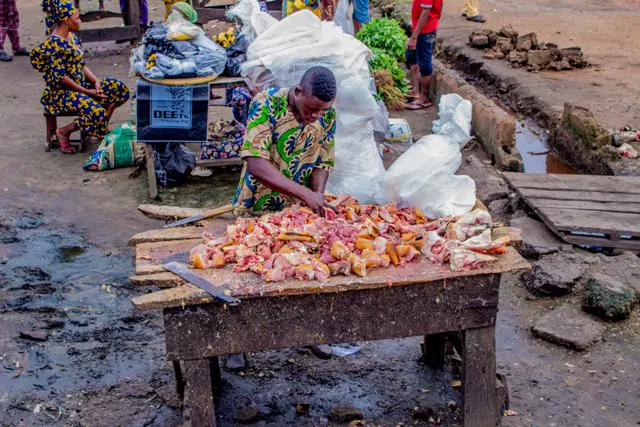
(Nigerian Abattoirs. Photo by Vangaurd News)
Meat from livestock is one of the main sources of protein in Nigeria, but the way animals are being slaughtered and processed at abattoirs has become a serious danger to public health.
Nigeria has millions of cattle, sheep, goats, pigs and poultry birds, representing huge economic value.
However, the abattoirs where these animals are killed have become major sources of disease-causing bacteria and germs.
According to experts, many Nigerians die from food poisoning linked to meat or contract serious illnesses from improperly processed meat, though people often don’t realize the connection.
A former head of the Nigerian Veterinary Medical Association said the situation is a national emergency that nobody is talking about.
He explained that butchers often ignore proper veterinary procedures and stick to dangerous traditional practices instead.
As a result, Nigerians unknowingly buy and eat meat contaminated with tuberculosis, brucellosis, salmonella, E. coli and parasites, along with harmful chemical residues.
While these diseases may not k!ll immediately, they damage the body, harm organs and shorten lifespans.
Another expert noted that about 90 percent of animals killed at Nigerian abattoirs are infected because they come from unsanitary environments.
Only about 10 percent of animals raised in controlled, managed conditions remain disease-free. Free-range animals are particularly risky.
Experts say the problems include diseased animals being slaughtered without proper inspection, weak checks after the animal is d£@d, dirty conditions, contaminated water, poor waste handling, unsafe meat transportation and lack of protective equipment for workers.
Many abattoirs operate informally with no real oversight.
Experts recommend that Nigeria strengthen abattoir management through better laws and regulation at all government levels.
Veterinarians should lead slaughterhouse operations instead of leaving it to untrained butchers.
Workers need proper training in food safety and health practices. Abattoirs need modern facilities with clean water, waste treatment and disease monitoring systems.
Most importantly, a regulatory agency should be stationed at every abattoir to inspect animals before and after slaughter to ensure only safe meat reaches the market.








Kano water rehabilitation projects to be completed by December — Commissioner

Ex-Bosnian Serb warlord, Ratko Mladic d!es in prison at 84

UEFA threaten legal action against FIFA president Gianni Infantino over World Cup sell-off plan

Gov. Sani approves N810m startup grants for 4,050 Kaduna skills graduates

Abducted 2-year-old boy rescued in Cross River

Neurosurgeons in London perform first successful AI-assisted operation to remove brain tumour

Three k!lled as tricycle rider clashes with touts over N200 in Lagos

 Investigation2 days ago
Former BBNaija star Ike Onyema issues warning amid photographer David Martins and wife Alicia Daniellaâs drama; claims that gospel singer Neon Adejo flirted with Alicia
- Investigation2 days ago
K!ller Robots could target humans â UN and Red Cross warn
- Investigation2 days ago
Kano man opens fire at neighbourâs wedding ceremony over loud music, k!lls one guest and injures four others
- Investigation2 days ago
Judge rejects Ghislaine Maxwellâs bid to throw out conviction for aiding Jeffrey Epstein s3xually abuse teenage girls
- Society1 day ago
Government Of Ghana Declines MTN’s GH¢20 Million Donation For Victims Of South African Xenophobic Attacks
- Investigation3 days ago
âNot every relationship needs to be revisited. Learn your lesson and move onâ â Actress Ireti Doyle advises
- National3 days ago
Nigeria’s envoy to India presents letters of credence
- National3 days ago
Lagos gives ultimatum to occupants of public setbacks