News
Kano Cuts Private School Tax From 15% to 5%

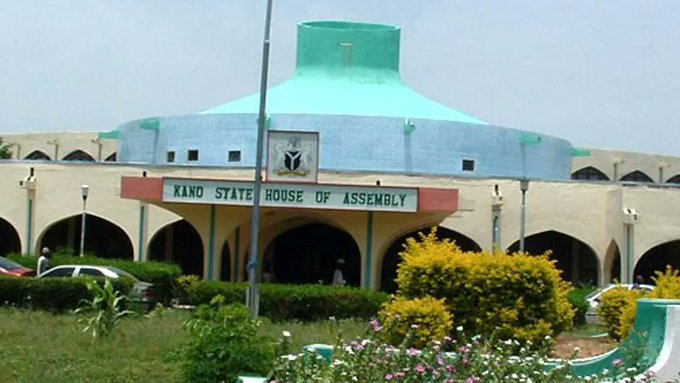
(Kano House of Assembly. Photo Credit: Leadership News)
In order to lessen the financial burden on parents, the Kano State House of Assembly amended the Kano State Private and Voluntary Institutions Board Law by reducing the tax and charge on private schools from 15% to 5%.
After being reviewed by the Committee of the Whole and read three times, the bill was approved yesterday at a plenary session led by Speaker Rt. Hon. Ismail Falgore.
The lawmakers explained that the reduction became necessary because the high taxes imposed on private school operators were often passed on to parents in the form of higher school fees.
Speaking to journalists after plenary, the majority leader of the House, Lawan Husseini, said the amendment also bars private primary and secondary schools from unilaterally raising tuition.
He explained that under the new law, any proposed fee increase must first be discussed and approved by the school’s Parent-Teacher Association, and that any approved increase must not exceed 10 per cent of the existing fee.
He further explained that the bill also seeks to curb excessive charges for external examinations, including the West African Senior School Certificate Examination, the National Examinations Council examination, and the National Board for Arabic and Islamic Studies examination.
Under the amended law, private schools are only permitted to charge a maximum administrative mark-up of 10 per cent above the official examination fees set by the relevant examination bodies.
Husseini stated that the legislation further makes it mandatory for all private schools in the state to comply with the government’s approved academic calendar regarding resumption dates and holidays.
He also noted that the bill stipulates that the Executive Secretary of the Kano State Private and Voluntary Institutions Board must be a retired or experienced educationist who attained at least Grade Level 14 to 16 in the public service.
He maintained that the amendments were introduced to ease the financial burden on parents, improve transparency in the operations of private schools, and strengthen regulatory standards across the education sector in Kano State.





Kano Assembly passes bill to limit private school fee hikes

Ukraine and Russia exchange attacks after ‘seven killed on beach’

Davido Reveals His Family’s Decades Long Foreign Education Tradition

Osimhen Turns Down Galatasaray Captain Armband During Friendly

Comedian Mazi Okeke cries out after fiancée allegedly cheated on him despite sponsoring her through University and building house for her parents (video)

Reforms: Tinubu deserves praise, not condemnation — Shettima

INGRA urges Kogi govt to prioritise mass transit, water supply, sanitation

 Investigation3 days ago
Tinubuâs government is bent on winning elections by all means – Bishop Onaiyekan
- Investigation2 days ago
âPsychicâ IT worker sacked for telling female colleague they already met âin his dreamsâ
- Investigation2 days ago
âPeople smugglersâ arrested after Moroccan migrants were caught trying to enter Spain on jet ski
- Investigation2 days ago
Fubaraâs political mistake was that he tried to build his own structure – Wike
- Investigation2 days ago
âSopranosâ Actor Vincent Pastore found dead at his home aged 80
- Investigation2 days ago
Donât politicise insecurity – Governor Radda
- Society3 days ago
BREAKING: Benue Catholic Diocese announces abduction of seminarian
- Investigation2 days ago
2026 Commonwealth Games: Team Nigeriaâs silver medal downgraded to bronze