Breaking
Nigeria can’t build $1trn economy without women’s participation – Shettima

Advertisement
Advertisement
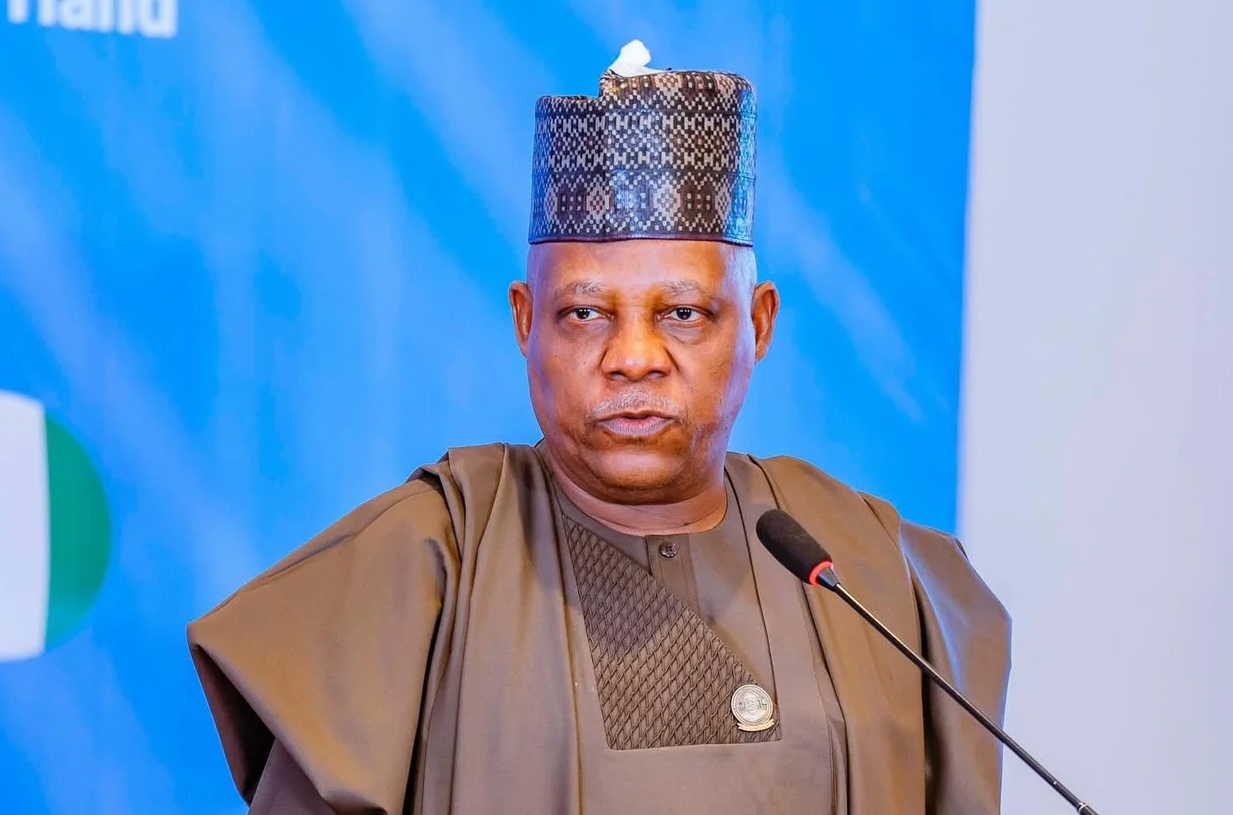
Vice-President Kashim Shettima says Nigeria’s ambition to build a one-trillion-dollar economy cannot be achieved without the full economic participation of women.
Mr Shettima said this on Wednesday in Abuja during the Second National Gender Inclusion Conference, #SheIsIncluded 2026, held at the conference hall of the Presidential Villa.
The vice-president was represented by the Special Adviser to the President on Special Duties, Dr Aliyu Modibo.
The conference, organised by the Presidential Committee on Economic Inclusion in the Office of the vice-president, was themed, “Designing for Delivery: From Financial Inclusion to Economic Transformation for the Nigerian Woman”.
Mr Shettima insisted that the one-trillion-dollar economic ambition of President Bola Tinubu’s administration would not be achievable without women’s participation in the nation’s economy.
“We have set our sights on a one-trillion-dollar economy. But what kind of economy can we build if half of our people cannot participate fully in creating it?” he said.
The vice-president outlined measures to move women from financial exclusion to productive economic participation.
He said only 47 per cent of Nigerian women had formal financial accounts, compared with 58 per cent of men.
Mr Shettima described the disparity as millions of women whose businesses lacked access to affordable capital and whose entrepreneurial potential remained largely untapped.
He said evidence showed that Nigeria’s economic output could be significantly higher if women participated equally in the economy.
He insisted that investing in women was a growth strategy, not an act of charity.
“The question is no longer whether we can afford to invest in women; it is whether we can afford not to. Our answer is no!” he declared.
He said the federal government was moving from policy declarations to an “architecture of delivery” through initiatives designed to connect women and young people to skills, capital and markets.
Mr Shettima cited the National Income Activation Initiative and the Women in Energy Partnership with the World Bank, among the initiatives.
According to him, it is positioning women to participate as entrepreneurs, engineers, investors and leaders in the energy transition.
Mr Shettima, however, cautioned against measuring progress through national averages alone, saying aggregate figures could conceal the continued exclusion of women in rural communities.
He challenged policymakers and programme implementers to identify who was being reached, who remained excluded, what interventions were working and who should be held accountable when programmes failed.
“That is the difference between announcing inclusion and governing for it,” Mr Shettima said.
He urged financial institutions, fintech companies, investors and development partners to treat gender-intentional finance as a viable market rather than concessionary charity.
“Women’s enterprises are demand; their savings are capital; their ideas are innovation,” he added.
He challenged state governments to measure success not merely by the number of women enrolled in programmes but by businesses expanded, jobs created and households whose resilience improved.
“Inclusion must be measured by changed lives, not attendance registers,” he said.
The vice president also demanded stronger accountability, insisting that every commitment from the conference should have an owner, a measurable target and a deadline.
He said successful interventions should be tracked, reviewed and scaled through mechanisms including the proposed National Gender and Financial Inclusion Awards.
Earlier, the Minister of Women Affairs and Social Development, Imaan Sulaiman-Ibrahim, affirmed that one-trillion-dollar ambition would remain incomplete unless women were fully integrated into the economic transformation agenda.
Sulaiman-Ibrahim identified poor last-mile delivery, unsuitable lending models, inadequate gender-disaggregated data, insecurity and unpaid care work as major barriers to women’s economic participation.
The minister disclosed that the Nigeria for Women Programme Scale-Up had expanded its women’s affinity-group model to 4.5 million women organised into 300,000 groups nationwide.
She said under the first phase, more than 560,000 women were mobilised into over 26,000 groups, saving more than N4.9 billion of their own resources and accessing about N15.6 billion in livelihood grants.
For his part, Technical Adviser to the President on Economic and Financial Inclusion, Dr Nurudeen Zauro, provided a clear outline of the government’s new delivery strategy.
Mr Zauro announced four platforms aimed at transforming financial inclusion into measurable economic participation.
He identified the platforms as digital trust infrastructure, data for accountability, blended finance and the National Income Activation Initiative.
Citing Economic and financial inclusion data, Mr Zauro said Nigeria’s overall financial inclusion rate stood at 74 per cent of adults, but a nine-percentage-point gender gap persisted.
According to him, the disparity in formal access stood at 11 percentage points.
He said the challenge was no longer simply getting women to open bank accounts, but ensuring that access translated into affordable credit, productive finance, enterprise growth and increased income.
“A woman may hold an account and still lack affordable credit; receive a loan and lack a market; own a business and lack the records or collateral to scale it.
“Access is the beginning of inclusion; it is not its destination,” he said.
NAN reports that the high point of the open-day session was the unveiling of the National Income Activation Initiative, delivered in partnership with the Federal Ministry of Women Affairs.
It is an initiative aimed at converting inclusion into income through skills acquisition, markets, digital tools, finance and business support.
Also, Mr Zauro led the Vice President and other dignitaries to the exhibition centres showcasing the innovations of the ShesIncluded initiative.
NAN


Atiku to Tinubu: Account for N30tr subsidy windfall now

Plateau: MACBAN raises alarm over alleged killing of 13-year-old herder by security operatives

FEC approves Bill to decriminalise attempted suicide

âI have not sold anyoneâs catalogueâ â Dapper Damm addresses claim in his new statement

Military pensioners protest in Abuja over benefit adjustments

Nigeria can’t build $1trn economy without women’s participation – Shettima

Over 100 bags of human faeces found in Abia residential building

 Investigation3 days ago
Osun election proves voters can beat rigging â Pat Utomi
- Investigation3 days ago
Osun election: No political deal with Tinubu â Adelekeâs camp replies Festus Keyamo after he remarked âAgreement is agreement.â
- Investigation3 days ago
âIâm tired of the bâ¬@ting, the l!es and the abus⬠in this marriage. I cannot take it anymoreâ â Nigerian woman shares video allegedly showing husband ass@ulting her
- National3 days ago
Vehicles: Lagos prohibits daily use of dealer plates
- National3 days ago
Kebbi 2027: Governor replaces deputy as running mate
- Politics3 days ago
Cameroon win first WAFCON title
- Politics3 days ago
AAU, Ekpoma Alumni protest election outcome
- News2 days ago
Many feared dead as gunmen attack Plateau community