Breaking
‘Which Atiku should Nigerians believe?’, Presidency tackles ex-VP over subsidy U-turns

Advertisement
Advertisement
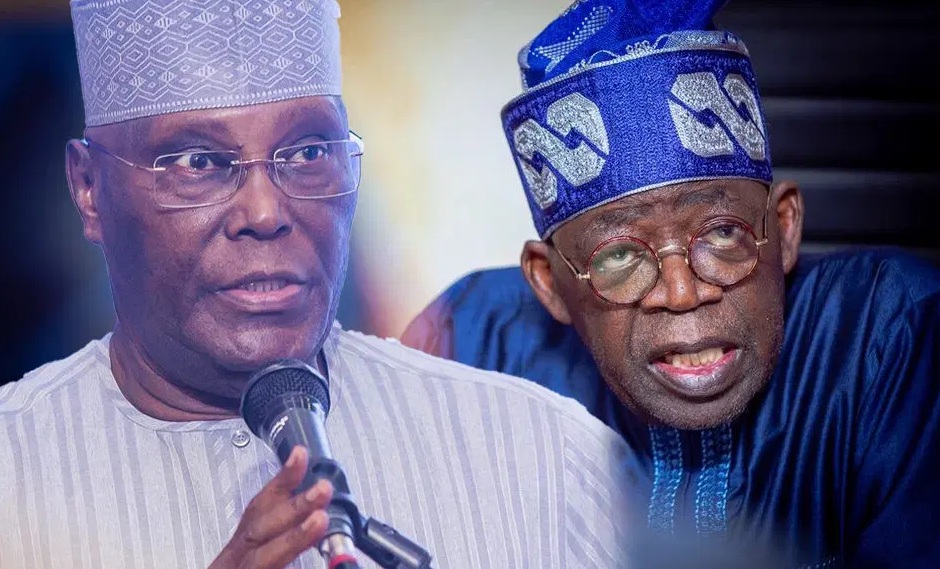
The Presidency has accused former Vice-President Atiku Abubakar of sending conflicting messages on petrol subsidy, describing his latest position as the “third U-turn” on the policy within one week.
Special Adviser to President Bola Ahmed Tinubu on Information and Strategy, Bayo Onanuga, made the accusation in a statement titled, “Atiku confused on petrol subsidy; third U-turn in one week shows he is simply playing politics.”
Mr Onanuga said the former vice-president’s conflicting statements had raised questions about whether he had a coherent economic policy on petrol subsidy or was merely attempting to exploit Nigerians’ current economic difficulties for political gain.
According to him, Atiku’s spokesperson, Paul Ibe, initially said Atiku would restore petrol subsidy if elected president and subsequently phase it out.
Mr Ibe had described the proposed subsidy as a temporary intervention aimed at giving Nigerians and businesses time to recover from economic pressures.
However, Onanuga said another senior aide to Atiku, Phrank Shaibu, later described Ibe’s statement as an “unauthorised and misleading characterisation” of the former vice-president’s position.
Mr Shaibu, according to the Presidency, said Atiku would not set a predetermined date for ending the subsidy but would retain it until domestic refining capacity expanded, fuel supply stabilised, competition deepened and the market could deliver affordable prices without government intervention.
“Then, just hours later, Atiku himself intervened and effectively overruled that clarification. He insisted that his position ‘has not changed’ and that he would restore what he called a ‘targeted subsidy’ if elected president,” Onanuga said.
Mr Atiku was quoted as saying: “I will restore targeted subsidy and put purchasing power back in the hands of Nigerians.”
The presidential aide argued that the conflicting explanations could not be dismissed as semantics, insisting that Nigerians deserved clarity on the former vice-president’s proposed petroleum policy.
“If Atiku’s position has not changed, why did one of his principal aides say the subsidy would be temporary and phased out? Why did another senior aide have to publicly disown that explanation and introduce a completely different framework based on market conditions? And why did Atiku then step in to reaffirm the original position?” he asked.
Mr Onanuga said Nigerians needed a clear and costed economic programme rather than what he described as “policy by trial and error.”
He also challenged Atiku’s argument that restoring petrol subsidy would automatically ease the cost-of-living crisis, saying pump prices were influenced by several factors beyond government subsidy.
According to him, international crude oil prices, exchange rates, refining costs, transportation, distribution and other market factors all contribute to the final price of petrol.
“Competition can improve efficiency and margins, but it cannot magically insulate Nigeria from global crude oil prices or other input costs,” he said.
Mr Onanuga also rejected what he described as an oversimplification of the relationship between petrol prices and food inflation.
He acknowledged that energy and transportation costs affect food prices but argued that petrol prices were not the sole cause of rising food costs.
He listed agricultural productivity, insecurity, exchange rates, logistics, storage, flooding, input costs, money supply and supply constraints among other factors affecting food prices.
“A serious economic programme must address these factors, as President Bola Ahmed Tinubu has been doing for the past three years, rather than reduce the entire cost-of-living crisis to petrol prices,” he said.
The presidential aide challenged Atiku to explain what he meant by “targeted subsidy” and provide details on its cost, beneficiaries, funding mechanism and conditions for its eventual termination.
“We therefore urge Atiku to stop shifting positions and explain precisely what he means by ‘targeted subsidy’: how much will it cost, who will benefit, how will beneficiaries be identified, how will it be funded, and what objective economic conditions will determine its eventual termination?” Onanuga said.
He warned that Nigerians could not afford what he described as another “opaque and potentially costly subsidy regime dressed up in new language.”
Mr Onanuga further defended the Tinubu administration’s decision to remove petrol subsidy, arguing that the policy had significantly improved government finances and helped stabilise the macroeconomic environment.
“The former vice-president should be honest with Nigerians: either he has a coherent, costed, and workable petroleum policy, or he is simply playing politics with a policy that has significantly restored fiscal health to the three tiers of government and stabilised the macroeconomic environment,” he said.
He also criticised Atiku’s argument that his proposed subsidy would “follow the barrel of crude,” questioning how such a policy would account for the other products generated from crude oil refining.
“Atiku says his subsidy will follow the barrel of crude. Is he aware that refined petrol only constitutes 45 per cent of the by-products of a refined barrel of crude?” Onanuga asked.
He said a barrel of crude also produces products such as aviation fuel, kerosene and diesel, which have been deregulated at various times.
According to Onanuga, diesel accounts for roughly 25 per cent of a refined barrel and was deregulated in 2004 during the administration in which Atiku served as vice-president.
He said jet fuel and kerosene account for about nine per cent of the barrel, adding that kerosene and jet fuel were deregulated in 2009, while subsidies were removed in 2016.
Mr Onanuga further said about 10 to 15 per cent of a barrel produces base ingredients used in manufacturing synthetic rubber, nylon, polyester and plastics, while asphalt accounts for about two to four per cent.
Hydrocarbon gas liquids, including propane and butane, account for about four per cent, while lubricants and waxes constitute about one to two per cent, he added.
He questioned whether Atiku’s proposed subsidy would extend to all the products derived from crude oil.
“Will Atiku subsidise all these by-products of the barrel as well, since kerosene is used by the underprivileged to cook, and many homes and factories use diesel to power generators and delivery trucks?” Onanuga asked.
He also questioned whether refineries receiving discounted crude under Atiku’s proposed policy would be allowed to profit from the other products derived from the same crude while government support focused on petrol.
“And will he allow the refineries he will supply discounted crude oil to profit from 55 per cent of the by-products, while focusing subsidy only on petrol, his obsession?” he asked.
Mr Onanuga concluded by accusing the former vice-president of lacking sufficient understanding of the petroleum economics underlying his proposed subsidy policy.
“The former Vice President is definitely suffering from a lack of basic understanding of his newfound policy prescription,” he said.


Gov. Sani approves N810m startup grants for 4,050 Kaduna skills graduates

Abducted 2-year-old boy rescued in Cross River

Neurosurgeons in London perform first successful AI-assisted operation to remove brain tumour

Three k!lled as tricycle rider clashes with touts over N200 in Lagos

Walson-Jack bows out as head of service, hands over battle to Enitan

Ghanaian woman d!es in China after collapsing at airport

Mali singer Salif Keita cancels South Africa shows over xenophobia concerns

 Investigation2 days ago
Former BBNaija star Ike Onyema issues warning amid photographer David Martins and wife Alicia Daniellaâs drama; claims that gospel singer Neon Adejo flirted with Alicia
- Investigation2 days ago
K!ller Robots could target humans â UN and Red Cross warn
- Investigation2 days ago
Kano man opens fire at neighbourâs wedding ceremony over loud music, k!lls one guest and injures four others
- Investigation2 days ago
Judge rejects Ghislaine Maxwellâs bid to throw out conviction for aiding Jeffrey Epstein s3xually abuse teenage girls
- Society1 day ago
Government Of Ghana Declines MTN’s GH¢20 Million Donation For Victims Of South African Xenophobic Attacks
- Investigation3 days ago
âNot every relationship needs to be revisited. Learn your lesson and move onâ â Actress Ireti Doyle advises
- National3 days ago
Nigeria’s envoy to India presents letters of credence
- National3 days ago
Lagos gives ultimatum to occupants of public setbacks