News
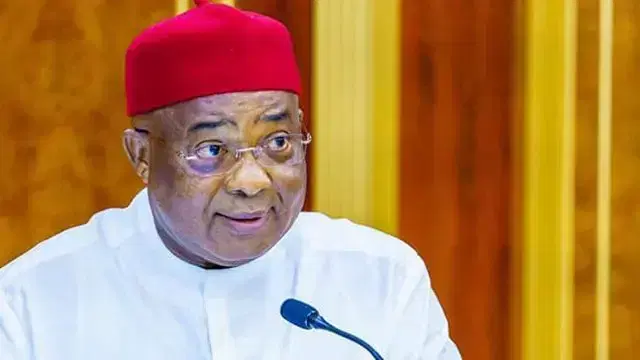
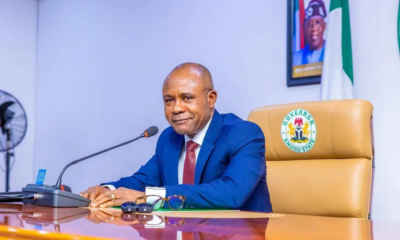
Uzodinma, an exemplar of democracy dividends

By Chioma Chigozie
There are moments in the life of a people when governance ceases to be a mere constitutional obligation and becomes an urgent rescue mission. Such moments demand more than political rhetoric; they demand vision, courage, stamina, and the rare capacity to confront decay without becoming overwhelmed by it. In many ways, that was the defining reality of Imo State on January 15, 2020, when Senator Hope Uzodinma took the oath of office as governor.
The Imo he inherited was psychologically exhausted. Public confidence in governance had thinned dangerously. The civil service was deeply demoralised, infrastructure had deteriorated alarmingly, and institutions that should inspire public trust appeared weakened by years of uncertainty and administrative drift. Across the state, there was a palpable sense of disillusionment among citizens who had long yearned for purposeful leadership and measurable progress. Yet leadership is often best revealed, not in moments of comfort, but in periods of institutional fatigue. Rather than become consumed by the enormity of the challenges before him, Uzodinma chose a different path — one anchored on bold reconstruction, strategic governance, and long-term developmental thinking. Six and a half years later, the results of that choice have become increasingly difficult to ignore. His administration’s 3-R agenda — Rehabilitation, Reconstruction and Recovery — was initially viewed by some as another political mantra destined to dissolve into familiar governmental abstractions. What has distinguished Governor Uzodinma era, however, is the deliberate attempt to translate policy language into visible governance outcomes. Across critical sectors, Imo State is undergoing transformations that now define the administration’s governing signature.
Perhaps the clearest evidence of this transformation lies in infrastructure development. In a country where abandoned projects often stand as monuments to failed promises, the completion of landmark projects in Imo under Governor Uzodinma has altered both the physical and psychological landscape of the state.
The iconic Assumpta Twin Flyover, for instance, has become more than an architectural statement. It represents a practical response to urban congestion and economic mobility within the capital city. By easing vehicular movement and facilitating the flow of goods and services, the project reflects a deeper understanding of infrastructure as an economic catalyst rather than a cosmetic exercise. Modern economies are built on mobility, efficiency, and connectivity. The flyover advances all three.
Equally significant is the activation of the Orashi Electricity Power Plant project, particularly its first phase which now guarantees uninterrupted electricity supply to public institutions within the state capital. In a nation where energy deficits remain one of the greatest obstacles to development, this achievement carries enormous strategic implications. Stable electricity is not merely about illumination; it is about productivity, digital growth, security, healthcare efficiency, and investor confidence.
Beyond physical infrastructure, one of the most consequential dimensions of the administration has been its push toward digital governance. Long before many subnational governments began to seriously contemplate digital transformation, Imo State positioned itself as an early mover through the establishment of the Ministry of Digital Economy and E-Government — the first of its kind in Nigeria. That decision reflected a recognition that governance globally is increasingly driven by technology, data systems, innovation ecosystems, and digital accessibility.
The establishment of the Imo Digital City further reinforces this vision. In an era where knowledge economies are rapidly overtaking resource-dependent models, governments that fail to prepare their populations for technological integration risk condemning future generations to economic irrelevance. By prioritising digital infrastructure and innovation, the Uzodinma administration is attempting to position Imo beyond conventional governance patterns and into the architecture of the future economy.
This explains why the successful hosting of the Imo State Investment and Economic Summit was particularly important. The summit did more than attract investors and foreign dignitaries; it projected a new narrative about the state. Investment capital gravitates toward environments where there is evidence of planning, stability, and administrative seriousness. Imo, under Uzodinma, appears to be pursuing a deliberate investment-oriented identity — one that seeks to transform the state from a passive federal allocation recipient into an active economic destination.
Critics may argue, understandably, that governance should never be assessed solely through infrastructure projects or investment conferences. They would be correct. The true measure of leadership ultimately lies in how governance improves the everyday lives of ordinary citizens. Yet even within that broader standard, there is an undeniable connection between visionary infrastructure, institutional reforms, economic planning, and human development outcomes. Roads expand commerce. Electricity stimulates productivity. Digital systems improve efficiency. Investment creates opportunities. What perhaps distinguishes Uzodinma most is the governing philosophy underpinning these initiatives. There appears to be a conscious effort to move governance away from performative politics toward measurable development. Whether in road infrastructure, digital policy, urban renewal, or economic planning, the administration has consistently projected the idea that public office must produce visible public value. That philosophy has not gone unnoticed nationally. In 2021, Uzodinma received The Sun Newspaper’s Governor of the Year Award, largely tied to his developmental strides and leadership approach. More recently, on April 11, 2025, he was honoured with Vanguard Newspaper’s Infrastructure Governor of the Year Award, further reinforcing the growing perception of his administration as one heavily defined by infrastructural renewal and developmental ambition. Awards alone do not validate leadership. Results do. But in democratic governance, recognition often emerges when visible outcomes begin to shape public perception beyond partisan boundaries. No administration is immune from criticism, nor should any democracy encourage blind adulation. Governance remains an evolving process with continuing expectations from citizens. However, fairness also demands acknowledgement when leadership demonstrates clarity of purpose, strategic direction, and implementation capacity. In the case of Imo State, the developmental trajectory under Uzodinma increasingly suggests an administration attempting to redefine governance through continuity of vision and tangible execution.
History is rarely kind to leaders who merely occupy office. It remembers more vividly those who leave behind enduring evidence that power was used to expand possibilities for their people. And in a nation where citizens have become accustomed to promises that evaporate after elections, perhaps the greatest political statement a leader can make is to build systems, structures, and progress that continue to speak long after the applause has faded.
•Chioma writes from Owerri.
The post Uzodinma, an exemplar of democracy dividends appeared first on Vanguard News.
Full Details Here...


Fuel subsidy removal saved Nigeria from bankruptcy — Tinubu

NRM picks cleric Olorunmagba as Reps candidate for 2027

2027: Aisha Yesufu denies dropping out of FCT senatorial race

Mbah’s ‘Tomorrow Is Here’ agenda yielding results in Enugu — Nwaokobia

Airport heist: How syndicates target, loot passengers’ luggage
Medical report: Trump's doctor declares him 'fully fit' but 'should lose weight'

Windstorm kills businesswoman, destroys homes, roads in Benue community

 Breaking2 days ago
Last-minute power game deepens as Kwankwaso plans to unveil Comrade Abdussalam as Kano NDC governorship candidate
- News2 days ago
Your phone has an expiry date – here’s how to find it
- News2 days ago
Full list of Samsung phones that will get the Android 17 update
- Breaking3 days ago
A prayerful man who doesn’t cheat and lie – Nigerian acid attack survivor reveals what she wants in a partner
- Politics3 days ago
Governor Okpebholo Reaffirms Commitment to Child Protection at 2026 Children’s Day Celebration
- Breaking2 days ago
Matthew Perryâs assistant who is accused of concealing evidence allegedly drove the late actorâs car at 4AM shortly after his de@th
 Politics3 days ago
Omo-Agege quits APC amid Delta crisis
- World2 days ago
Marco Rubio says no more Ebola patients will be allowed into U.S.