World
A 2200-year-old Chinese four-lane highway discovered buried in the mountains, revealing a lost Qin dynasty megaproject

This Video Is Trending Right Now
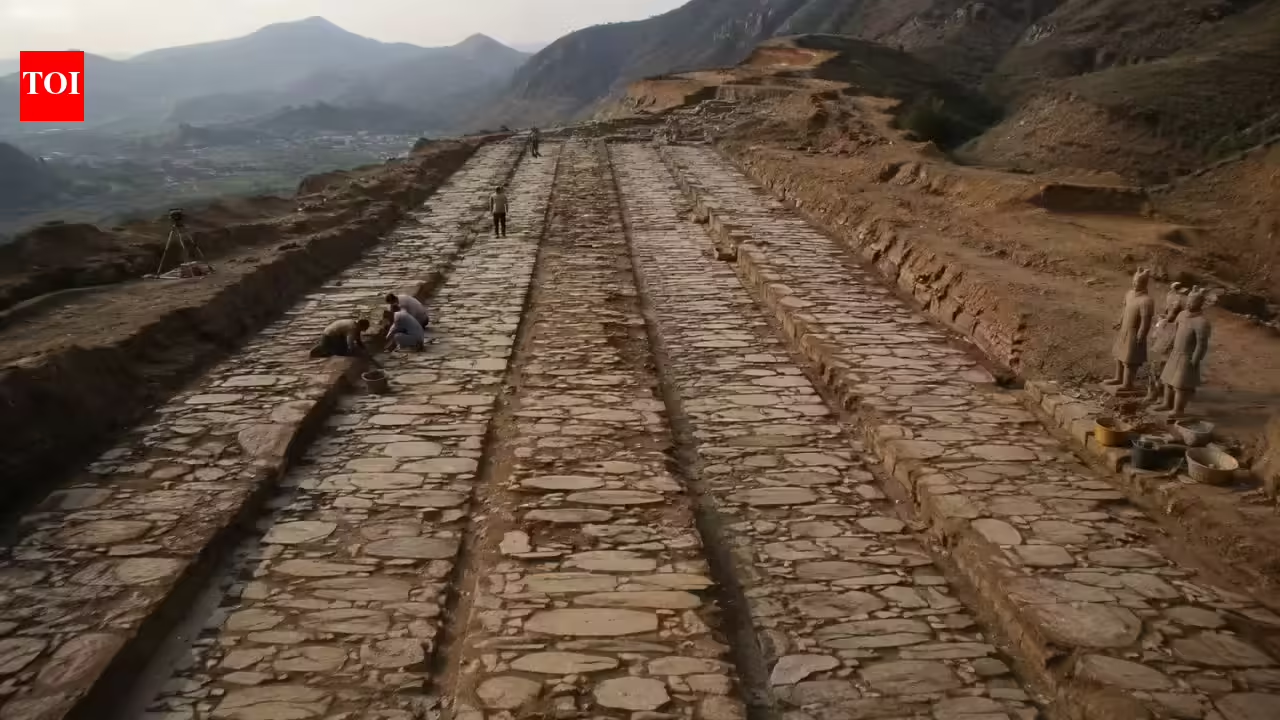
In northwest China’s Shaanxi province, a 13-kilometre stretch of the Qin Straight Road is forcing archaeologists to redraw parts of one of antiquity’s most ambitious transport systems. The corridor, built more than 2,200 years ago under the Qin dynasty, is often described as a “four-lane highway,” a comparison that captures its width but not its intent, as reported by The South China Morning Post.The newly documented section was identified during a survey led by the Cultural Heritage Protection and Research Institute of Yulin, with fieldwork supported by satellite imaging that picked up faint linear disruptions across reforested and semi-desert terrain. On the ground, archaeologists confirmed nine aligned trench cuts, rammed-earth layers, and compacted surfaces still traceable after millennia of erosion and land use change.What emerges is not just a road fragment, but a reconstructed piece of a nearly 900-kilometre imperial artery linking the Qin heartland near modern Xi’an with frontier zones near present-day Baotou in Inner Mongolia.
Archaeologists uncover the ancient “straight-line” megaproject that shocked engineers
The Qin Straight Road was constructed during the reign of Qin Shi Huang, following the unification of the warring states in 221 BCE. Historical accounts, particularly those preserved by historian Sima Qian, attribute the project to imperial orders aimed at securing rapid military access to the northern frontier.That frontier was defined by repeated conflict with the Xiongnu, whose mobility forced the Qin state to rethink how distance itself could be controlled. Rather than follow natural contours, engineers pursued directness at scale. The road connected Xianyang near modern Xi’an with Jiuyuan, now Baotou, passing through the broader Yulin region in Shaanxi province.
What new excavation data reveals
Reportedly, excavation data from the newly identified section reinforces what ancient texts already suggested but could not prove at scale. This was not a road that adapted to the terrain. Archaeologists documented:
- Rammed-earth slope reinforcements
- Compacted roadbeds
- Trench-style passes cut through elevated terrain
- Valleys deliberately filled to maintain alignment
- Consistent straight-line orientation across uneven topography
Rammed earth is central to understanding durability. By compacting soil in successive layers, builders created a dense, stone-like foundation capable of supporting repeated heavy traffic without modern binding agents.The road’s width, generally around 40 meters and expanding in places to 60 meters, adds another layer of interpretation. It was not built for lane discipline but for parallel movement, with military columns, supply carts, mounted couriers, and administrative convoys operating within a controlled corridor.
The 13-kilometre discovery and how it was found
The latest segment was identified through a combination of historical mapping and remote sensing. Researchers compared older survey data with modern satellite imagery, looking for linear anomalies in areas where vegetation patterns diverged from natural formations.Field verification confirmed:
- Nine continuous trench sections aligned in a straight axis
- Compact soil layers consistent with engineered roadbeds
- Trampled surface zones indicating sustained traffic use
- Slope stabilisation structures embedded into hillside cuts


INEC Warns Court Rulings Could Disrupt 2027 Election Timetable, Files Appeals

Why we appealed ruling on 2027 election timetable — INEC

Belfast unrest: Starmer condemns anti-immigrant violence after knife attack, vows action against rioters

Oyo Community Gets Relief Support After Abduction Tragedy as Search for Victims Continues

EPL: Man Utd announce six players leaving club this summer [Full list]

Human Rights Lawyer Demands Independent Probe into Atsar Sesugh’s Death, Calls for EFCC Reforms

N5bn suit: Obi should ask me if he needs money to campaign – Okonkwo

 National2 days ago
Exclusive: Inside Union Bank’s Boardroom Storm And Crumbling Bank, MD Yetunde Oni Acquires N1.9 Billion US Home Barely One year in Office
- World2 days ago
Russia burning as Ukraine launches massive attack with 'more than 50 explosions'
- Breaking2 days ago
I was forced to sleep with 20 men daily – 18-year-old Benue girl recounts escape from s3x traffickers in Mali
- Breaking2 days ago
"Before HIV vs living with HIV" – Man writes as he shares his photos before and after HIV diagnosis
- World2 days ago
Horror as woman gang raped in field after being knocked unconscious
- World1 day ago
Pope Leo denounces what he calls "scourge" of sexual abuse by Catholic clergy
- Breaking3 days ago
Netizen claims newly wedded woman declared missing in Abuja left her matrimonial home after discovering her husband has two children with different women
 National3 days ago
SCOAN Marks TB Joshua’s 5th Anniversary, Says “He’s With The Saints”