Society
How PHCs are driving child immunisation in hard-to-reach Bauchi communities


For years, reaching children with life-saving vaccines in many rural communities across Nigeria has been a daunting challenge. Poor roads, long distances to health facilities, inadequate healthcare infrastructure, and deep-rooted misconceptions about immunisation have often left children vulnerable to preventable diseases.
But in some of the country’s hardest-to-reach communities, Primary Healthcare Centers (PHCs) are steadily changing that narrative.
In Bauchi State, the experiences of Gamsha Primary Health Care Centre in Bilkicheri Ward of Itas/Gadau Local Government Area and Beli Primary Health Care Centre in Beli Ward of Shira Local Government Area illustrate how frontline health facilities are expanding access to immunisation services and protecting children against deadly diseases despite significant operational challenges.
These facilities, though separated by geography, share a common mission, ensuring that every child, regardless of where they are born, receives the vaccines needed to survive and thrive.
Taking vaccines where children live
In Gamsha, a remote community that also serves patients from neighbouring Jigawa State, accessing healthcare can be difficult, particularly during the rainy season.
According to the facility manager, Fatima Umar Adam, health workers and residents often cross three rivers to reach the community.
Despite the difficult terrain, routine immunisation services continue uninterrupted.
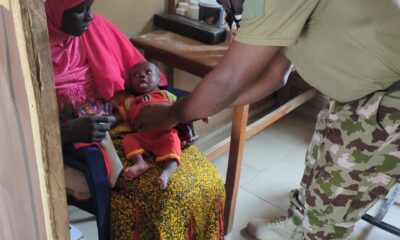
Tribune Online reporter, who visited the centre, learnt that the facility conducts weekly fixed immunisation sessions and two outreach visits every week to ensure children in surrounding settlements are not left behind.

Continuing, Adam said the introduction of an immunisation incentive programme about five years ago transformed vaccine uptake in the community.
“Before the intervention, we were recording fewer than 20 children for immunisation in a month. Today, we record more than 100 children monthly. The programme encouraged mothers to complete their children’s immunisation schedule, especially the measles vaccine at nine months,” she said.
Under the initiative, caregivers receive financial incentives at different stages of a child’s immunisation journey, helping to improve compliance and reduce dropout rates.
The result has been a significant increase in vaccine coverage and stronger protection against childhood diseases.
Winning the battle against vaccine hesitancy
In Beli, health workers say one of their greatest achievements has been overcoming vaccine resistance that once undermined immunisation efforts.
Awalu Umar, who works as the Facility Manager, told our reporter that acceptance improved after residents witnessed the consequences of refusing vaccination.
“There was a time when some families rejected vaccines. But people began to notice that vaccinated children remained healthy during outbreaks while unvaccinated children became seriously ill,” Umar said.

He recalled instances where children whose parents refused vaccination developed severe complications from vaccine-preventable diseases.
“Some of the unvaccinated children suffered tetanus-related convulsions, which people here call Kankamo. These experiences changed many minds. Today, parents understand the value of immunisation because they have seen the difference themselves,” he said.
The change in attitude has contributed to major public health gains.
According to Umar, no confirmed case of polio has been recorded in the area in the last five years.
“Diphtheria was a major concern in some settlements about two years ago, but the outbreak was successfully contained. Cases of measles have dropped significantly, and child malaria has reduced drastically,” he said.
Traditional leaders say the impact has been evident across the community.
Mallam Shirama Mohammed, who spoke to this reporter on behalf of the District Head of Beli, Alhaji Muhammed Babangida Beli, credited routine immunisation with improving child health outcomes.
“Routine immunisation has helped eliminate polio, measles and chickenpox from our communities. Parents now understand that prevention is better than cure,” he said.
Reaching children beyond the clinic walls
For health workers, vaccinating children extends far beyond those who visit health facilities.
Many settlements served by the two PHCs are located far from the centers, requiring outreach teams to travel long distances to deliver vaccines.
At Beli PHC, routine immunisation is conducted twice weekly, while outreach services target communities located more than two kilometers from the facility.
Similarly, Gamsha PHCC deploys outreach teams twice a week to ensure children in remote settlements receive routine vaccines.
These outreaches often involve transporting vaccines under strict temperature-controlled conditions to maintain their potency.
The effort is particularly important in communities where transportation costs and distance discourage regular visits to health facilities.
Former Beli PHC manager, Hajia Fatima Muhammed, while speaking about the growing barriers to healthcare access, blamed them on economic hardship.
“Transportation costs have increased significantly. In some communities, the cost of travelling to the health facility is now a bigger challenge than the cost of treatment itself,” she said.
To bridge the gap, health workers increasingly rely on community mobilisation and outreach activities to bring services closer to families.
Technology helping to keep vaccines safe
A critical component of successful immunisation programmes is maintaining the vaccine cold chain. Without proper storage temperatures, vaccines lose their effectiveness.
At both facilities, solar-powered systems have become essential tools for preserving vaccines.
Tribune Online gathered that Gamsha PHCC now benefits from uninterrupted solar electricity and a solar-powered water system installed following the facility’s revitalisation.

The upgrade has improved vaccine storage conditions and enabled health workers to provide services around the clock.
At Beli PHC, a solar inverter system has similarly strengthened service delivery despite the absence of a functioning public electricity supply for more than a decade.
These investments have reduced dependence on unreliable power sources and improved the facilities’ ability to store and administer vaccines safely.
Building trust through community engagement
Community trust remains one of the most important ingredients of successful immunisation programmes.
At both facilities, health workers work closely with traditional leaders, community volunteers, and religious figures to educate families about the importance of vaccination.
The approach appears to be yielding results.
In Beli, years of sustained engagement have helped dispel myths and misconceptions surrounding immunisation.
Parents who once hesitated to vaccinate their children are now said to be among the strongest advocates for routine immunisation.
The transformation demonstrates how trust-building can be as important as vaccine availability in improving coverage.
Challenges remain
Despite the progress, significant challenges persist. Both facilities face severe staffing shortages.
At Gamsha PHCC, only four personnel currently manage the entire facility, including immunisation, maternal health, record-keeping, and outreach activities.
This reporter gathered that the centre also lacks a dedicated vehicle for emergency referrals and outreach services, relying instead on a borrowed ambulance that is often unavailable or unserviceable.
At Beli PHC, shortages affect nearly every department, including pharmacy, laboratory, and monitoring units.
Broken ambulances, transportation constraints, and inadequate manpower continue to place pressure on health workers striving to sustain immunisation gains.
Nevertheless, staff remain committed to reaching every eligible child.
Protecting the next generation
The experiences of Gamsha and Beli PHCs highlight the central role of primary healthcare facilities in Nigeria’s immunisation programme.
In communities where rivers, poor roads, and poverty often stand between children and healthcare services, frontline health workers are ensuring that lifesaving vaccines reach those who need them most.
Their efforts are yielding tangible results: increased immunisation uptake, reduced outbreaks of vaccine-preventable diseases, declining child mortality risks, and growing community confidence in modern healthcare.
For Fatima Umar Adam, the success of immunisation programmes in Gamsha is reflected in the growing number of mothers who now bring their children for vaccination, while Awalu Umar believes that the disappearance of diseases that once threatened children’s lives is a big win.
Together, their stories demonstrate that while challenges remain, primary healthcare centers continue to serve as the backbone of child survival efforts in rural Nigeria.
And in communities such as Gamsha and Beli, that work is helping to ensure that more children live long enough to celebrate their first birthdays, attend school, and fulfill their potential.
Nigeria’s battle against zero-dose children
The progress recorded at the Beli and Gamsha Primary Health Care Centers reflects a broader national effort to improve childhood immunisation coverage and reduce the number of children left unprotected against vaccine-preventable diseases.
According to UNICEF, Nigeria has made notable gains in routine immunisation in recent years, contributing to improved child survival and better health outcomes. However, the country still carries one of the world’s largest burdens of “zero-dose” children—those who have never received a single routine vaccine.
Data from WHO and UNICEF estimate that Nigeria had about 2.3 million zero-dose children in 2022, making it one of the countries with the highest number of unvaccinated children globally. Although recent interventions have led to improvements, the figure remains above two million.
Many of these children live in remote, underserved, and conflict-affected communities where access to healthcare is limited by poor infrastructure, insecurity, poverty, and vaccine hesitancy.
The challenge is particularly pronounced in northern Nigeria, where difficult terrain, long distances to health facilities, and socio-cultural barriers continue to affect vaccine uptake.
To address the problem, the National Primary Health Care Development Agency (NPHCDA), with support from UNICEF, Gavi, and other partners, has intensified outreach programmes targeting hard-to-reach settlements and communities with large numbers of unvaccinated children.
Recent WHO and UNICEF estimates indicate gradual improvements in routine immunisation coverage, including increased uptake of Pentavalent, Measles, and BCG vaccines. The federal government has also prioritised reducing the number of zero-dose children through targeted interventions in high-burden local government areas.
The experiences of Gamsha and Beli demonstrate how these national strategies are being translated into results at the community level.
Through routine immunisation sessions, outreach services, community engagement, and improved vaccine storage systems, the two facilities are helping to close immunisation gaps among children living far from urban centers.
For many families in these hard-to-reach communities, the regular arrival of vaccinators represents more than a health service. It provides children with protection against diseases that once claimed countless young lives and offers them a better chance of reaching adulthood healthy and thriving.


Nigerian man arraigned for allegedly defrauding Australian investor of AUD$8.4m, US$3.6m

How the Supreme Court ruled on Trump's agenda this term

Supreme Court upholds state transgender athlete bans in girls' and women's sports

World Cup 2026: Stay humble – Didier Deschamps to Mbappe, other France stars

Consumers need protection from AI agents, lawmaker says

Actress Cara Delevingne admits she dated Amber Heard during Johnny Depp divorce

Atiku urges Tinubu to sack Gbajabiamila, probe alleged N400 million PFIPC bribe

 Breaking2 days ago
UNBELIEVEABLE: Video of A Fat Wife Beating And Flogging Her Slim Husband Sparks Debate Online Among Couples and Youths
 Breaking1 day ago
Forget about body count. Sometimes itâs better to marry a lady who has gone into the world and experienced life than to marry one who hasnât- Nigerian doctor’s advice to men sparks debate online
- Investigation2 days ago
âThe Islamic Republic of Iran will no longer exist!â Trump threatens amid fragile ceasefire
- Investigation2 days ago
Emerging facts points to his innocence – Harrison Gwamnishu shares update on man brutally beaten after being accused of N2m theft in Enugu
- Investigation2 days ago
Iran vows to unleash âhellâ on US bases after fresh attacks as Trump warns regime will âno longer existâ if war restarts
- Investigation2 days ago
ISWAP fighterâs wife surrenders to troops with her two-month-old baby in Borno
- Investigation2 days ago
Former MLB star Gorkys Hernandez’s wife d!es in Venezuela earthquake
- World1 day ago
Iran launches strikes targeting Bahrain, Kuwait, threatens "complete halt" to talks