National
NGO Trains CSOs On Reporting To Strengthen Anti-Trafficking Data Systems -By Prosper Okoye (Abuja)

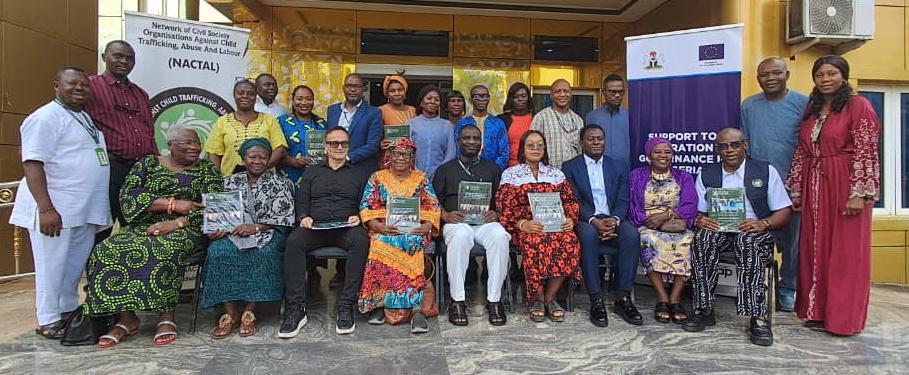
Participants At The Event
The Foundation for the Internationalization of Public Administration (FIAP) conducted a three-day Learning Lab for members of the Network Against Child Trafficking, Abuse and Labour (NACTAL) aimed at strengthening monitoring, evaluation and reporting on human trafficking in Nigeria.
The training, held in Keffi, Nasarawa State, forms part of Component Three of the European Union-funded Support to Migration Governance in Nigeria project, which focuses on improving Nigeria’s response to trafficking in persons (TIP) and smuggling of migrants (SOM), building on existing capacities and cooperation to prevent, protect and prosecute.
FIAP, a Spanish public foundation working across more than 100 countries, said the initiative was designed to close gaps in reporting and ensure that the work of civil society actors is properly reflected in national and international anti-trafficking data systems.
Speaking on the sidelines of the workshop, FIAP’s Deputy Team Lead, Javier Leon, said the training was developed in response to identified needs within partner networks, including NACTAL and government agencies such as the National Agency for the Prohibition of Trafficking in Persons (NAPTIP), the Nigeria Police and the Nigeria Immigration Service.
“This training is part of our work plan. We work with our partners to identify gaps and design activities that respond to those needs,” Leon said.
He said weak reporting systems had continued to limit the visibility of anti-trafficking interventions despite ongoing efforts by civil society and government actors.
Leon, a seasoned Spanish police investigator who worked on trafficking cases involving Nigerian victims and traffickers before his deployment to Nigeria, said poverty remained a major driver of irregular migration across Africa, warning that many migrants underestimate the risks of irregular journeys.
“Many people believe that opportunities abroad will automatically provide a better life, but the reality is more complex,” he said.
He called for strengthened safe and legal migration pathways alongside efforts to address economic pressures driving irregular migration.
NACTAL National President, Abdul Ganiyu Abubakar, said the training was aimed at improving members’ capacity to use nationally approved reporting tools for trafficking in persons.
He said poor documentation had contributed to the underreporting of civil society efforts in national and international assessments, including the U.S. Trafficking in Persons report.
“If we do not capture these interventions properly, we cannot present a realistic picture of the situation,” he said.
Abubakar said school abductions were also increasing children’s vulnerability to trafficking, adding that disruptions to education expose children to recruitment by traffickers.
“When schools are closed or children are at home, they become vulnerable. We must strengthen preventive measures,” he said.
NACTAL National Secretary, Osita Osemene, commended FIAP for supporting the strategic learning lab saying long-standing gaps in monitoring and evaluation had affected CSO reporting effectiveness.
“We are very happy with this support. It addresses a long-standing capacity gap in monitoring and evaluation,” he said.
A trainer, Eric Umoru, said the programme focused on improving members’ understanding and use of national trafficking reporting tools to ensure that CSO activities are properly documented and reflected in official data systems.
He said while CSOs were actively engaged in anti-trafficking work, weak reporting structures had limited the visibility of their contributions.


Update: Police arrest 20-year-old woman for k!lling her grandmother with wooden chair in Katsina

Zimbabwe Mandates ESG Compliance for Miners: Access to Markets and Investment Now Contingent on Sustainability

FIFA extends South Africa’s Themba Zwaneâs World Cup ban

Kano Govt hails Nigerian Navy Logistics College for producing skilled personnel

Barau seeks revocation of Kano-Gwarzo-Dayi road contract over poor performance

ADC knocks APC for celebrating Abuja judges’ housing project

Alexx Ekubo laid to rest in Abia amid tears

 News16 hours ago
Bandits Strike Under Rain Cover, Kill 2 and Make Shocking Abductions in Sokoto
- Investigation2 days ago
Dad, are you also leaving us? Congolese man married to South African woman addresses xenophobic individuals after his son’s heartbreaking question
- World2 days ago
Horror as woman 'gang-raped by men with handmade weapons' who 'dragged her from home'
- Investigation3 days ago
"Anytime Yul Edochie appeared on TV, Judy would tell me she loved him" â Actress Judy Austin’s ex-husband breaks down, shares marriage photos
- National3 days ago
A’Court Upholds N197m Damages, Awards 20% Interest Against Nigerian Bottling Company Over Obanikoro’s Crash
- Investigation1 day ago
Actor IK Ogbonna leads mourners as Alex Ekubo’s body arrives his hometown Arochukwu ahead of his funeral (videos)
- World2 days ago
Trump slams Israel, praises Iran at G7 summit
- News1 day ago
Abdulsalami Says Nigeria Could Have Been Better Off If Buhari and Idiagbon Stayed Longer