National
Nigerian govt, security forces leaving gaps for criminal networks, illegal miners to fill: Reps

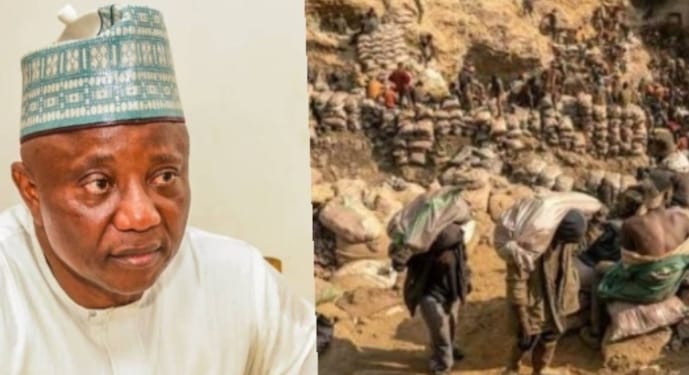
The House of Representatives Ad Hoc Committee on Mineral Exploitation, Security and Anti-Money Laundering has called for stronger collaboration to curb illegal mining and financial crimes nationwide.
Committee chairman Sannio Abdulraheem (APC-Kogi) made the appeal on Monday during a stakeholders’ workshop on Extractive Industry Governance in Abuja.
Mr Abdulraheem blamed weak enforcement, organised criminal activities and money laundering for undermining the country’s extractive industry and preventing citizens from benefiting from valuable mineral resources.
“That gap has a name: illegal mining, weak enforcement and the laundering of proceeds that should belong to the Nigerian people. It is a gap filled by criminal networks, revenue leakages and security threats that have turned some mineral-rich communities into dangerous territories,” he said.
He urged the Federal Ministry of Solid Minerals Development and the Nigeria Mining Cadastre Office to provide licensing and regulatory information supporting the committee’s investigations.
The lawmaker also requested that security agencies, including the Nigeria Security and Civil Defence Corps and the Mining Marshals, identify operational challenges requiring legislative intervention.
He appealed to the Nigerian Financial Intelligence Unit and the Economic and Financial Crimes Commission to intensify efforts against illicit financial flows linked to illegal mining.
Mr Abdulraheem urged state governments and traditional institutions to monitor mining activities within their communities and promptly provide credible intelligence to relevant authorities.
He reaffirmed the committee’s determination to ensure that Nigeria’s mineral resources deliver sustainable national development rather than enriching criminal networks through unlawful exploitation.
According to him, the committee was established to investigate illegal mineral exploitation, trace illicit financial flows, assess the security of mining communities, and recommend comprehensive regulatory reforms.
He disclosed that relevant agencies had already appeared before the committee, while summons were issued where necessary to obtain critical information.
“We do this not out of confrontation, but out of conviction because oversight without candour achieves nothing. Reform without accurate information is guesswork dressed as policy,” he added, stressing the importance of transparency and cooperation from relevant institutions.
Mr Abdulraheem emphasised that ending illegal mining required coordinated action involving federal and state governments, security agencies, financial intelligence institutions, traditional rulers, mining operators and civil society organisations.
NSCDC commandant-general Ahmed Audi advocated establishing a special court to accelerate the prosecution of illegal miners nationwide.
Represented by Mining Marshals commander, Attah Onoja, Mr Audi described illegal mining as a major driver of insecurity, organised crime and illicit financial flows. According to him, the marshals have arrested more than 671 suspects since 2024, while 397 have already been charged before competent courts.
Mr Audi said enforcement operations had shut illegal mining sites, strengthened compliance with mining regulations and contributed to a 337 per cent increase in mining revenue.
He called for funding to procure drones, CCTV surveillance systems, a national mining situation room, better logistics and additional personnel.
Mr Audi urged lawmakers to provide stronger legislative backing and adequate resources to sustain ongoing efforts against illegal mining and safeguard Nigeria’s mineral wealth.
(NAN)


US Firm Warns Tinubu After Briefing Trump Administration on PFIPC Scandal

Peter Obi Hints 2031 Presidency Bid May Be Unlikely

“He was punching me”: Ria Jalesa accuses Beyoncé’s nephew Julez Smith of hotel assault, says she was left with bruises

Mother-of-One in UK Died by Suicide After Year-Long Mental Health Struggles

Lai Mohammed remembers Buhari as patriot, compassionate leader

Supreme Court Directs Counsel To Upload Case Documents For September To December 2026 Appeals Via Online Management System

South African football star Jayden Adams’ father declines to address su!cide reports as Police investigate sudden passing

 National2 days ago
At Last, Fresh Video Showing How Some Of The Terrorists Was Arrested During Rescue Of Oyo Schoolchildren Emerged [WATCH HERE]
- Investigation18 hours ago
Each and every one of you is guilty РDanish aid worker Anja Ringgren Lov̩n slams Nigerians filming malnourished child accused of being a witch in viral video
- News2 days ago
Army officer killed during rescue of kidnapped Oyo pupils, teachers buried
- Investigation2 days ago
Please help poor Nigerians. The burden is heavy on government – First lady, Remi Tinubu appelas to Davido, Asake, Burna Boy (video)
- News3 days ago
Keyamo gives Obi 1-week to apologise, pay ₦25,000 airport parking fine
- Investigation3 days ago
Taylor Swift paid $160,000 for New York Wedding permit â New York Mayor
- Investigation2 days ago
Become a presidential candidate before you challenge me to a debate – Peter Obi replies Minister of Works, Dave Umahi (video)
- Society2 days ago
Yoruba elders alert of plot by Fulani to conquer South-West, rally eminent Nigerians