World
Coming Soon to the Asia Pacific: A Storm Named Dim-sum

This Video Is Trending Right Now
If you see that a storm named Dim-sum is gathering steam in the Pacific Ocean, it’s not an error.
In June, as the Pacific typhoon season began, the Hong Kong Observatory said it had chosen the city’s bite-sized cuisine as its latest contribution to the list of names for tropical cyclones that form in the Pacific.
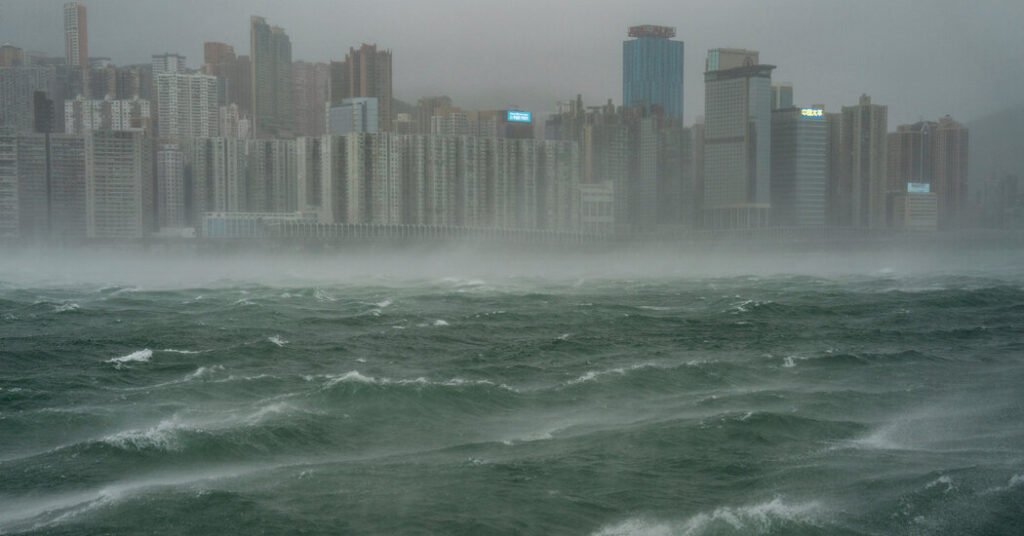
It’s not the first time that Hong Kong has named a storm after a beloved symbol. Typhoon Dolphin, which is forecast to approach Japan and Taiwan this weekend, takes its name from the city’s animal mascot.
The names are compiled by the Typhoon Committee, which was formed in 1968 by the United Nations and the World Meteorological Organization to help Asia Pacific countries prepare for tropical storms. The committee maintains an active list of 140 names, divided into five columns, that it cycles through every four or five years, depending on the frequency of storms.
Each of the committee’s 14 members — including the United States, China, the Koreas, Hong Kong and Malaysia — contributes 10 names. They are drawn from each member’s language and culture, resulting in storms named for animals, plants, historical and mythological figures, and, of course, food.
That means Dim-sum will eventually be joined by typhoons such as Gaeguri (frog, in Korean), Burapha (the Thai word for “east”) and Tirou (a Micronesian greeting), according to the committee’s latest list of names released in March.
Here’s how the system works.
U.S. forecasters started the naming practice.
Tropical cyclones form when warm ocean water, moist air and light winds persist long enough to combine into systems that produce violent winds, large waves and torrential rain. Those that form over the western Pacific Ocean and affect Asia are called typhoons.
During World War II, meteorologists in several Asian countries were prevented from working by occupying Japanese forces because weather forecasts were considered sensitive military intelligence, Rey Lirios, a historian at the Philippine Atmospheric, Geophysical and Astronomical Services Administration, said in an interview. As a result, those countries relied on American military forecasters in the U.S. Pacific territory of Guam.
To distinguish among storms, American forecasters first compiled a list of female names, often drawn from their wives and girlfriends, according to meteorologists. In the 1970s, amid the gender equality movement, the U.S. government began adding male names, according to Lam Chiu Ying, a former director of the Hong Kong Observatory, in a 2017 video interview.
Some naming processes are open to the public.
Members of the Typhoon Committee pushed to replace American names with regional ones in the 1990s. Some opened the process to the public.
“We wanted to leave all of the old names behind in the 20th century,” said Mr. Lirios, who created the criteria for the Philippines’ public submissions in 1999.
He said the Typhoon Committee rejected names that were indecent or carried negative connotations in other languages. Storms also cannot be named for public figures, including politicians and celebrities.
In 2005, the committee rejected two names chosen by the public in Hong Kong. Taichi, the ancient Chinese martial art, could be mistaken as a Japanese man’s name, while Kapok, the cotton tree, sounded like a slang term for sexual organs in some languages, Mr. Lam said.
Dim-sum, by contrast, was uncontroversial. Lui Yuk Sing, a spokesman for the Hong Kong Observatory, said it was selected by the public in 2024, along with Sparrow and Shui-sin, the Cantonese word for daffodil.
The names reflect regional culture.
Aside from Dim-sum and Dolphin, Hong Kong has submitted Banyan, named for the tree, and Lionrock, for a mountain overlooking the city.
The Japan Meteorological Agency said in an email that it typically contributes the Japanese names of constellations, such as Koinu (“puppy,” for Canis Minor) and Koguma (“bear cub,” for Ursa Minor). The committee’s list also includes mythological figures such as the Chinese folk heroine Mulan, the Micronesian nature goddess Sinlaku and the Vietnamese mountain god Son Tinh.
Malaysia submits the names of native flora and fauna that are easy to pronounce, like the Cempaka flower, said Mazly Bin Mohamed, a spokesman for the Malaysian Meteorological Department. Other countries also draw inspiration from nature, including Vietnam’s Ha Long Bay, Thailand’s Khanun (meaning “jackfruit”) and the Philippines’ Mount Amuyao.
Because the Philippines is typically one of the first countries in a typhoon’s path, Filipino meteorologists assign storms a local name, Mr. Lirios said.
For example, Typhoon Jangmi, which caused heavy flooding in the Philippines and Japan in early June, was known in the Philippines as Domeng, a local diminutive of Domingo.
The names of deadly storms are often removed from the list.
Some names are retired after becoming associated with particularly devastating or deadly storms.
The Philippines stopped using the local name Yolanda after the 2013 typhoon that killed more than 6,000 people. The Typhoon Committee retired the storm’s official name, Haiyan, in 2015.
This year, the committee added Dim-sum to the list to replace Man-yi, which was retired after the storm caused more than a dozen deaths in the Philippines in 2024.


Actress Bella Thorne says she can smoke as much weed as rapper Snoop Dogg

Nigerian police to receive specialised training in cybercrime, digital evidence — IGP Disu

Music executive Diddy paid his lawyers $8 million to defend him in criminal case

Infantino should quit as FIFA president – Canadian prime minister Mark Carney

PSC deploys eight CPs, appoints AIG as police academy commandant

Dangote Refinery slashes petrol price by N50, diesel by N80

The joyful, complicated legacy of ‘Graceland’ at 40

 Investigation1 day ago
âWhat kind of brother talks like this?â- Designer, Toyin Lawani slams Jude Okoye over comments about brother Peter’s solo career
- Investigation1 day ago
âI hand over everything to God. You will be in my prayersâ – Jude Okoye responds after brother Peter makes more allegations against him
- Society24 hours ago
Man Claims He Lost ₦1 Million After Using Roadside POS
- Investigation23 hours ago
US firm initiates moves to stop Tinubuâs meeting with Trump at UN General Assembly
- Investigation23 hours ago
2027: Weâll do whatever Tinubu wants us to do at the field â Rotimi Amaechi
- Breaking19 hours ago
"Iâm the mother of a one-year-old, I’m flying her to London for her birthday partyâ â Toke Makinwa says in video
- National16 hours ago
Court freezes WEMPCO accounts as executives face jail over ₦61.45 billion UBA debt
- Investigation2 days ago
âThe Catholic Bishops are conscience of the country. Thereâs difficulty in Nigeria but itâs not the fault of President Tinubu- Senator Orji Uzor Kalu (video)