World
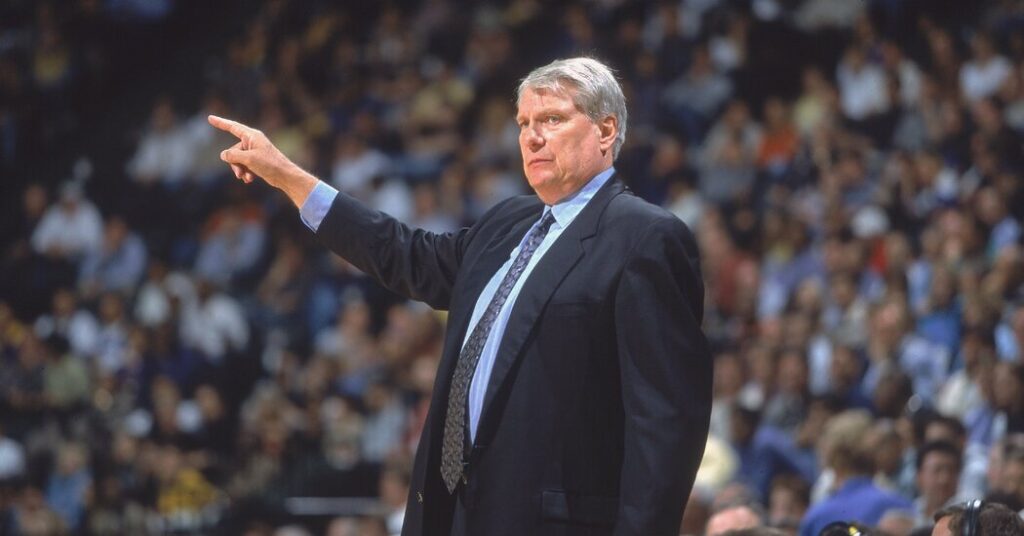
Don Nelson, Hall of Fame N.B.A. Coach and Celtics Star, Dies at 86

This Video Is Trending Right Now
Don Nelson, who won five N.B.A. championship rings as a player with the Boston Celtics and went on to become an innovative and freethinking Hall of Fame head coach and one of the winningest in league history, has died. He was 86.
His death was announced on social media by the Golden State Warriors, a team that Nelson coached for more than a decade across two stints. The announcement did not include any further details.
Nelson, whose N.B.A. playing and coaching careers spanned nearly 50 years, was an unlikely success story, both on the hardwood and on the sideline.
Nellie, as he was called, was an undersized small forward and not particularly fast or athletic; he was twice waived by N.B.A. teams before joining the Celtics in 1965.
But he became an integral part of a Boston dynasty. In his arsenal were a deadly jump shot and a knack for coming off the bench to spark his team. He is most famous as a player for a game-winning basket in the 1969 N.B.A. Finals against the Los Angeles Lakers.
After retiring as a player in 1976, Nelson had barely tossed his sneakers into the closet when Milwaukee Bucks Coach Larry Costello recruited him to be an assistant, though Nelson had never coached at any level before.
But when the 1977 season got off to a 3-15 start, Costello was fired and the Bucks’ owner, Jim Fitzgerald, offered Nelson the top spot.
“I said, ‘Jim, I’m not ready to be a head coach,’” Nelson recalled at his induction into the Naismith Memorial Basketball Hall of Fame in 2012. “And Fitz said to me: ‘Give it a try. If it doesn’t work out at the end of the year, we’ll talk about it.’ Eleven years later, I was still there.”
Nelson spent 31 years as a head coach, leading the Bucks, the Golden State Warriors and the Dallas Mavericks to the upper echelons of the N.B.A. with a total of 1,335 wins. He was named N.B.A. Coach of the Year three times, though his teams never won a championship.
He also briefly coached the New York Knicks to 34-25 to start the 1995-96 season but was fired, he later told The Times, when Patrick Ewing rebelled after hearing that Nelson was seeking to trade him for Shaquille O’Neal.
On April 10, 2010, he passed Lenny Wilkens as the league’s winningest coach. He has since been surpassed by Gregg Popovich, with 1,390 wins.
The point guard Steve Nash said Nelson had an enormous impact on his career when he played for Dallas in the late 1990s and early 2000s.
“He was pivotal,” Nash told Marc Stein of The New York Times. “We had some tough times and a couple tough moments, but over all I look back on Nellie as an absolute beauty. He was just tired of seeing me a little bit meek and sheepish instead of shooting and being aggressive.”
Donald Arvid Nelson was born on May 15, 1940, in Muskegon, Mich. His father was a hog farmer, but when the farm failed, the family moved to Rock Island, Ill., where Nelson started playing basketball at the Y.M.C.A.
“When I first started, I was the guy who never got picked,” Nelson recalled. An inveterate gym rat, he practiced relentlessly and improved enough to star on his high school team and win a scholarship to the University of Iowa.
In Iowa City, he became a third-team all-American and was taken 17th in the 1962 NBA draft by the Chicago Zephyrs (today the Washington Wizards). Waived after his rookie season, he signed with the Lakers, featuring Jerry West and Elgin Baylor, and after two uninspiring seasons was waived again.
In 1965, sitting at home contemplating an uncertain future, Nelson got a call from the Celtics coach, Red Auerbach. “He said ‘Heinsohn just retired,’” Nelson recalled, referring to the Boston all-star Tom Heinsohn. “‘We’re looking for a forward, and we want to give you a tryout.’”
Nelson caught the next plane to Boston and stayed for 11 productive seasons, playing alongside future Hall of Famers like Bill Russell and John Havlicek and winning five championships, the last in his final season, 1975-76.
A crowd favorite, Nelson was cheered for his accurate pull-up jump shots, his potent up-fakes and his unique shotput-style foul shots. His number, 19, was retired in 1978 and hangs from the rafters of the TD Garden in Boston alongside those of other Celtics greats.
“Nellie was a complete product of his times in his style of play,” the veteran sportswriter Bob Ryan said in an interview. “He was a clever forward, knew all the tricks of the trade and was a sneaky offensive rebounder.”
Ryan, who covered the Celtics for The Boston Globe during much of Nelson’s time with the team, noted that Nelson was a “pure jump shooter” who, at 34 in 1974, led the N.B.A. in field goal percentage at 53.9 percent, an unheard-of accomplishment in an era of slam-dunking big men.
“Ninety percent of his shots were foul line jumpers,” Ryan said.
Nelson nailed his most famous shot in the seventh game of the 1969 N.B.A. finals against the heavily favored Lakers. The Celtics were clinging to a one-point lead with just over a minute remaining when Keith Erickson of the Lakers knocked the ball out of Havlicek’s hands right into Nelson’s. He launched a jumper from the foul line just before the shot clock expired. The ball hit the back of the rim, went high in the air and came straight down through the net.
The Celtics hung onto the lead and won the title on the Lakers’ home floor.
Nelson had his best years as a Celtic after Bill Russell and Sam Jones retired in 1969. As the team rebuilt, Nelson became a starter and was a steady presence and mentor to young players like Dave Cowens and Jo Jo White, who led the franchise back to its customary championship perch. The Celtics won titles in both 1974 and 1976.
Nelson, who was inducted as a coach into the Hall of Fame in 2012, was adept at taking moribund teams and building winners. He was one of only two coaches in N.B.A. history to win 300-plus games with three different teams.
He also coached the United States team to a gold medal at the 1994 FIBA World Championships. His one coaching regret was the short, unpleasant stint with the New York Knicks in 1996.
Nelson favored flamboyant outfits and unconventional strategies. He is credited with creating the “point forward” concept, in which a small forward instead of a guard directed the offense. He employed the fast-breaking, small-ball approach, which was called “Nellie Ball” by reporters.
In his first of two stints at Golden State, for example, he created the fast-breaking “Run-TMC” teams starring Tim Hardaway, Mitch Richmond and Chris Mullin.
He was an early advocate for foreign-born players, though he called his son, Donny, the actual pioneer based on his playing amateur ball around the world. In 1999, Dirk Nowitzki, a German forward, became Nelson’s signature draft pick for the Mavericks and the N.B.A.’s first European-born superstar.
Near the end of his coaching career with the Warriors in 2009, he insisted on drafting a spindly guard from Davidson College named Stephen Curry. Curry went on to win multiple M.V.P. awards and lead the Warriors to several titles.
In a 2016 essay in The Players Tribune, Nelson assessed his playing and coaching careers. “Fifty years ago, a wise man said something to me that I never forgot: ‘We are going to play fast,’” Nelson wrote, referring to Auerbach.
He noted how Auerbach, despite the 1960s being called the “Decade of the Big Man,” decided to speed up the pace of the game, use smaller, more versatile players, and run opposing teams off the court.
“All my success as a coach is shared with my many assistant coaches, training staff members and players,” he wrote. “But without Red Auerbach teaching me the mechanics of running the fast break, none of it would have been possible. He deserves all the credit for Nellie Ball, and for how fast the game is played today.”
Nelson’s survivors include his wife Joy. Complete information on survivors was not immediately available.
During his coaching career, Nelson began buying up real estate on Maui, Hawaii, and he and his wife retired to the small town of Paia where he smoked cigars, played poker with island neighbors like Willie Nelson, Woody Harrelson and Owen Wilson, and grew marijuana he used for medicinal purposes.
Alex Traub contributed reporting.


FG deploys special guards to protect Lagos-Calabar highway

APC beats INEC deadline, uploads all candidates for 2027 elections

Police release Osun commissioner after 24 hours in detention

Osun election: ADC’s Salaam not in alliance with any party, will contest to win — Aregbesola

5,091 killed in three months, Tinubu’s scorecard is soaked in blood — Atiku

Sanwo-Olu congratulates Grand Khalifa of Tijaniyya at 77
Sanwo-Olu congratulates Grand Khalifa of Tijaniyya at 77

 Society2 days ago
Two Ladies Subjected To Public Humiliation, Forced To Remove Their Drɔss, Clothes And Dance After Being Caught Stealing Bone-Straight Wig
- Investigation2 days ago
Jude is not a good person, I donât know if he used juju on Paul – PSquareâs elder brother, Henry Okoye finally opens up on family feud (video)
- News2 days ago
Two Farmers Abducted in Ondo as Suspects Demand ₦100m Ransom
- Society2 days ago
Man Allegedly Collected GH¢60,000 as a Lawyer, Then Paid a Qualified Lawyer Just GH¢8,000 to Handle the Case
 News2 days ago
Woman Arrested Over Alleged ₦42m Visa Scam Targeting 90 Travellers
- Society2 days ago
I Only Used You, I Never Loved You — Emotional Breakup Message Of Lamine Yamal To His Ex-Girlfriend Surfaces
- News2 days ago
Customs Intercepts ₦362m Worth of Contraband in Adamawa and Taraba
- Investigation2 days ago
Man City reject Barcelonaâs £38.5m bid for Rodri