National
Fuel subsidy removal creates fiscal headroom for development — Information minister

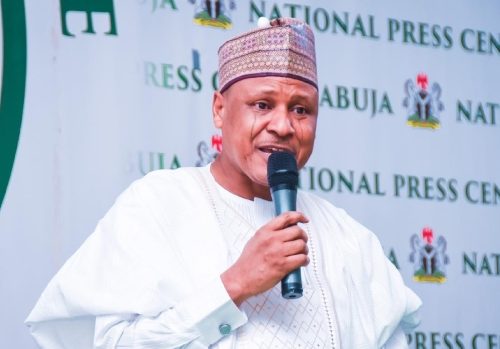
The Minister of Information and National Orientation, Mohammed Idris, says the removal of fuel subsidy has created fiscal headroom for the Federal Government to pursue developmental projects across the country.
Idris stated this on Thursday when he paid an official visit to Gov. Agbu Kefas of Taraba in Jalingo, on the sidelines of activities marking Taraba’s 35 years of existence.
The theme of the anniversary was “Celebrating 35 Years of Unity, Peace and Progress.”
The minister said the administration of President Bola Tinubu had, since assuming office on May 29, 2023, introduced a number of reforms aimed at repositioning the Nigerian economy.
He listed the removal of fuel subsidy and the unification of the foreign exchange market, among others, as major reforms undertaken by the administration.
Idris said Nigeria was facing one of its toughest economic challenges before Tinubu assumed office on May 29, 2023.
The minister said about 27 of the 36 states in the country were at the time unable to pay the salaries and wages of their workers because of the difficult economic situation.
He added that there was also no provision for the continuation of fuel subsidy beyond June 2023 when the President assumed office.
Idris noted that several individuals who had aspired to lead the country had acknowledged the need to address the subsidy regime.
He said Tinubu took the decision to remove the subsidy immediately after assuming office and had remained committed to the reform in spite of the challenges associated with it.
The minister said the removal of the subsidy had provided the federal and state governments with additional fiscal space to undertake developmental programmes.
He said the resources had made it possible for governments at different levels to embark on infrastructure projects and reposition key sectors of the economy.
Idris said Nigerians could see construction and other development projects taking place in different parts of the country as a result of increased fiscal capacity.
He argued that such projects would have been difficult to undertake without the resources generated through the reforms.
The minister also highlighted the Nigerian Education Loan Fund (NELFUND) as one of the flagship programmes of the Tinubu administration.
He said more than 1.2 million young Nigerians had so far benefited from the scheme, enabling them to remain in school in spite of financial challenges.
According to Idris, the Federal Government has not only provided tuition support for beneficiaries but also introduced stipends to help students remain in school.
He said the programme was designed without political, ethnic, religious or geographical discrimination.
Idris explained that applicants were not required to disclose their political affiliation, ethnicity or religion before accessing the education loan scheme.
He said the objective of the President was to ensure that every young Nigerian who had the credentials and desire to pursue education was given an opportunity to do so.
The minister said the policy was aimed at preventing children from being excluded from education because their parents or guardians could not afford school fees.
He also said the foreign exchange reforms had helped to create greater predictability for businesses operating in the country.
Idris recalled that businesses previously faced difficulties planning because exchange rates could change several times within the same day.
He said the situation had made it difficult for entrepreneurs to predict costs and determine the likely outcomes of their investments.
According to him, the reforms have improved stability and provided businesses with a more predictable environment for planning and investment.


Walson-Jack bows out as head of service, hands over battle to Enitan

Ghanaian woman d!es in China after collapsing at airport

Mali singer Salif Keita cancels South Africa shows over xenophobia concerns

‘Which Atiku should Nigerians believe?’, Presidency tackles ex-VP over subsidy U-turns

She was sleeping with my baby daddy. I won’t let her go into the grave with whatâs mine – Woman claims she snatched her wig off her d3ad sister’s head during funeral

YouTuber Chris Sails arrested for allegedly lying to cops about his kids being in danger

Reality show star Kylie Jenner says she wants bigger b00bs

 Investigation2 days ago
Former BBNaija star Ike Onyema issues warning amid photographer David Martins and wife Alicia Daniellaâs drama; claims that gospel singer Neon Adejo flirted with Alicia
- Investigation2 days ago
K!ller Robots could target humans â UN and Red Cross warn
- Investigation2 days ago
Kano man opens fire at neighbourâs wedding ceremony over loud music, k!lls one guest and injures four others
- Society1 day ago
Government Of Ghana Declines MTN’s GH¢20 Million Donation For Victims Of South African Xenophobic Attacks
- National3 days ago
Adeleke disburses N500m to victims of election violence
- Investigation3 days ago
âNot every relationship needs to be revisited. Learn your lesson and move onâ â Actress Ireti Doyle advises
- Investigation2 days ago
Judge rejects Ghislaine Maxwellâs bid to throw out conviction for aiding Jeffrey Epstein s3xually abuse teenage girls
- National3 days ago
Nigeria’s envoy to India presents letters of credence