National
Tinubu administration willing to forge stronger partnership with Catholic Bishops, others — Akume

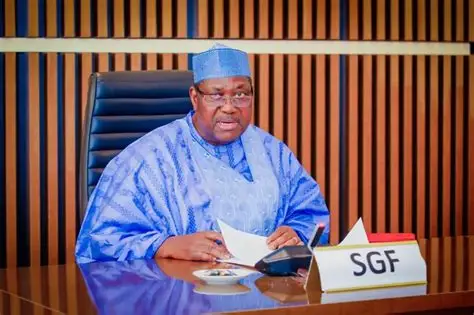
The Secretary to the Government of the Federation (SGF), Senator George Akume, has said the Federal Government believes that many of Nigeria’s pressing challenges can only be addressed through sustained partnership with faith communities, traditional institutions, civil society organisations, the private sector and citizens.
He stressed that constructive engagement is essential to promoting peace, social cohesion and national development.
Akume said the administration of President Bola Tinubu would continue to deepen consultations with the Catholic Bishops’ Conference of Nigeria (CBCN), other faith-based organisations and relevant stakeholders on issues affecting the country.
He maintained that government remains open to honest counsel and would continue to govern with openness, accountability and evidence-based policies.
He also assured that the Tinubu administration is neither seeking nor in support of a one-party state, just as it remains deeply respectful of the independence of the Independent National Electoral Commission, in the spirit of true democracy.
In a statement on the recent engagement between President Tinubu and the leadership of the Catholic Bishops’ Conference of Nigeria, Akume, who personally signed the statement, said the government was also sustaining dialogue and conflict prevention through the Nigeria Inter-Religious Council (NIREC), describing collaboration with religious institutions as indispensable to advancing the national interest.
According to him, “many of the challenges confronting our nation require partnership. Faith communities, traditional institutions, civil society, the private sector and citizens all have indispensable roles to play in promoting peace, strengthening social cohesion and advancing national development. Constructive engagement between Government and these institutions is therefore not only welcome but essential.”
Akume added that, “the Office of the Secretary to the Government of the Federation will continue consultations with the leadership of the Catholic Bishops Conference, other faith-based organisations and relevant stakeholders on the issues raised during the meeting and on areas where greater collaboration can advance the national interest.”
He said the Federal Government had taken note of public reactions following the meeting between President Tinubu and the Catholic Bishops, using the opportunity to reaffirm its profound respect for the Catholic Church and its enduring contributions to Nigeria’s development through education, healthcare, humanitarian services, peacebuilding and moral guidance.
The SGF said government recognised the Church as one of Nigeria’s most important development partners and acknowledged that, like all faith communities, it had both the right and responsibility to speak on issues affecting the welfare of citizens and the country’s future.
He explained that discussions between the President and the Bishops were candid, respectful and constructive, covering concerns relating to security, economic hardship, public services, education, electoral credibility, political pluralism and religious freedom.
According to him, both parties also acknowledged progress made under the administration, including the student loan programme and recent successes by security agencies in securing the release of abducted schoolchildren and teachers.
Akume noted that while there were areas of agreement and differences in assessment, such differences should not be interpreted as a breakdown in mutual respect or detract from the shared commitment to Nigeria’s peace, unity and progress.
On the economy, the SGF acknowledged the hardship facing many Nigerians but described it as a passing phase, insisting that government policies were deliberately designed to confront the country’s challenges through investments in rail transport, the Sokoto-Badagry and Lagos-Calabar superhighways, road construction and rehabilitation nationwide, and the transformation of Abuja’s road network.
He said food security initiatives involving improved agricultural inputs, tractors and institutional support through the National Agricultural Land Development Agency (NALDA) were also being implemented to boost agricultural productivity.
Akume further stated that the administration had pursued improvements in electricity generation and distribution through CNG power stations and constitutional reforms allowing sub-national governments greater participation in the energy sector.
He added that health facilities at both primary and tertiary levels were being upgraded, while development commissions established across the country’s regions were creating jobs and addressing peculiar developmental needs. He also disclosed that ministries, departments and agencies were recruiting Nigerians.
The SGF defended the administration’s economic reforms, describing them as difficult but necessary measures aimed at correcting long-standing structural weaknesses, restoring macroeconomic stability, rebuilding investor confidence and placing the economy on a sustainable path.
He said there was now growing evidence that the reforms were yielding results, with the foreign exchange market becoming more stable, inflationary pressures moderating, macroeconomic fundamentals strengthening and investor confidence returning.
Akume maintained that official data showed continued real economic growth, moderation in headline inflation and declining food-price pressures, arguing that these developments underscored the need to sustain reforms while intensifying targeted interventions to reduce living costs and expand economic opportunities.
He listed the Social Investment Programmes, Credit Corps, NELFUND, support for business start-ups and Conditional Cash Transfers as evidence of government efforts to ensure that the benefits of reforms reached households through improved welfare, employment, education, healthcare, infrastructure and economic opportunities.
The SGF also commended the Central Bank of Nigeria for discharging its statutory responsibility for monetary and price stability with professionalism and institutional independence, assuring that monetary credibility, financial-system stability and public confidence would remain above partisan politics.
According to him, the next phase of the administration’s reforms would focus on ensuring that economic stability translated into lower inflation, more affordable food, quality jobs, stronger public services, improved infrastructure and expanded opportunities for Nigerians.
Addressing security, Akume admitted that the true measure of government policy remained the safety experienced by citizens in their homes, farms, schools, markets, places of worship and on highways.
He said every life lost to terrorism, banditry, kidnapping and other violent crimes was regrettable, adding that the government was expanding and fine-tuning the country’s security architecture with encouraging results.


Any woman you love and respect will treat you like a kingâunless she is a witch – Intentional Nigerian husband says

Rumors swirl as Kristi Noem and Corey Lewandowski spotted together

Rapper Drake gifts women over $1 million in cash and cars at annual ladies’ night bash

CAC to host global conference on beneficial ownership, asset recovery

Apologise" – India calls out Mark Zuckerberg over removal of Prime Minister Narendra Modiâs video

Actress Bella Thorne says she can smoke as much weed as rapper Snoop Dogg

Nigerian police to receive specialised training in cybercrime, digital evidence — IGP Disu

 Investigation1 day ago
âWhat kind of brother talks like this?â- Designer, Toyin Lawani slams Jude Okoye over comments about brother Peter’s solo career
- Investigation7 hours ago
Japa: Canadaâs Ontario opens new permanent residence programme for foreign workers
- Investigation1 day ago
âI hand over everything to God. You will be in my prayersâ – Jude Okoye responds after brother Peter makes more allegations against him
- Society1 day ago
Man Claims He Lost ₦1 Million After Using Roadside POS
- Investigation24 hours ago
US firm initiates moves to stop Tinubuâs meeting with Trump at UN General Assembly
- Investigation23 hours ago
2027: Weâll do whatever Tinubu wants us to do at the field â Rotimi Amaechi
- Breaking20 hours ago
"Iâm the mother of a one-year-old, I’m flying her to London for her birthday partyâ â Toke Makinwa says in video
- National17 hours ago
Court freezes WEMPCO accounts as executives face jail over ₦61.45 billion UBA debt