Society
Stocks rise, oil edges up as US, Iran agree to halt attacks

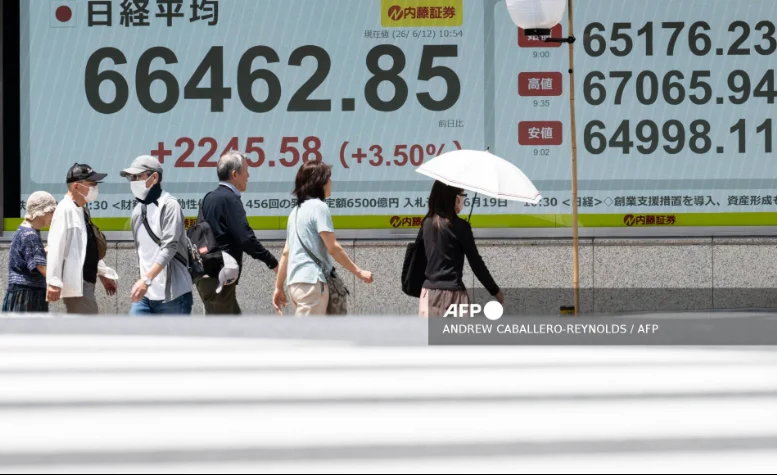
Asian stocks mostly rose, and oil prices edged up on Monday as reports said the United States and Iran had agreed to stop attacking each other following a weekend of strikes that threw their fragile truce into question.
Investor confidence remains shaky after last week’s rollercoaster ride that saw markets whipsaw on the Middle East crisis and growing concerns about a tech bubble fuelled by the AI boom.
While there is an expectation that Washington and Tehran will finalise a deal to end their conflict and reopen the Strait of Hormuz, the process has been fraught with tensions between the long-time foes.
The two have traded strikes in recent days, disrupting shipping through the vital waterway and fanning concerns Iran will shut it down again.
The US Central Command said on Saturday it had attacked 10 Iranian military targets over “continued Iranian aggression against commercial shipping”.
Iran said it retaliated with strikes against US bases in Kuwait and Bahrain. Both Kuwait and Bahrain denounced the Iranian attacks.
Tehran has been angered by Oman’s announcement of an alternative route through the strait that hugged the Omani shoreline.
Iran insists on controlling passage through the vital strait, something it did not enjoy before the war.
Both countries agreed to stop attacking each other, US media outlets reported late on Sunday, citing senior US officials, and plan to meet in Qatar on Tuesday for more talks.
US President Donald Trump has repeated past threats of military action if the Iranian strikes continue, saying on Saturday that Iran would “no longer exist” if the United States is “forced” to resume the war.
Iran’s top diplomat warned on Sunday that any attempt by ships to bypass its preferred route would “increase tensions”.
A US official said on Sunday: “Technical talks are slated to continue… Both sides will stand down for now and vessels can move freely” in and around the strait.
Iran’s foreign ministry said on Monday it had held the first meeting with Oman on managing the waterway.
Oil prices, which fell last week to pre-war levels, rose on Monday.
Equity markets finished the day mostly in positive territory.
Tokyo, Hong Kong, Shanghai, Sydney, Singapore, Wellington, Taipei, Manila and Bangkok all rose, though Mumbai and Jakarta slipped.
London and Paris retreated, but Frankfurt edged up.
Tech firms were again in the spotlight after leading hefty losses last week, with South Korean chip makers SK hynix and Samsung extending last week’s selling.
The companies’ losses weighed on Seoul’s Kospi, though they pared big early losses after the government said it would invest nearly $`1.2 trillion — equivalent to more than two-thirds of its GDP — in a new chip-building hub and AI data centres over several years.
Samsung and SK will make a record investment of more than `$500 billion in a new semiconductor fabrication hub in the southwest, officials said as President Lee Jae Myung attended an event to unveil the public-private collaboration.
The tech sector has been hammered by concerns that valuations have gone too far and questions about when firms will see a return on the trillions of dollars pumped into AI.
The tech rally has sent Seoul, Tokyo and Wall Street’s three main indexes to record highs this year, with SK hynix soaring 300 per cent in the first six months of the year.
The Bank for International Settlements — considered the central bank of central banks — warned on Sunday of a possible bust following a long-running investment boom by companies looking to keep ahead in the AI race.
“Disappointment in returns could trigger a sudden pullback in financing and turn the capex boom into a protracted investment bust, with potential knock-on effects on financial conditions,” it said in its annual report.
It added that “a major equity-market correction could have larger macroeconomic consequences today than in the past”.
Investors are looking ahead to the release of US jobs data, which could have a bearing on the Federal Reserve’s monetary policy plans.
The bank has taken a more hawkish turn amid concerns over surging inflation caused by the Iran war.
“Last month, the strong data triggered a four per cent sell-off on the Nasdaq, its worst single-day decline in over a year, as higher-for-longer fears weighed heavily on the AI trade,” said IG market analyst Fabien Yip.
“A repeat beat on Thursday could trigger a similar rotation; a miss, by contrast, may dampen hike expectations and lift rates-sensitive equities.”
Key figures around 0810 GMT include: Seoul – Kospi: DOWN 0.2 per cent at 8,394.65 (close), Tokyo – Nikkei 225: UP 0.2 per cent at 69,468.11 (close), Hong Kong – Hang Seng Index: UP 1.6 per cent at 23,026.68 (close), Shanghai – Composite: UP 1.2 per cent at 4,073.90 (close).
Others include, London – FTSE 100: DOWN 0.1 per cent at 10,496.46, West Texas Intermediate: UP 0.6 per cent at 72.09 a barrel, Euro/dollar: UP at 1.1388 on Friday, Pound/dollar: UP at 1.3200, Dollar/yen: UP at 161.80 yen from 161.75 yen, Euro/pound: UP at 86.29 pence from 86.28 pence, New York – Dow: DOWN 0.1 per cent at 51,876.11 (close).
AFP


I already prayed for the repose of my soul – Woman rescued from kidnappers in Ogun forest narrates harrowing ordeal in captivity

2027: Don’t push Nigeria into chaos — Timi Frank on fresh plot to delist ADC

Residents Of Achimota Mile 7 Forced To Climb Onto Roofs Of Their Houses For Safety After Early Morning Rain Caused Severe Flooding

We have ended Christian killings in Nigeria — Trump

I was worried about being the oldest mommy in school – Toke Makinwa shares her initial apprehension on embracing motherhood at 40

Adyen Secures UAE Central Bank License, Enhancing Local Payment Control and Compliance

Bandits kill imam, three others, abduct 12 residents in Sokoto

 Investigation3 days ago
Nud£ painting done by Sigmund Freudâs grandson sells for a mind-blowing $39M at auction
- Society3 days ago
“I smuggled cocaine and marijuana to the UK for my son’s father, then served 10 years in prison”-Ghanaian woman recounts ordeal
- Breaking1 day ago
UNBELIEVEABLE: Video of A Fat Wife Beating And Flogging Her Slim Husband Sparks Debate Online Among Couples and Youths
- Investigation3 days ago
Stop insulting the intelligence of Nigerian women – Arise TV anchor, Ayo Mario-Ese knocks First lady, Remi Tinubu, over âAkara, Kuli-Kuliâ business advice
- Breaking3 days ago
Ondo state government withholds WASSCE results of graduating students over signing out rampage
- News3 days ago
Oyo School Abduction: Government Launches International Rescue Push as Search Tightens
- Investigation3 days ago
âWhen I get good news, the first person I call is my girlfriend. Nobody cares about me more than she doesâ â Rapper Odumodublvck
- News3 days ago
Bandits Burn Niger Primary School After Alleged ₦10 Million Levy Payment