News
Afghanistan's Malnutrition Crisis Deepens as Families Depend on Food Aid to Survive


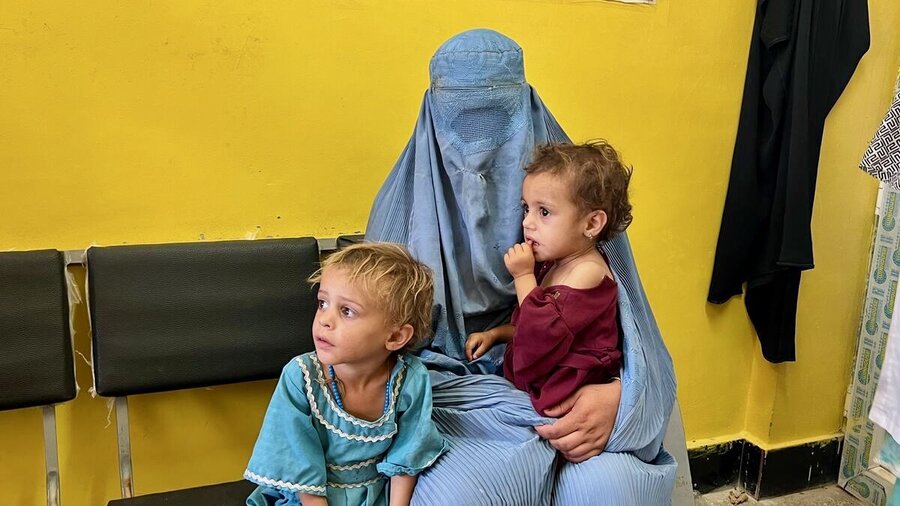
(Child Tested for malnutrition With The Mother. Photo Credit: World Food Programme)
Families across Afghanistan are relying on World Food Programme nutritional support to prevent their children from succumbing to severe malnutrition as cascading crises deepen hunger across the country.
Sediqa, a mother of seven, collects WFP supplements for her two malnourished daughters at a health clinic in southern Afghanistan, describing her family’s subsistence diet of primarily bread and tea.
With her husband, a day labourer, earning approximately $3 daily when work is available, half his income covers rent, leaving minimal resources for nutritious food.
Her children struggle with malnutrition exacerbated by her own illness with typhoid, which impairs her ability to breastfeed.
She describes vegetables her family can afford causing her children to become ill after consumption.
Afghanistan faces a deepening child malnutrition crisis driven by overlapping circumstances including conflict, unemployment, elevated food prices, supply chain disruptions and declining humanitarian funding.
Wasting a condition characterised by dangerous underweight relative to height has reached critical and record levels across roughly one-third of the country’s provinces and is anticipated to worsen further.
The World Food Programme warns that approximately 3.7 million children are projected to experience malnutrition in 2026, alongside 1.2 million pregnant and nursing women, fuelling increased communicable disease transmission.
Healthcare workers at clinics treating malnourished populations emphasise the necessity of WFP nutritional assistance for families unable to access sufficient nutrition independently.
However, aid reductions are forcing clinic closures and constraining WFP food distributions across Afghanistan.
Supply chain disruptions from regional instability and border restrictions have elevated operating costs and left nearly 1 million mothers and children without essential nutrition services for extended periods.
Other families similarly subsist on minimal diets whilst depending entirely on clinic-based nutritional support to prevent their children’s deterioration.
The cuts threaten to remove this critical lifeline for populations lacking alternative resources.
Across Afghanistan, Health WorkersR Seeing Growing Numbers Of Malnourished Kids Arrive4 Treatment. ⚠️Yet Funding Cuts & Supply ShortagesR Forcing Nutrition Cuts!pic.twitter.com/9Z9NK8iIUD@SarahRudolp @jboogiebrown @elvislver56 @philly_nj @CarolynAILG @SpeakTruth911 @TheOralBuffet
— Phillip Morris (@PMorris185) August 5, 2026







Two Officers Injured as Anti-Immigration Protest Turns Violent in UK Town

Woman Says Doctor’s Decision Not to Tie Her Tubes Became a Blessing After Losing Her Child

Osun election will send strong message to APC – Adeleke

The FOMO of not seeing The Odyssey in 70 mm IMAX

Police raid South Korea’s football HQ as part of probe into woeful World Cup campaign.

"Is Osun State not tired of having a dancing governor? For 4 years he has been dancing – Gov Okpebholo taunts Gov Adeleke

Police in Rivers intensify crackdown on kidnapping, arrest five suspects

 Investigation2 days ago
âWhat kind of brother talks like this?â- Designer, Toyin Lawani slams Jude Okoye over comments about brother Peter’s solo career
- Investigation24 hours ago
Japa: Canadaâs Ontario opens new permanent residence programme for foreign workers
- Investigation2 days ago
2027: Weâll do whatever Tinubu wants us to do at the field â Rotimi Amaechi
- Investigation2 days ago
âI hand over everything to God. You will be in my prayersâ – Jude Okoye responds after brother Peter makes more allegations against him
- Society2 days ago
Man Claims He Lost ₦1 Million After Using Roadside POS
- Investigation2 days ago
US firm initiates moves to stop Tinubuâs meeting with Trump at UN General Assembly
- Breaking2 days ago
"Iâm the mother of a one-year-old, I’m flying her to London for her birthday partyâ â Toke Makinwa says in video
- National1 day ago
Court freezes WEMPCO accounts as executives face jail over ₦61.45 billion UBA debt