World
F.D.A. Moves Toward Tighter Restrictions on Food Ingredients

This Video Is Trending Right Now
The Trump administration proposed a new rule on Monday that would require food companies to tell the government when they are adding new ingredients to their products, moving to close a longstanding loophole decried by food safety experts as a major weakness in the regulation of the nation’s food supply.
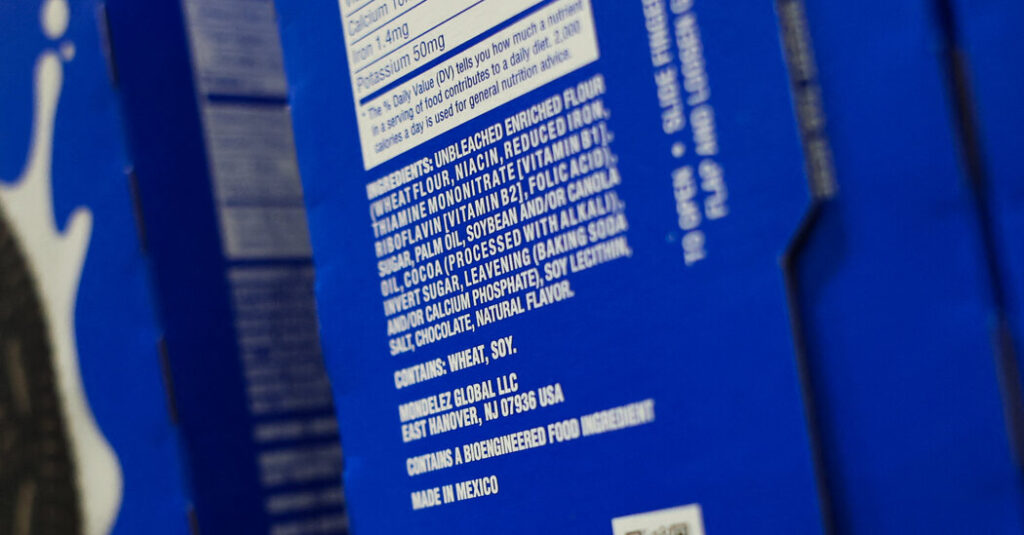
For decades, food and beverage companies have been able to introduce new ingredients without review by the Food and Drug Administration, by asserting that they are “generally recognized as safe,” a designation known as GRAS. While the policy was initially drafted to allow companies to forgo review for common ingredients like baking soda and flour, companies have also used it to quietly introduce at least a thousand substances — including thickeners, extracts and flavorings — into the U.S. food supply, with little evidence that they are safe.
Under the proposed rule, which Health Secretary Robert F. Kennedy Jr. announced at an event on Monday at the Department of Health and Human Services, companies must tell the F.D.A. about new ingredients that they plan to use and submit data showing that the ingredients are safe. Officials said they also would create a “streamlined review process” for ingredients already on the market, though they did not describe how that process might work, or what would happen to ingredients deemed unsafe.
“We don’t even know exactly how many chemicals are in the food that Americans eat every day, and the food industry continues to develop novel compounds and chemical combinations that do not exist in nature,” Mr. Kennedy said. “Our bodies did not evolve consuming many of these substances, and that makes rigorous science and transparent safety review even more important.”
Food policy experts welcomed the effort to bolster the oversight of food manufacturers. “It’s been the Wild West for them for long enough,” said Jennifer Pomeranz, an associate professor of public health policy and management at New York University.
But the experts cautioned that the proposed new rule may do little to improve the healthfulness of the food supply. It was not clear whether it would require companies to provide more safety data on many substances already used in foods. By law, companies would also still be allowed to decide for themselves if they believed an ingredient was safe and whether they wanted to use it in their products, said Kyle Diamantas, the F.D.A.’s acting commissioner.
“What we’re doing is requiring companies that utilize that pathway to notify us of their conclusions, so that we have greater visibility into those conclusions, and so that consumers have awareness,” Mr. Diamantas said, in a call with reporters on Monday morning.
In announcing the proposed rule, which has not yet been finalized, Mr. Kennedy is acting on his promise to close the loophole, which he has said had been “hijacked” by the food industry. Mr. Kennedy has argued that ingredients added to products under GRAS have contributed to a toxic food environment in the United States and to rising rates of obesity and other chronic diseases.
Beyond requiring companies to notify the F.D.A. of their plans to add an ingredient through GRAS, the proposed rule would also create a public inventory of GRAS ingredients already in the food supply, so that the F.D.A. could more easily monitor the safety of those substances, Mr. Diamantas said. He did not elaborate on how the agency would do that.
Dr. Pomeranz said she “couldn’t be more thrilled” that the F.D.A. had moved to close the GRAS loophole, adding that the proposed rule would mean that companies could no longer add ingredients without the F.D.A.’s knowledge and oversight.
But the proposal will do little to keep companies from simply deeming ingredients to be safe and then adding them into food and beverages, and it is unlikely to address many of the ingredients that researchers believe pose a threat to the nation’s health. For example, the new policy would not address many common ingredients used in ultraprocessed foods — in particular, refined carbohydrates like high fructose corn syrup, maltodextrin and dextrose — that are contributing to the country’s high rates of obesity, Type 2 diabetes and other chronic diseases, Dr. David Kessler, a former F.D.A. commissioner, said.
“The proposed GRAS actions do not tackle the root causes of chronic disease in this country,” said Dr. Kessler, who petitioned the F.D.A. last year to revoke the decades-old GRAS status of those ingredients.
Experts also said they wanted to see the F.D.A. modernize the type of safety data it collects, moving from focusing on obvious signs of toxicology, like cancer or organ damage, to also looking at how food chemicals may affect the gut microbiome, brain development and behavior in children.
The food industry has pushed back aggressively on efforts to reform GRAS, arguing that stricter rule would impede companies from bringing new products to market. Trade groups have said the F.D.A.’s review process would slow down innovation in the food industry by requiring more paperwork and would prove especially burdensome for smaller companies.
But Dr. Pomeranz said it is already the companies’ responsibility to ensure that their ingredients are safe, so the companies should not feel that submitting evidence is an added burden. “The food industry needs to come around that they’re finally getting regulated,” she said.
As for the F.D.A.’s ability to scrutinize the safety of every new food ingredient in a timely manner, that was a concern, especially after the Trump administration’s cuts to the agency, said Tom Neltner, the director of a nonprofit focused on lead exposure and an expert in chemical safety. Improving the oversight of food ingredients would take “a heck of a lot more staff than this administration seems willing to commit to the issue,” he said.
At the Monday event, Mr. Kennedy also called on Congress to pass legislation that he said would give the F.D.A. “additional tools that it needs to keep pace with a changing food supply and protect the American people.” Dr. Pomeranz said the agency needed more funding to conduct food safety evaluations, and she suggested that Congress implement a system asking food companies to contribute toward financing the F.D.A.’s work.
Mr. Kennedy also announced on Monday that the government had taken another step toward improving the nation’s health: finalizing a long-awaited federal definition for ultraprocessed foods, a sprawling group of foods and drinks that have been linked to a wide range of health conditions including obesity, Type 2 diabetes, depression and heart disease. Health officials were expected to release the definition on Monday, but instead only said that it had been finalized, without providing details about what it would include.


EU reacts to reported claims it rejected INEC invitation to observe 2027 elections

PTI attack: Delta govt. suspends works commissioner

F.D.A. Moves Toward Tighter Restrictions on Food Ingredients

CP Daaor Assumes Duty In Edo, Assures Highly Mobile Policing

I’m not lobbying to become APC campaign DG — Wike

VGN patron fires warning at kidnappers, criminals in Ika Land

Iran Insists Strait Will Stay Closed Until U.S. Agrees to Demands

 Investigation3 days ago
Jude is not a good person, I donât know if he used juju on Paul – PSquareâs elder brother, Henry Okoye finally opens up on family feud (video)
- Investigation2 days ago
âHe was the coolest guyâ – Tom Holland says Justin Bieber was his childhood celebrity obsession
- Society3 days ago
Man Allegedly Collected GH¢60,000 as a Lawyer, Then Paid a Qualified Lawyer Just GH¢8,000 to Handle the Case
- Investigation2 days ago
Power sectorâs progress will now be measured by communities electrified and not megawatts – Minister of Power Joseph Tegbe
- Society2 days ago
Drama at Elubo as Assembly Pulls Down GH¢4m Building Over Permit Dispute
- Investigation2 days ago
25 Children from Kebbi, Kwara, Niger died in Terroristsâ Captivity â Lawmaker
- Investigation2 days ago
Former US Leader Joe Bidenâs cancer has spread further into his body, His Son Says
- Society2 days ago
Drama at Elubo as Assembly Pulls Down GH¢4m Building Over Permit Dispute