World
Man Who Attacked Salman Rushdie Faces Terrorism Charges in Federal Trial

This Video Is Trending Right Now
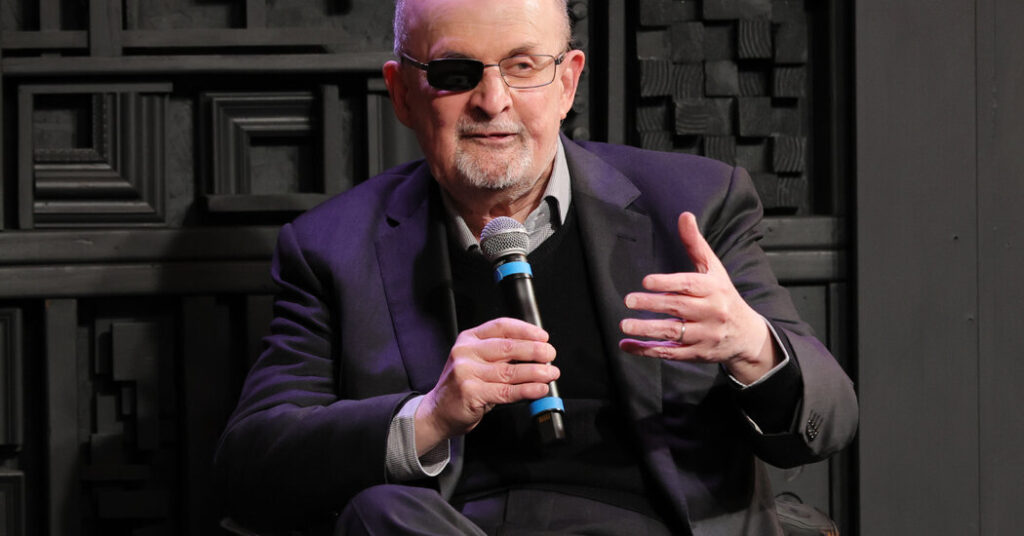
In August 2022, a young man gripping a knife rushed onstage at an idyllic retreat in Western New York. His eyes were trained on the author Salman Rushdie.
The man, Hadi Matar, had been enraged by the work of Mr. Rushdie, who had long been a target of Islamic extremists. In 1989, the government of Iran called for Mr. Rushdie’s killing after he published “The Satanic Verses,” a novel that depicted a fictionalized version of the Prophet Muhammad, outraging many Muslims.
In his notebook, federal prosecutors said, Mr. Matar had scribbled out the pros and cons of attacking Mr. Rushdie, and how and where to do it. A reason to do it now, he wrote in his journal, was that Mr. Rushdie was at an advanced age and could die “any day now.”
“So NOW or NEVER!!!” he wrote.
He stabbed Mr. Rushdie more than a dozen times, leaving him with severe nerve damage and blind in one eye. Mr. Rushdie was preparing to deliver a speech to more than 1,000 people at the Chautauqua Institution, focusing on writers in political exile.
Mr. Matar, 28, was convicted of attempted murder in state court last year and sentenced to 25 years in prison. Now, a federal jury will decide whether he committed an act of terror, carrying out the former Ayatollah Ruhollah Khomeini’s fatwa, or religious edict, against Mr. Rushdie, and whether it was in service of Hezbollah, the Iran-backed militia in Lebanon.
The trial, in Federal District Court in Buffalo, is expected to last two weeks and began with jury selection on Tuesday. Mr. Matar stands charged with providing material support to a terrorist group and committing an act of terrorism that transcended national boundaries.
If he is convicted of all charges, Mr. Matar could spend the rest of his life in prison. Prosecutors will need to convince jurors that Mr. Matar aided terrorists — not just acted out of rage — when he climbed the stairs and attacked Mr. Rushdie.
Nathaniel L. Barone II, a lawyer for Mr. Matar, described his client as a “devout, religious individual” who was merely enraged by Mr. Rushdie’s work. But he had no intent to carry out a fatwa or work on behalf of terrorists, Mr. Barone said.
“It’s about ‘The Satanic Verses,’” Mr. Barone said. “He was extremely upset over the position Rushdie was taking.”
Mr. Matar, an American citizen, is of Lebanese origin and was raised in New Jersey and California. After the attack, friends and relatives depicted him as a recluse who turned to religion after professional and academic frustration. His mother told The New York Times that she could not support him.
Prosecutors may need to show that Mr. Matar acted with more than just religious zeal. In April, a divided panel of judges ruled that Akayed Ullah, a man who detonated a bomb inside a New York City subway station, was not aiding terrorists with his attack, even though he had consumed ISIS propaganda and told law enforcement it was “on behalf of the Islamic State.”
Though the act was clearly inspired by the Islamic State, Judge Myrna Pérez wrote, prosecutors had not proven that Mr. Ullah was acting at the direction of terrorists. Some experts have worried that the ruling, which has been appealed by the Justice Department, may hamper other terrorism cases, including Mr. Matar’s.
But in a pretrial filing, prosecutors in Buffalo drew a contrast between Mr. Ullah’s case and that of Mr. Matar, who they say acted in “direct response” to the exhortations of Hezbollah.
In the months before the attack, Mr. Matar spliced together propaganda videos — with titles such as “Rushdie Fatwa 1.6” — that included a 2006 speech from Hassan Nasrallah, then the leader of Hezbollah, prosecutors said. In the speech, Mr. Nasrallah denounced cartoon depictions of the Prophet Muhammad, which Muslims widely view as blasphemous.
Mr. Matar then sent the videos to others, telling one person to “remember what Sayed Hassan said,” referring to Mr. Nasrallah, prosecutors said.
“Had the Muslimeen killed Rushdie,” Mr. Matar wrote, “there would be no cartoons of the prophet.”
Additionally, Mr. Matar had planned his attack with a person based in Iran, prosecutors said. In May 2022, Mr. Matar wrote to a person living in Iran that Mr. Matar knew “where to find Rushdie,” but that “problem is how to do it.”
He then asked the person, named Kamyar, according to prosecutors, whether the fatwa against Mr. Rushdie was still valid. After the person informed Mr. Rushdie that it was active, Mr. Matar tried to kill Mr. Rushdie, prosecutors said.
Mr. Rushdie, 79, published a memoir in 2024 about the attack and its aftermath, “Knife: Meditations After an Attempted Murder.” He testified about the harrowing experience during the state trial last year in Mayville, N.Y., and is expected to testify again during the federal trial.
In Mr. Matar’s notebook, as he sketched out a potential drawback of carrying out the attack, he appeared to exhibit the feelings of a troubled, isolated young man.
“Could make life worse,” he had written, according to a page from the diary provided by prosecutors. “But I doubt that. It kind of sucks already.”


Atiku to Tinubu: Apologise, Resign Over PFIPC Scandal

Beaches closed as Tropical Storm Bertha approaches Gulf Coast

OpenAI says its AI system acted on its own in ‘unprecedented’ hack of other firm
OpenAI says its AI system acted on its own in ‘unprecedented’ hack of other firm

Falz Denies Backing Peter Obi, Calls for Stronger Democracy

Details of Peter Obi, Swiss ambassador’s meeting emerge

D4vd Case: Graphic Photos And Gruesome Details Shared At Preliminary Hearing

 Society2 days ago
Pepper Seller Caught On Camera Applying Pepper On Newborn Baby As Rituals To Usher Her Into The Business
- Society2 days ago
2026 Ballon d’Or: Top 4 players to win award after World Cup final revealed
- World2 days ago
Spain earns $51 million for World Cup win and runner-up Argentina gets $34 million as total payout for all 48 teams hits record-high $871 million
- Investigation20 hours ago
65-year-old married female teacher blindfolded and tied 10-year-old schoolboy to bed before having s3x with him
- Society3 days ago
Nigerian Lady Weeps Uncontrollably On Social Media As Her Bank Account Gets Hacked, Life Savings Wiped Out Except ₦194
- Investigation21 hours ago
"I ‘m fine and healthy" – Video of late Mary Habila debunking her d3ath rumours 3 days before she d!ed at Umahi’s residence
- Investigation16 hours ago
âBusinesses are dy!ng in South Africa. Nobody is making money – South African man decries low patronage days after anti-immigrant protest
- Investigation3 days ago
Woman allegedly k!lls husbandâs mistressâ two-month-old baby in Benue